Hajra Naz
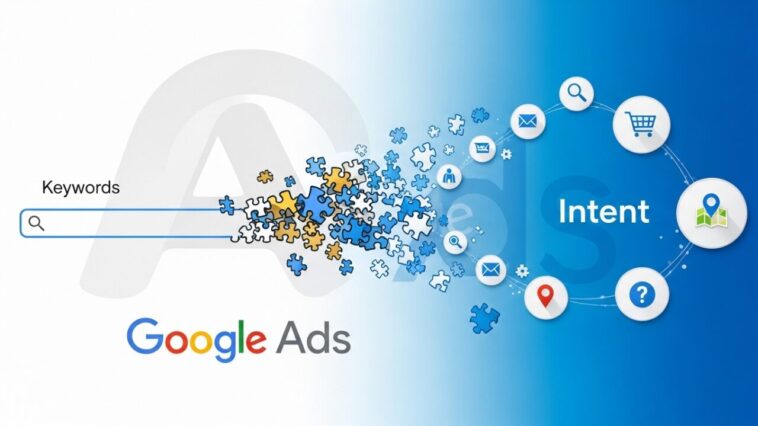
If you’re still building Google Ads campaigns around keywords, you might be behind the curve. The rules of the game have changed, and that has big implications for campaign structure, eligibility, and PPC strategy.
Most PPC teams still do things the old way: pull a keyword list, set match types, and organize ad groups by search terms. It’s muscle memory. But Google isn’t running its auctions like that anymore.

Search now behaves more like a conversation than a simple lookup. In AI Mode, users ask follow-up questions, refine their queries, and expect answers that make sense. Google’s AI reasons through those queries first, then decides which ads fit the answer.
In short, the auction isn’t triggered by the exact keyword you bid on anymore. It’s triggered by inferred intent.
Read More: Mastering Google Ads: A Comprehensive Guide
Why Keywords Alone Won’t Cut It
If you’re still relying on exact or phrase match campaigns, you’re building for a system that doesn’t really exist anymore. The new foundation is intent—not the words people type, but what they’re actually trying to achieve.
Focusing on intent gives you a more durable way to structure campaigns, ad creative, and measurement as Google rolls out more AI-driven ad formats.
Keywords aren’t dead. But they’re no longer the blueprint.
How Google’s AI Really Works
Here’s what’s happening behind the scenes:
-
Google uses something called “query fan-out.” A complex search is broken into multiple subtopics, and the system runs parallel searches to build a complete response.
-
The auction can happen before a user even finishes typing.
-
The AI infers commercial intent, even from queries that seem purely informational.
For example, someone might search, “Why is my pool green?”
They’re not shopping—they’re troubleshooting. But Google’s AI sees a problem that products can solve and serves ads for pool-cleaning supplies alongside the explanation. Even though the user didn’t type a buying query, the AI anticipates a need.
This is a fundamental shift: it’s not matching a keyword to a query. It’s matching your offering to the user’s inferred goal, based on the broader conversation.
If your campaigns assume people search only in transactional, bottom-funnel moments, you’re missing a huge part of the journey.
What “Intent-First” Really Means
Intent-first doesn’t mean keyword research is gone. It means keywords are no longer the organizing principle.
Instead, start asking:
-
What problem is the user trying to solve?
-
Where are they in the decision-making process?
-
What “job” are they hiring my product to do?
The same intent can show up in dozens of queries. And the same query can reflect different intents depending on context.
Take “Best CRM.” That could mean:
-
“I need feature comparisons.”
-
“I’m ready to buy and want validation.”
Google’s AI can now tell the difference. Your campaigns should, too.
Think of it as a mental model shift rather than a tactical one. You still build keyword lists and ad copy—but you group keywords by intent and write copy that addresses user goals, not just matches search terms.
Read More: How To Drive Revenue With Google Ads Smart Bidding: 5 Best Tips
What Changes in Practice
Once you organize campaigns around intent, the effects show up quickly:
Campaign Eligibility
To appear in AI Mode or AI Overviews, you need:
-
Broad match keywords
-
Performance Max campaigns
-
Or AI Max for Search
Exact and phrase matches still help with brand defense and high-visibility placements, but they won’t get you into the conversational layer where exploration happens.
Landing Page Evolution
Your pages need more than product specs. They should explain why and how someone should use your product.
Google rewards contextual alignment. If the AI builds an answer around a problem, and your page addresses that problem, you’re much more likely to win the auction.
Asset Volume and Training Data
AI prioritizes rich metadata, multiple images, and fully optimized feeds. Using Customer Match and first-party data helps the system understand which users are most valuable. That, in turn, influences how aggressively the AI bids.
Gaps You Need to Know
Even with intent-first campaigns, there are blind spots:
-
No clear reporting: You can’t isolate AI Mode performance from traditional search.
-
Budget barriers: AI campaigns like Performance Max or AI Max need at least 30 conversions in 30 days to scale effectively. Small advertisers may struggle.
-
Funnel position: AI Mode attracts exploratory users. Conversion rates are lower than those of bottom-funnel searches. Adjust expectations accordingly.
Read More: 5 Best Google Ads Alternatives To Diversify & Growth
Where to Start
You don’t need to rebuild everything at once.
-
Pick a campaign where intent is more complex than keywords suggest.
-
Map it to user goal states, not just search terms.
-
Test broad match in a limited way.
-
Rewrite one landing page to answer the “why” rather than just list features.
The shift to intent-first isn’t just a tactic—it’s a new lens for planning campaigns. And it’s the most durable approach as Google rolls out more AI-powered formats.