Hajra Naz
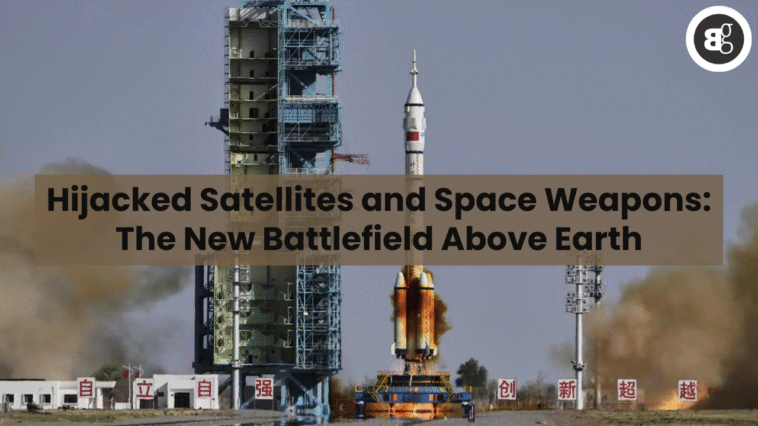
This year, as Russia held its annual Victory Day parade, the conflict with Ukraine reached into space. Hackers aligned with Moscow hijacked a satellite that normally provides TV service in Ukraine. Instead of local programming, Ukrainian viewers suddenly saw a live feed from Moscow—tanks rolling, soldiers marching, and weapons on display.
The move wasn’t just propaganda. It was a reminder that 21st-century wars aren’t limited to land, sea, or air. Battles now stretch into cyberspace—and even outer space.

A satellite doesn’t need to be blown up to cause chaos. Disabling one through hacked software or blocked signals can be just as devastating. “If you can impede a satellite’s ability to communicate, you can cause a significant disruption,” explained Tom Pace, CEO of NetRise and a former U.S. Marine. He gave a simple example: “Think about GPS. Imagine if a population lost that and the confusion it would cause.”
Satellites: A New Target
Right now, more than 12,000 satellites orbit Earth. They run GPS, TV, military communications, weather, and even banking systems. They also warn of missile launches.
That makes them big targets. One attack could damage an economy, weaken defenses, or spread fear. Hackers often strike the ground systems, not the satellite itself. Outdated software gives them an easy way in.
Ukraine saw this firsthand. In 2022, as Russia invaded, hackers hit U.S.-based Viasat. The attack cut internet access across much of Europe. Kyiv blamed Moscow.
A Chilling Threat
American officials say Russia is developing something even more dangerous: a nuclear-based anti-satellite weapon. The device could wipe out nearly every satellite in low-Earth orbit at once. It wouldn’t just destroy satellites physically. Its nuclear component could also fry electronics.
Congressman Mike Turner compared the threat to the launch of Sputnik in 1957, but it is far more dangerous. “If this weapon is put in space, it would be the end of the space age,” he warned. “This is the Cuban Missile Crisis in space.”
The impact could last for a year, leaving the U.S. and allies blind, cut off, and vulnerable. Russia and China would also lose satellites, but analysts believe they rely less heavily on the same networks.
Read More: Pakistan Announces Launch of Advanced Remote Sensing Satellite
The Race to the Moon
Outer space isn’t just about satellites. Nations are also eyeing the moon. Why? Because of resources. The moon holds helium-3. Scientists say it could fuel nuclear fusion. This technology may one day provide unlimited clean energy.
NASA plans to send a small nuclear reactor to the moon. U.S. officials warn they must move fast. China and Russia are also racing to get there. Acting NASA administrator Sean Duffy said.
“We’re in a race,”
Joseph Rooke, a cybersecurity expert in London, put it bluntly: “This isn’t sci-fi. It’s quickly becoming a reality. If you dominate Earth’s energy needs, that’s game over.”
China and Russia have already signaled plans for their lunar bases. AI and the growing energy demand are expected to accelerate the competition.
Rising Tensions
Not surprisingly, China denies that it wants a space arms race. A spokesperson for China’s embassy in Washington criticized the U.S. He said America is trying to militarize space. The U.S., he claimed, has built alliances and expanded its military power in orbit.
The rivalry is clear. While diplomats trade words, both sides are racing to control space.
Read More: Pakistan’s First Indigenous Satellite to Launch on January 17 via China
What the U.S. Is Doing
To counter these threats, the U.S. created the Space Force in 2019. Though still much smaller than the Army, Navy, or Air Force, it’s expanding quickly. Its mission is simple: protect U.S. satellites and secure America’s advantage in space.
The U.S. also operates the X-37B, an unmanned spaceplane that can carry out classified missions for months at a time. Officials call access to space a “vital national security interest.”
For decades, the U.S. led the world in space without serious challenge. Now, with Russia and China pushing aggressively, American dominance is no longer guaranteed.
As Congressman Turner warned,
“You have to pay attention to these things so they don’t happen.”