Hisham Sarwar
Earlier this year, I got an opportunity to visit LEAP, a future of jobs event consisting of 3 days in Riyadh, Saudi Arabia.
I was surprised by the range of innovations that major tech companies introduced. From human-less coffee shops to fully AI-enabled healthcare, one thing is clear: the future has arrived. The world—despite not being fully prepared—is about to face significant automation challenges.

When I returned to Pakistan, the first thing I set out to do was explore the possibilities AI offers in automation and intelligent application building agents. It didn’t take long before two compelling ideas came to light. In this article, I’ll focus on the first one. While the future of economies and societies will undoubtedly be global, I believe the platforms that power them—the networks that enable connection, commerce, and coordination—will increasingly be national.
Dare I say this because the need for local content—content that is surfaced, indexed, and prioritized by GPTs and other large models for effective AEO (Answer Engine Optimization)—is becoming essential. Platforms like Grok have already hinted at this within “X.” So I thought, why not build Pakistan’s own version of a social media platform—one where we can shape the narrative, highlight local voices, and talk about what truly matters to us?
Platforms such as Meta, YouTube, X, and LinkedIn mark major content as “Fact check,” which often represents a single viewpoint that dismisses accounts labeled as “false freedom of speech.”
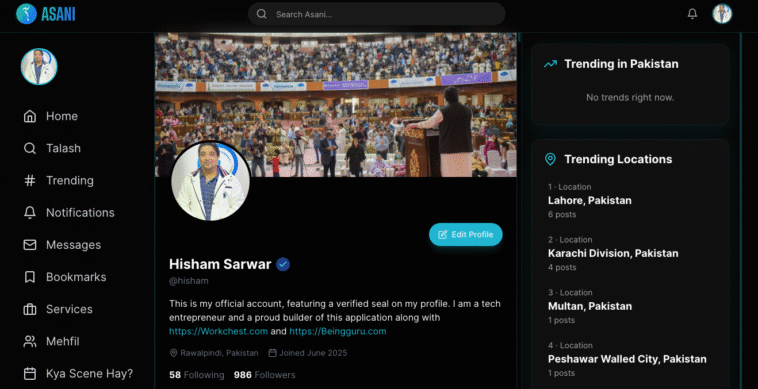
I came up with Asani. The challenge? I’m not a coder, and I certainly didn’t dare to build something on the scale of X or Facebook. But then I discovered AI-powered app builders, two in particular stood out: Lovable and Hostinger’s Horizons. I started experimenting with both.
You’ll be surprised how much I was able to achieve. With the help of early-stage blueprints (thanks to ChatGPT) and AI-driven architecture design, I built nearly 85% of Asani without writing a single line of code.
Today, Asani is a social media network with over 5,000 users. It gives people in Pakistan a space to share their thoughts freely—something they often can’t do on international platforms. And yes, it even has a LIVE streaming feature.
Guess what?
I’m not a programmer. I’ve never written a single line of code in my life. Yet, with the help of AI assistants, I built a large-scale, functional application from scratch.
Folks, AI is real, and it’s not just knocking—it’s breaking down the doors of traditional work. The future is here. The only question is: will you adapt or be left behind?
What started as a distant concern is now a visible reality—AI isn’t just augmenting work; it’s replacing it. From HR roles at IBM to engineering teams at Meta, and even product staff at Microsoft, the layoffs are no longer about “economic uncertainty”—they’re about automation. AI tools are becoming capable enough to handle entire workflows, making some roles obsolete almost overnight.
AI Is Already Taking Tech Jobs — And It’s Just the Beginning
Executives are no longer shy about admitting it. The narrative has shifted. This isn’t the future. This is now.
Tech companies are increasingly citing AI and automation as reasons for job cuts and hiring freezes. In May, IBM replaced hundreds of human resources roles with AI as part of broader layoffs affecting 8,000 employees. That same month, Duolingo CEO Luis von Ahn announced the company would no longer rely on contractors for tasks AI could handle. Klarna CEO Sebastian Siemiatkowski also revealed that the buy-now-pay-later firm had reduced its workforce by 40%, partly due to its investment in AI technologies.
Major layoffs driven by AI and automation
-
IBM: In May, hundreds of HR roles were replaced by AI as part of broader cutbacks affecting around 8,000 employees. TechRadar+15Forbes+15CFO Dive+15.
-
Microsoft:
-
Intel:
-
Amazon: CEO Andy Jassy explicitly stated that generative AI will shrink its corporate workforce; the company is implementing over 1,000 AI agents for tasks from inventory to customer responses GrackerAI+2Reuters+2New York Post+2.
-
Meta (Facebook):
-
Chegg: The education platform cut 22% of its staff (~248 employees) in May, citing competition from AI-powered study tools like ChatGPT, according to Reuters.
-
CrowdStrike: Laid off ~500 employees (~5% of staff) with CEO citing AI-driven streamlining of operations
Broader trends & data
-
TechCrunch Layoff Tracker: Over 22,000 tech jobs lost in H1 2025; ~10,400 of those in May alone TechCrunch.
-
FinalRoundAI: Estimates show 507 tech workers lose jobs to AI daily in 2025, with nearly 94,000 layoffs so far—Microsoft, Tesla, IBM, Meta among highest impacted Final Round AI.
-
World Economic Forum Survey: 40% of employers expect to eliminate roles where AI can take over; companies like Microsoft, Citigroup, and Disney cited CFO Dive.
-
White-collar displacements: Generative AI tools now handle up to 50% of tasks in some companies like Microsoft and Salesforce, threatening middle- and high-skill jobs beyond just clerical work New York Post.
Takeaway:
-
AI isn’t just augmenting; it’s replacing—from HR roles (IBM) to mid-tier engineers (Meta) and corporate functions (Amazon, Microsoft, Intel).
-
AI-first restructuring is widespread, encompassing industries such as technology, education, cybersecurity, and online retail.
-
The scale is significant—tens of thousands of jobs lost so far in 2025, with AI foundations cited as the key driver.
-
The future lies in adaptation—executives urge upskilling and AI literacy to remain employable amid this transition.
These patterns reflect a clear shift: companies are investing heavily in AI and reallocating resources accordingly, often at the direct expense of human roles.