Hassan Khan
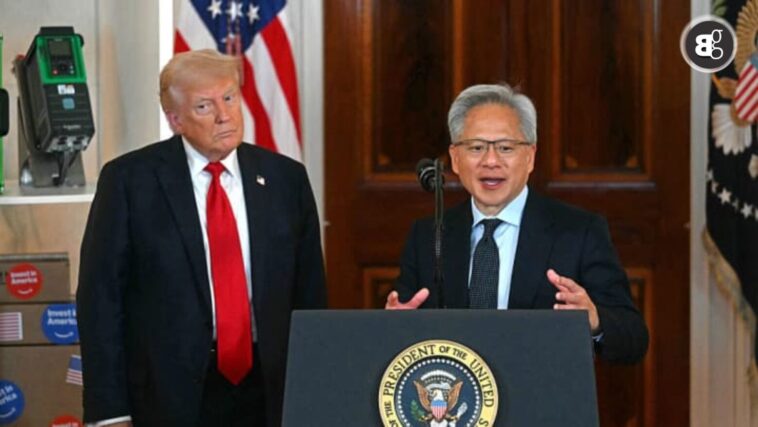
In a significant policy shift, President Donald Trump has approved the sale of advanced AI chips to certified buyers in China. This includes Nvidia’s high-end H200 chips and other U.S.-made AI processors, which are crucial for powering Artificial Intelligence systems. A 25% export fee on these transactions will go directly to the U.S. government, helping fund national priorities.
Trump emphasized that the decision aims to protect national security, support American jobs, and maintain the United States’ leadership in AI technology.

The Importance Of This Decision
The approval comes after extensive lobbying from Nvidia CEO Jensen Huang, who argued that allowing exports to certified customers would strengthen U.S. employment and global competitiveness. Other chipmakers, including AMD, are now included under this new policy.
Analysts note that while the policy benefits American companies and the economy, it could also enhance China’s AI capabilities, a country already investing heavily in artificial intelligence for sectors ranging from healthcare to autonomous vehicles.
Example: Nvidia’s H200 chip, designed for large-scale AI workloads, can train massive AI models far faster than older processors, making it a critical tool for research and development.
The export policy also provides the U.S. with strategic leverage in ongoing negotiations with China over rare-earth minerals, which are essential for semiconductor manufacturing. By controlling high-end AI chip exports, Washington gains bargaining power in broader technology and trade discussions.
Industry Reactions
Nvidia welcomed the decision, stating that it could create thousands of American jobs in manufacturing, research, and AI infrastructure.
Financial analysts, however, urge caution:
-
Morgan Stanley warns that China may accelerate its AI research once access to advanced chips is available.
-
Brookings Institution experts note that while the policy helps U.S. companies, it requires strict compliance monitoring to prevent misuse in sensitive sectors.
This policy is also part of a larger global trend where countries are trying to balance economic growth with national security concerns in the AI and semiconductor industries.
What This Means for the Future
-
Boost for U.S. AI Industry: American chipmakers can expand their international market reach.
-
China’s AI Development: Certified access may help accelerate AI research and applications.
-
Strategic Leverage: The 25% export fee and certification process give the U.S. government a tool to influence trade and technology practices.
-
Job Creation: Thousands of manufacturing, engineering, and research positions could be supported in the U.S.
Conclusion
President Trump approval of AI chip exports to China marks a delicate balancing act between fostering U.S. technological leadership, protecting national security, and managing international trade dynamics. While American companies stand to gain significantly, close monitoring will be essential to ensure that sensitive technology does not compromise U.S. strategic interests.
The policy sets a precedent for how nations may regulate emerging AI technologies in a way that supports domestic growth while navigating global competition.