Hajra Naz
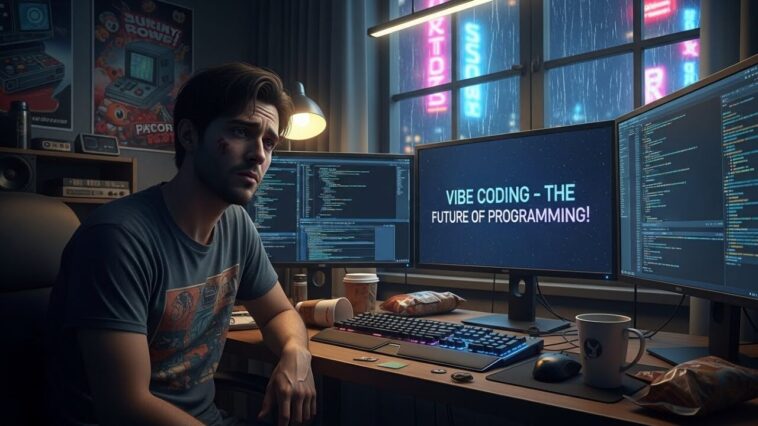
OpenAI alum Andrej Karpathy says he’s struggling to fully capitalize on the latest generation of AI-powered programming tools. Writing on X, Karpathy—who famously coined the term “vibe coding”—admitted that despite his deep experience in the field, he has never felt more behind as a programmer.
He described the moment as unsettling, saying it feels as if the industry has been handed a “powerful alien tool” with no instruction manual.

A Career Built Ahead of the Curve
For most of his career, Karpathy has been ahead of major technological shifts. He joined OpenAI as a founding member in 2015, well before AI competitors like Anthropic and xAI entered the scene. He also moved early into autonomous driving, leading Tesla’s Autopilot and computer vision efforts as head of AI.
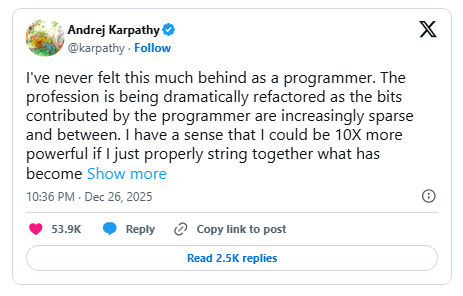
That history makes his recent admission stand out. “I’ve never felt this much behind as a programmer,” Karpathy wrote, acknowledging a rare sense of being outpaced by the tools he helped inspire.
Programming Is Being “Dramatically Refactored”
In his post, Karpathy said the software industry is undergoing a fundamental transformation. Individual programmers, he noted, are writing fewer and fewer lines of code as AI systems take on more of the workload.
“I have a sense that I could be 10X more powerful if I just properly string together what has become available over the last year,” he wrote. “A failure to claim the boost feels decidedly like a skill issue.”
That shift reflects broader changes across the field, as AI-powered code editors and agentic development tools reshape how software is built.
The Rise of AI Coding Tools
AI has rapidly transformed software engineering, with tools like Cursor, Claude Code, and OpenAI’s Codex redefining how developers write, debug, and deploy code. Business Insider reporter Amanda Hoover has described 2025 as “the year coding changed forever,” pointing to the speed and scale of this transition.
Karpathy himself played a key role in shaping the conversation. In February, he coined the term “vibe coding,” a style of programming where developers prompt AI systems to generate code and lean into intuition rather than rigid control. The phrase quickly spread through developer communities and was later named Word of the Year by Collins Dictionary.
Read More: Most Popular AI Tools for Coding Every Developer Should Know
“A Powerful Alien Tool With No Manual”
Despite popularizing the concept, Karpathy says the reality of using these tools remains disorienting.
“It’s like a powerful alien tool was handed out,” he wrote, “and everyone has to figure out how to hold it and operate it, while the resulting magnitude 9 earthquake is rocking the profession.”
The metaphor captures both the promise and instability of the current moment, where productivity gains are real, but mastery remains elusive.
Other AI Leaders Feel the Same Way
Karpathy’s comments struck a chord with other leaders in AI-assisted programming. Boris Cherny, who created Claude Code at Anthropic—now one of the most widely used AI tools among developers—said he often feels the same way.
Cherny wrote that he experiences that sense of being behind “most weeks,” sometimes realizing only after the fact that AI could have solved a problem faster than a manual approach.
Why New Developers May Have an Edge
According to Cherny, newer programmers may actually adapt more easily to this environment. Without long-held assumptions about what AI can or cannot do, early-career developers may be more open to letting models handle larger portions of the workflow.
“It takes significant mental work to re-adjust to what the model can do every month or two,” Cherny wrote, noting that AI systems continue to improve rapidly at coding and engineering tasks.
Read More: How Can ‘Vibe Coding’ Make You Millions Overnight?
A Tool That Sometimes Misfires—and Sometimes Amazes
Responding to Cherny, Karpathy said he recognized the same pattern in his own work. He compared modern AI tools to a weapon that doesn’t always behave predictably.
Sometimes it “shoots pellets” or “misfires,” he wrote, underscoring the unfinished, experimental nature of current AI systems. But at other moments, everything clicks.
“Once in a while,” Karpathy added, “when you hold it just right, a powerful beam of laser erupts and melts your problem.”
The comment captures the tension defining modern programming: extraordinary potential paired with constant recalibration, even for the people who helped bring these tools into existence.