Hajra Naz
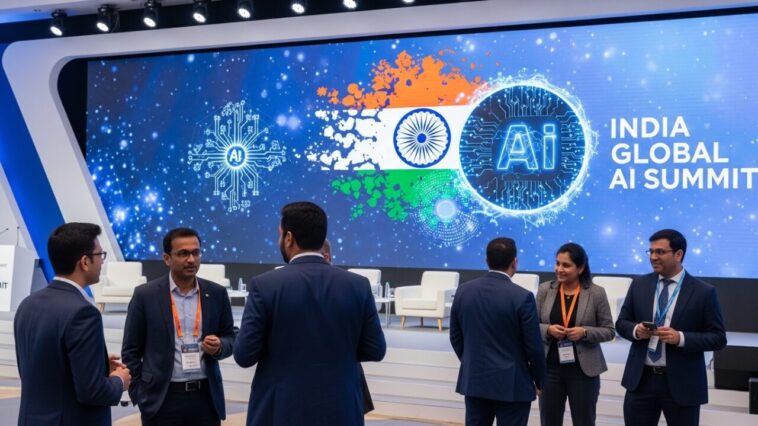
NEW DELHI (AP) — Prime Minister Narendra Modi on Thursday positioned India as an emerging force in the global artificial intelligence (AI) landscape, outlining an ambitious vision to develop advanced technologies domestically and deploy them worldwide.
“Design and develop in India. Deliver to the world. Deliver to humanity,” Modi said while addressing world leaders, technology executives, and policymakers gathered at the India AI Impact Summit in the capital.

His remarks underscored India’s broader strategy to harness its rapidly expanding digital economy and reputation for building large-scale public digital infrastructure, presenting the country as a competitive and affordable destination for AI innovation.
The summit also featured remarks from French President Emmanuel Macron, Google CEO Sundar Pichai, and U.N. Secretary-General António Guterres. Guterres proposed the creation of a $3 billion global fund aimed at helping developing nations strengthen foundational AI capabilities, including w
- Workforce training
- Data access
- Affordable computing resources.
“The future of AI cannot be shaped by only a few nations, nor dictated by a handful of billionaires,” Guterres said, emphasizing that artificial intelligence must “belong to everyone.”
Read More: Everything You Need to Know from the India AI Impact Summit
India seeks to scale its AI ambitions
New Delhi is using the summit to cast India as a connective force—not quite in the league of the United States or China, but positioned between advanced economies and the developing world. Officials often point to the country’s digital ID program and its real-time payments system as evidence that large-scale, low-cost technology can work at a population scale. The argument now is that artificial intelligence (AI) could follow the same path.
“We must democratize AI. It must serve as a vehicle for inclusion and empowerment, especially for the Global South,” Modi said.
For global technology companies, India’s scale is hard to ignore. With nearly one billion internet users, the country has become one of the most important markets for firms expanding their AI footprint.
Microsoft moved first in December, announcing plans to invest $17.5 billion over four years to deepen its cloud and AI infrastructure in India. Google had already committed $15 billion over five years, including plans to establish its first AI hub in the country. Amazon, meanwhile, has pledged $35 billion by 2030, tying much of that spending to AI-driven digitization.
Indian officials are now talking about drawing as much as $200 billion in data center investment in the years ahead — a figure that underscores how central computing infrastructure has become to the country’s ambitions.
Still, headline investment numbers mask a more complicated reality. India does not yet have a homegrown frontier AI model comparable to those built by OpenAI in the United States or China’s DeepSeek. Limited access to cutting-edge semiconductor chips, gaps in high-end data center capacity, and the challenge of training systems across hundreds of local languages remain significant hurdles.
Read More: India is teaching Google how to Scale AI in Education
Organizational challenges cloud the summit
The summit’s launch earlier in the week was marred by logistical issues. Attendees and exhibitors reported long queues and administrative delays, while some participants took to social media to complain that personal items and exhibition materials had gone missing. Organizers later stated that the missing items were recovered.
Further controversy emerged on Wednesday when a private Indian university was removed from the event after a staff member presented a commercially available Chinese-made robotic dog as the institution’s original innovation.
The disruptions continued on Thursday when Microsoft co-founder Bill Gates canceled his scheduled keynote address. No explanation was publicly provided, though the Gates Foundation said the decision was made “to ensure the focus remains on the AI Summit’s key priorities.”
Gates has recently faced renewed scrutiny over his past associations with convicted sex offender Jeffrey Epstein.