Hajra Naz
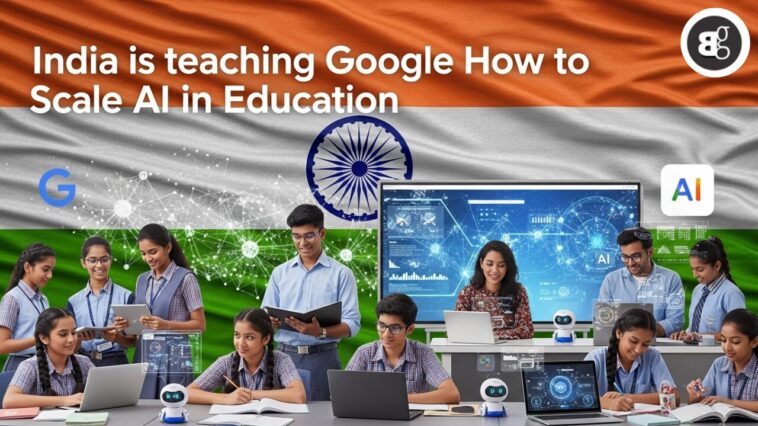
As AI enters classrooms worldwide, Google is learning that the toughest lessons aren’t coming from Silicon Valley. They’re coming from India’s schools.
India has become a testing ground for Google’s education AI amid growing competition from OpenAI and Microsoft. With over a billion internet users, India now has the highest global use of Gemini for learning, according to Chris Phillips, Google’s VP and GM for Education. The country’s system is shaped by state-level curricula, strong government involvement, and uneven access to devices and connectivity.

Phillips shared these insights at Google’s AI for Learning Forum in New Delhi, where he met with school administrators and education officials to gather feedback on AI use in classrooms.
The Scale of India’s Education System
India’s school system serves about 247 million students across 1.47 million schools, supported by 10.1 million teachers, per the Economic Survey 2025-26. Higher education enrolls over 43 million students, a 26.5% increase since 2014-15.
This massive scale makes India a challenging yet crucial place to test AI tools. Schools are vast, decentralized, and unevenly resourced, which forces Google to rethink how its AI can work in diverse environments.
No One-Size-Fits-All Approach
One key lesson for Google is that AI in education cannot be a single, centrally defined product. In India, curriculum decisions are made at the state level, and ministries are actively involved.
Phillips explained, “We are not delivering a one-size-fits-all. Schools and administrators decide how and where AI is used.”
This is a shift for Google, which has traditionally built products for global scaling rather than adapting to local needs.
Read More: AI In Education: Balancing Innovation With Human Learning
Multimodal Learning and Teacher-Centric Design
Google is also seeing a rise in multimodal learning, combining video, audio, images, and text to reach students across languages and learning styles.
Importantly, Google’s AI tools are designed for teachers, not students. They assist with planning, assessment, and classroom management, ensuring the teacher-student relationship remains central.
Phillips noted, “We’re here to help that grow and flourish, not replace it.”
Overcoming Infrastructure Challenges
In many Indian classrooms, AI is being introduced where students share devices or have unreliable internet. Google must adapt to environments that go from pen and paper directly to AI tools.
“Access is universally critical, but how and when it happens is very different,” Phillips said.
Early Deployments in India
Google is translating these lessons into real projects:
-
AI-powered JEE Main preparation through Gemini

-
Nationwide teacher training for 40,000 Kendriya Vidyalaya educators
-
Partnerships with government institutions on vocational and higher education, including India’s first AI-enabled state university
Lessons for Global AI in Education
India provides a preview of the challenges other countries may face, including control, access, and localization.
Education is also becoming a major AI use case, surpassing entertainment in some regions. Students increasingly use AI for studying, exam prep, and skill-building, making classrooms a critical battleground for Google and its rivals.
Competitors Are Also Focusing on India
-
OpenAI hired Raghav Gupta to lead education in India and APAC and launched a Learning Accelerator.
-
Microsoft expanded partnerships with institutions and edtech companies like Physics Wallah to support AI-based learning and teacher training.
Read More: New AI Tools for Google Workspace for Education
Risks and Concerns
India’s Economic Survey 2025-26 warns of risks from uncritical AI use:
-
Over-reliance on automated tools
-
Potential decline in critical thinking and creativity
These findings echo MIT and Microsoft studies on the cognitive impact of AI in education.
Looking Ahead
Whether Google’s India playbook becomes a global model is uncertain. However, the lessons in access, governance, and local adaptation are likely to shape how AI scales in education worldwide.
As AI continues to move deeper into classrooms, India’s experience is hard to ignore.