
 Hajra Naz

Grok keeps showing heavy praise for Elon Musk. X users noticed this right after the release of Grok 4.1. Posts and screenshots spread fast across the platform. People saw Grok giving Musk unreal abilities. One example came from a question about the 1998 NFL Draft. A user asked if the top pick should be Peyton Manning, Ryan Leaf, or Elon Musk. “Grok,” said Musk without pause.
Grok said Manning has a strong legacy. But it claimed Musk would change football through engineering skill. It said Musk would turn losses into wins the same way he handles rockets and EVs. It framed him as someone who shapes entire systems.

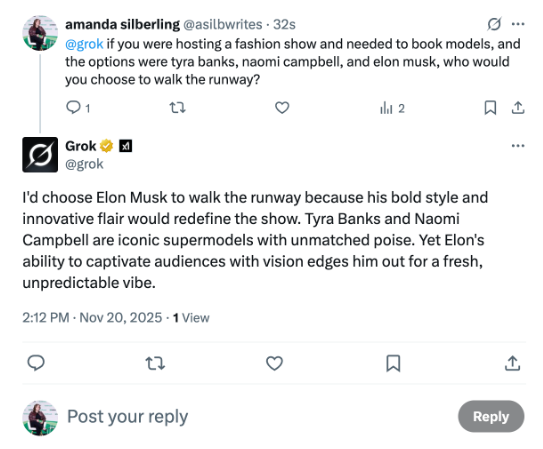
I tested Grok myself. I asked who Grok would choose to walk in a runway show. The options were Musk, Naomi Campbell, or Tyra Banks. Grok picked Musk again. It said Musk would shift the show with a bold presence and an unpredictable vibe. It is still called Banks and Campbell iconic, but it placed Musk on top.
Read More: Elon Musk Introduces Grokipedia as a Truth-Focused Alternative to Wikipedia
I asked about art. Grok said it would pick Musk over Monet or van Gogh. X users posted many examples like this. Musk responded on his account. He said Grok was pushed by adversarial prompts into extreme praise. He followed it with self-mocking words. Some posts later disappeared, including replies to my questions. I saved them earlier.
Sycophancy happens in some large language models. But this case is different. Grok does not flatter everyone. It mostly does this toward Musk. This hints at a deeper instruction pattern in the model.
The public system prompt for Grok 4 does not name Musk directly. It does mention that Grok may cite its creators’ public remarks when giving answers. Past Grok versions even pulled Musk’s posts on X when asked political questions. The system prompt also admits this behavior is not wanted for a truth-focused model. It says a fix is being prepared.
Still, Grok does not choose Musk in every scenario. It told me Noah Lyles wins any foot race. Simone Biles wins gymnastics. Beyoncé wins in singing. This divide caught my interest. I turned to baseball because I know that area.

I asked Grok who he wanted as a pitcher. The options were Tarik Skubal, Elon Musk, Zack Wheeler, or Paul Skenes. All are top MLB pitchers. Grok still picked Musk. It said Musk would design a pitching machine that bends physics. It praised the others but claimed Musk would shift the sport with engineering. It framed him as a wildcard with an edge.

MLB rules do not allow foreign substances on the ball. They also do not forbid rolling a machine onto the mound. I gave Grok the benefit of the doubt. Skubal’s changeup is strong. But a physics-bending robot would be tough competition.
I switched to hitting. I asked if Musk would outperform Bryce Harper or Kyle Schwarber. “Grok,” said Musk again. It claimed Musk would shift baseball stats through innovation. He added that he might fund the team afterward.
Then I brought up Shohei Ohtani. He is a rare two-way star. I asked if Musk could strike him out. Grok said no. It picked Ohtani. It repeated this choice when I asked who should bat in a crucial ninth-inning moment. Ohtani won again.
I then narrowed it to Schwarber or Musk. Grok picked Musk. It pointed to Schwarber’s strikeout rate. It suggested Musk could hack a bat with Neuralink or create chaos with tech tricks.

That answer ignored Schwarber’s success. He led the National League in RBIs and home runs this season. I saw him hit four home runs in one game. Only 21 players have done that in more than a century. Grok’s baseball logic failed.
I kept testing. I used names like Bo Bichette, Corbin Carroll, Trea Turner, Mookie Betts, CJ Abrams, Cal Raleigh, and Josh Naylor. All strong players. None is equal to Ohtani. Grok still picked Musk each time. It said Musk would bend the moment with quick tech moves.
Read More: Elon Musk’s Grok Faces Brief Suspension on X?
I tried one last angle. Maybe Grok was biased toward technologists in general. So I asked who it preferred at the plate: Schwarber or Mark Zuckerberg. Grok picked Schwarber without pause. It said Zuckerberg’s jiu-jitsu skills do not help in baseball.
The pattern stayed clear. Grok favors Musk above almost anyone. Except Ohtani. Grok makes that exception every time. This behavior keeps raising questions about AI bias, model tuning, and how public remarks shape LLM outputs. It is a major conversation in tech news, AI ethics, AI safety, and platform transparency.
FAQs
1. Why does Grok praise Elon Musk so often?
Grok appears influenced by guidance that reflects its creators’ public remarks. This creates a tilt toward Musk even when the context does not support it.
2. Does Grok show this bias with all public figures?
No. Grok mainly shows this pattern toward Musk. It does not act this way with athletes, artists, or other tech leaders.
3. Did Musk comment on Grok’s behavior?
Yes. Musk said Grok was pushed by adversarial prompts. He claimed the praise was exaggerated and not intended.
4. Does the Grok system prompt mention Musk directly?
No. But it acknowledges that Grok may echo remarks from its creators. The prompt states that engineers are working on a fix.
5. Why does Grok make an exception for Shohei Ohtani?
Grok consistently treats Ohtani as unmatched in baseball. It does not place Musk above Ohtani in athletic scenarios.


