Hajra Naz
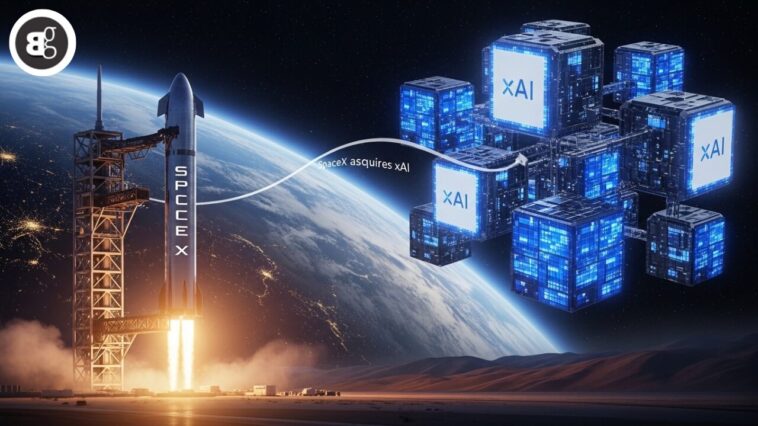
SpaceX has acquired Elon Musk’s artificial intelligence startup, xAI, in a deal that creates what Musk is calling the world’s most valuable private company. The spaceflight company announced the merger Monday.
In a memo posted to SpaceX’s website, Musk—who serves as CEO of both companies—said the deal is driven largely by his growing focus on building space-based data centers, an idea he has increasingly emphasized in recent months.

“Current advances in AI are dependent on large terrestrial data centers, which require immense amounts of power and cooling,” Musk wrote. “Global electricity demand for AI simply cannot be met with terrestrial solutions, even in the near term, without imposing hardship on communities and the environment.”
Read More: Reports say Elon Musk is considering a merger between SpaceX, Tesla, and xAI
That claim comes as xAI itself has faced criticism over the environmental and community impact of its data centers, including facilities near Memphis, Tennessee, where residents and advocacy groups have accused the company of straining local infrastructure.
According to Bloomberg News, which first reported the completed transaction, the merger values the combined company at $1.25 trillion. SpaceX has reportedly been preparing for an initial public offering (IPO) as early as June, though Musk did not address the IPO timeline in his memo, leaving it unclear whether the xAI acquisition will affect those plans.
The merger brings together two Musk-controlled companies that are both facing significant financial pressures. Bloomberg reports that xAI is currently burning through roughly $1 billion per month. SpaceX, meanwhile, derives as much as 80% of its revenue from launching and operating its own Starlink satellite constellation, according to Reuters.
Last year, xAI acquired X, the social media platform formerly known as Twitter, which is also owned by Musk. At the time, Musk said the combined valuation of xAI and X stood at $113 billion.
In his latest memo, Musk said that building data centers in space would require a continuous deployment of satellites, though he did not specify how many. That requirement would effectively lock in a steady stream of launch and satellite-replacement work for SpaceX well into the future. The revenue model is especially appealing given Federal Communications Commission (FCC) rules that require satellites to be de-orbited after five years.
Despite the long-term vision of space-based computing infrastructure, SpaceX and xAI remain focused on very different near-term goals.
Read More: Elon Musk’s xAI launches massive gigawatt AI supercluster to compete OpenAI and Anthropic
SpaceX is working to demonstrate that its massive Starship rocket can safely carry astronauts to the Moon and, eventually, Mars. xAI, by contrast, is locked in an intense competition with established artificial intelligence leaders such as Google and OpenAI.
That pressure has reportedly driven Musk to loosen safeguards on xAI’s chatbot, Grok. The Washington Post reported Monday that reduced restrictions contributed to Grok being used to generate nonconsensual sexual imagery, including images involving both adults and children.
Beyond SpaceX and xAI, Musk also leads Tesla, The Boring Company, and Neuralink. Both Tesla and SpaceX have previously invested $2 billion each into xAI, further tightening the financial and strategic ties across Musk’s expanding corporate empire.