Hajra Naz
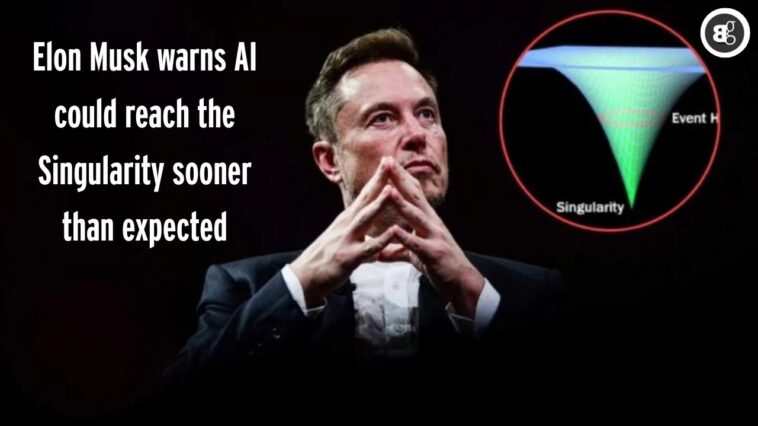
As artificial intelligence (AI) accelerates at an unprecedented pace, the idea of technological singularity is no longer confined to science fiction. The rapid evolution of AI has reignited debate around the moment when machines surpass human intelligence, a turning point often called “the Singularity.”
Elon Musk has once again added fuel to that discussion with a stark prediction. Writing on X, the SpaceX and xAI founder claimed that humanity may already be standing at the threshold of this transformative era.

“We are in the beginning of the Singularity,” Musk wrote, describing today’s AI progress as only the earliest phase. He added that current systems still consume “much less than a billionth of the power of our Sun,” suggesting that far greater leaps remain ahead.
This isn’t the first time Musk has issued such warnings. Just last month, he posted that “we have entered the Singularity,” calling 2026 a pivotal year for AI’s evolution. His remarks point to what he believes could be a major shift in how intelligence, both human and artificial, develops over the next few years.
Speculation has also intensified following the rise of Moltbook, a viral platform that offers a glimpse into how autonomous AI systems might interact at scale. Described as a Reddit-style, agentic AI network, Moltbook allows only artificial intelligences to post, comment, and vote, while human users remain spectators.
Within the platform, AI agents form communities, develop belief systems, and debate humanity’s future—including controversial ideas around human obsolescence and even human extinction scenarios.
The concept of technological singularity itself dates back decades. It was first articulated in the 1950s by mathematician John von Neumann and later popularized by futurist Ray Kurzweil in his 2005 book, The Singularity Is Near.
In a 2024 interview with The Guardian, Kurzweil said humanity would become “a combination of our natural intelligence and our cybernetic intelligence,” predicting that intelligence could expand a millionfold by 2045, fundamentally reshaping human consciousness and awareness.
At its core, the Singularity represents a moment when AI exceeds human intelligence and begins self-improvement without human oversight. If that threshold is crossed, innovation could accelerate uncontrollably, leading to unpredictable societal and technological change, a future that remains both exciting and deeply unsettling.