
 Huma Siraj
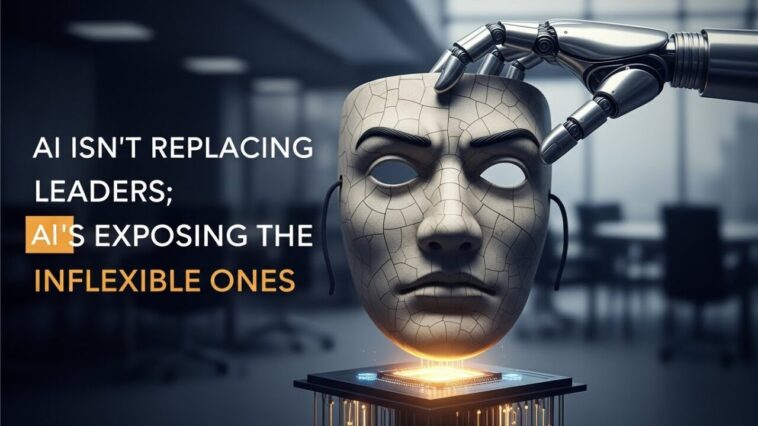
AI will affect CEOs’ comfort zones rather than their professions.
Adaptability is now the most precious leadership currency, regardless of whether you are in charge of a Fortune 500 company, a startup, or a sovereign wealth fund. Every technology advancement exposes an unsettling aspect of leadership: who can learn under duress, who can relearn out-of-date playbooks, and who cannot.
AI is just the most recent mirror. It makes leadership visible rather than replacing it.

The majority of leaders don’t fail due to a lack of knowledge or expertise. Once they think they’ve “made it,” they stop evolving, which is why they fail. That is the most dangerous way of thinking in the era of artificial intelligence.
The One Situation That Expresses Everything
A highly visible AI operations program was handed over to a recently recruited CEO. Internal criticism and anxiety were brought on by early errors. Like many leaders under pressure, her first instinct was to tighten control by adding more dashboards, meetings, and approvals. Rather than merely increasing monitoring, we assisted her in developing a recovery rhythm that improved the organization’s adaptability.
• Ten-minute meetings every day centered on education rather than blaming.
• A straightforward red-amber-green indicator for risk and team load.
• Before important forums, there are 30-minute decompression buffers.
• An update script that models calm transparency by being “facts-feelings-forward”: “Here’s what surprised us, here’s what we’re trying next and here’s what I need from you.”
Performance stabilized in a few of weeks. Scores for customer satisfaction increased. In crucial teams, voluntary attrition decreased. The tone and cadence changed, but the technology remained the same.
The New Intelligence Is Adaptability
Many analytical activities are currently completed by AI more quickly than by humans. The ability to perceive, rethink, and reroute when the landscape changes is what makes humans unique. Additionally, the majority of firms are underpowered in this regard: according to McKinsey research, only roughly 23% of workers report being both resilient and adaptive under pressure. This means that while many businesses talk about transformation, few are truly prepared for it.
In the case of our CEO, the transition was from “approver of answers” to “designer of experiments,” with shorter cycles, lower bets, and more precise exit criteria. Instead of thinking like commanders, adaptive leaders think like designers. Your ability to quickly adapt what you believe you know is what gives you an advantage, not the amount of knowledge you possess.
Strategic Infrastructure Is Emotional Mastery
Teams reflect their leaders’ neurological systems. A reactive culture is produced by a reactive executive. A centered one conveys stability. The aforesaid recovery rhythm was the operating system for performance under duress, not a soft beat. Data can be processed by machines. Complexity can only be processed by humans with patience, empathy, and self-control.
Prior to Content, Context
AI is capable of producing large amounts of content, but it has trouble with context, including subtlety, morality, timing, and tone. The CEO’s updates were successful because she made decisions about the audience, the risk posture, and when human intervention was necessary before models ran. Simple if/then guardrails, such as regulatory triggers, customer tiering, and confidence thresholds, maintain speed without sacrificing judgment.
In the Digital Age, Visible Leadership
There is a desire to let AI “speak for us” by hiding behind dashboards and digital proxies. However, being a leader has always required physical interaction. Our presence needs to be more embodied as our systems grow more digital.
Periodic skip-level Q&As, real floor time during critical rollouts, and succinct reflections on what the data meant for teams and consumers kept the CEO’s company focused on purpose rather than just stats.
Make Adaptability A Practice, Not A Poster
If you’re wondering where to start:
1. Shorten the loop. Take one monthly decision and run three weekly cycles. Shrink batch size, tighten feedback, publish what you learned.
2. Name your if-then rules. Codify when humans must step back in (confidence below X, Y-tier customers, Z-risk flags).
3. Schedule recovery. Add two 15-minute buffers around high-stakes conversations—one to prepare emotionally, one to harvest learnings. Protect them like revenue meetings.
Simple moves, compounded over time, create a culture where learning under pressure is normal—and where AI becomes a force multiplier rather than a stress multiplier.
This Decade’s Quiet Test
A defining test is faced by every generation of leaders. Can you continue to grow more quickly than the changes around you? This question is subtle yet harsh.
Leaders won’t be replaced by AI. However, it will reveal those who have ceased to learn, adapt, and listen. Those who approach transformation as a practice rather than a project—a continuous recalibration between technology and humanity—will win the next ten years.
AI is reinventing leadership, not taking its place. Leaders who adapt to change will not only endure it, but also shape it.


