Hajra Naz
A world increasingly powered by AI coding tools is one where software creation is thought to be cheap and fast, leaving traditional software companies scrambling. As one analyst noted, “vibe coding will allow startups to replicate the features of complex SaaS platforms.”
This prediction sparked hand-wringing and warnings that traditional software companies are doomed.

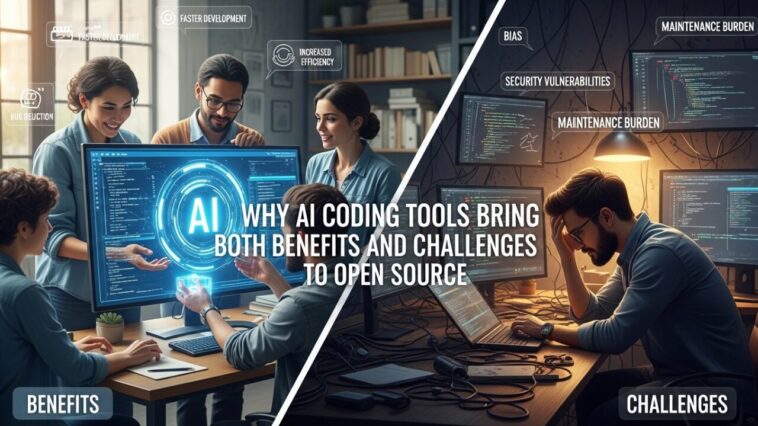
For open source software, which often faces resource constraints, AI tools should logically be a boon. But the reality is more complicated: AI’s impact on open source projects has been mixed, creating as many challenges as it solves.
Quality vs. Quantity
Experts note that AI coding tools have made building new features easier than ever — but maintaining them is still hard. The ease of creating code has also led to a flood of poor-quality submissions, threatening to fragment software ecosystems.
As Jean-Baptiste Kempf, CEO of the VideoLAN Organization (which oversees VLC), said, “For people who are junior to the VLC codebase, the quality of the merge requests we see is abysmal.”
Kempf remains optimistic overall, adding that AI coding tools are best “for experienced developers.”
Similar issues have appeared in Blender, a 3D modeling tool maintained as open source since 2002. Blender Foundation CEO Francesco Siddi said that LLM-assisted contributions often “wasted reviewers’ time and affected their motivation.” Blender is still developing a policy for AI coding tools, which are currently “neither mandated nor recommended for contributors or core developers.”
Read More: Most Popular AI Tools for Coding Every Developer Should Know
Managing the Flood of Contributions
The surge in merge requests has forced developers to build new management tools.
Earlier this month, developer Mitchell Hashimoto launched a system limiting GitHub contributions to “vouched” users, effectively closing the open-door model for open source. As Hashimoto explained, “AI eliminated the natural barrier to entry that let OSS projects trust by default.”
The same issue has appeared in bug bounty programs. The open source data transfer program cURL paused its bug bounty program after being overwhelmed by what creator Daniel Stenberg called “AI slop.”
Stenberg remarked,
“In the old days, someone actually invested a lot of time [in] the security report. There was a built-in friction, but now there’s no effort at all in doing this. The floodgates are open.”
AI Tools Still Provide Benefits
Despite these challenges, AI coding tools have clear advantages. Kempf notes they make building new VLC modules much faster—but only “if there’s an experienced developer at the helm.”
He explained,
“You can give the model the whole codebase of VLC and say, ‘I’m porting this to a new operating system.’ It is useful for senior people to write new code, but it’s difficult to manage for people who don’t know what they’re doing.”
Conflicting Priorities in Open Source
The bigger problem for open-source projects is competing priorities. Tech companies often reward new code and products, while open source emphasizes stability.
“The problem is different from large companies to open-source projects,” Kempf said. “They get promoted for writing code, not maintaining it.”
Complexity Meets AI
Open-source software is already highly fragmented. Konstantin Vinogradov, an open-source investor, explained:
“On the one hand, we have an exponentially growing code base with an exponentially growing number of interdependencies. And on the other hand, we have several active maintainers, which is maybe slowly growing, but definitely not keeping up. With AI, both parts of this equation accelerated.”
AI coding tools make it easier to produce working software, but managing complexity remains difficult. Active planning and skilled maintainers are still essential.
“AI does not increase the number of active, skilled maintainers,” Vinogradov said. “It empowers the good ones, but all the fundamental problems just remain.”
Read More: Emergent, India’s Vibe-Coding Startup, Crosses $100M ARR in 8 Months
Conclusion
For open source, AI coding tools are a double-edged sword. They speed up development for experienced developers but also introduce low-quality contributions, management challenges, and fragmentation.
The promise of AI in software is clear, but maintaining and stabilizing large open-source projects still relies on skilled human engineers.