Hajra Naz
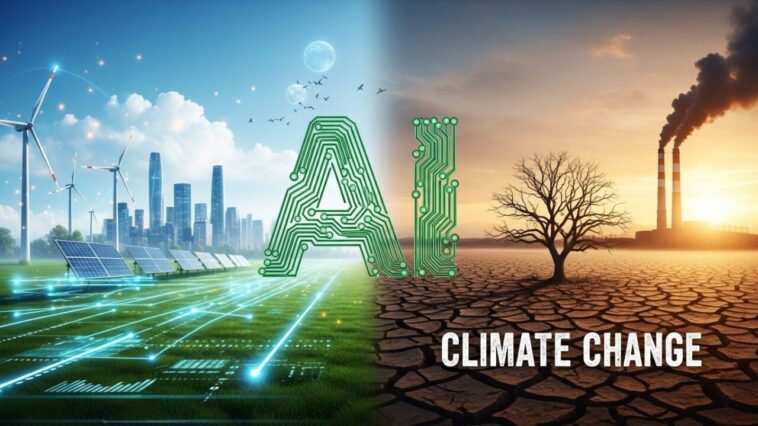
As climate change continues to worsen, many have looked to artificial intelligence (AI) as a potential solution. Tools like AI-powered forecasting, satellite monitoring, smart grids, and early warning systems were meant to help the planet. But in reality, AI is also consuming huge amounts of energy and water, creating a growing carbon footprint.
Despite this, tech companies often claim that their AI can cut emissions and fight climate change. These promises give hope to people already feeling the impacts of extreme weather and environmental changes. But experts warn the truth may be more complicated.

What Tech Giants Say About AI and the Climate
Supporters argue AI can make a real difference:
-
The UN’s climate chief, Simon Stiell, says AI can help reduce emissions in industries by making processes more efficient.
-
In 2023, Google claimed AI could cut 5–10% of global greenhouse gas emissions by 2030 if widely used.
-
The International Energy Agency (IEA) also reported AI could reduce emissions by up to 5% by 2035.
These numbers sound promising, but some experts say they overstate AI’s real-world impact.
Read More: AI Role in Climate Change | Smart Solutions for a Greener Future
The Evidence Isn’t Clear
A recent report by non-profits like Climate Action Against Disinformation calls many of these claims a “green AI hoax.”
Key points from the report:
-
Out of 154 statements made by tech companies and the IEA, 36% had no evidence at all.
-
Only 26% were backed by real research.
-
Popular tools like Google’s Gemini and Microsoft’s Copilot haven’t shown any measurable reduction in emissions.
The report also noted that even if AI does save energy, those gains are often dwarfed by the massive energy use of modern AI systems, especially generative AI.
Generative AI: Big Energy, Big Problems
Not all AI is the same. Experts draw a line between older AI models and generative AI, which powers chatbots, text generators, and image creation tools.
-
Sasha Luccioni, AI and climate lead at Hugging Face, says:
-
“AI that’s bad for the planet is mostly generative AI and large language models.”
-
“AI that’s good for the planet is usually older AI, like predictive or resource-optimizing models.”
-
Generative AI requires massive data centers, which use huge amounts of electricity and water. A study in the journal Patterns estimates that data centers alone could emit 32–79 million tonnes of CO₂ in 2025 — roughly the same as a small European country.
Read More: Bill Gates Sparks Debate Over Climate Adaptation Strategy
Greenwashing in Tech
Many experts warn that tech companies are using greenwashing tactics:
-
They highlight minor environmental benefits from older AI systems while hiding the real emissions from modern AI.
-
Marketing makes it seem like AI is solving climate change, even when the evidence is weak or missing.
This can mislead the public and even influence climate policy and funding.
How AI Could Actually Help
Experts suggest steps to make AI genuinely sustainable:
-
Transparency – Companies should share how much energy their AI systems use.
-
Renewable energy – Power data centers with green energy.
-
Focus on impactful AI – Use AI for predictive modeling, energy optimization, and climate research.
-
Independent checks – Third-party audits to verify environmental claims.
-
Government rules – Policies to limit emissions or incentivize green AI development.
Without these steps, AI may end up hurting the planet more than it helps.
Read More: AI’s Hidden Climate Cost: How Our Digital Habits Shape the Planet
Conclusion
AI has the potential to fight climate change, but right now, its impact is mixed. Generative AI, in particular, is consuming a lot of energy and resources, while corporate promises often overstate the benefits.
The key question remains: Will AI become a true climate ally, or just another example of corporate greenwashing?