Hajra Naz
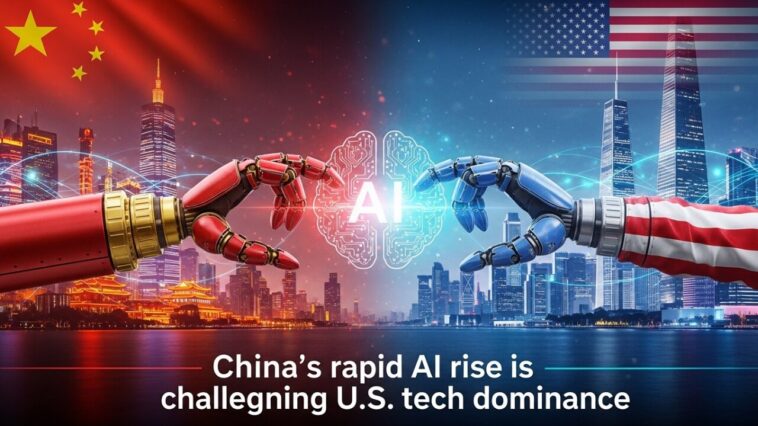
China’s rapid rise in technology is beginning to challenge what many once saw as America’s firm grip on artificial intelligence (AI). According to Rory Green, chief China economist at TS Lombard, this shift is not a one-off moment—it’s the start of something much bigger.
Speaking on Squawk Box Europe on CNBC, Green said the long-held belief that the U.S. had a monopoly on advanced tech and AI is now over. In his view, China’s tech surge is accelerating quickly, and AI is only part of the story.

“It’s not just AI or companies like DeepSeek, and it’s not just electric vehicles,” Green explained. “China is moving up the value chain very rapidly.” He described the moment as historic—the first time an emerging economy has positioned itself at the forefront of science and technology.
China’s strategy blends advanced innovation with lower production costs, powered by its vast manufacturing base and supply chain strength. Under President Xi Jinping, Beijing has aggressively backed key sectors. Last year, the government quietly launched a 60.06 billion yuan ($8.7 billion) national AI fund and rolled out its “AI+” initiative, designed to integrate artificial intelligence across the economy.
Read More: The Enterprise AI Race Is Heating Up, and Glean Is Playing the Long Game
In the AI race specifically, China has closed the gap faster than many expected. While U.S. chipmaker Nvidia remains the gold standard for AI training chips, Chinese tech giant Huawei has been scaling up by deploying massive chip clusters built on homegrown semiconductors. Combined with cheaper energy and large-scale infrastructure, China is rapidly expanding its computing power.
Green believes this could lead to the formation of a distinct “China tech sphere.” As one of the world’s largest trading nations, China already has deep ties with emerging and frontier markets. If those relationships expand into advanced technologies, the global impact could be significant.
Developing countries that do not view China as a national security threat may face a straightforward choice: adopt lower-cost Chinese technology — including Huawei’s 5G equipment, batteries, solar panels, AI systems, and even RMB financing — or opt for higher-cost American and European alternatives. For many, the economic decision may be clear.
Green suggested that within five to ten years, much of the world’s population could be operating on a “Chinese tech stack” — meaning the core digital infrastructure behind communications, energy systems, and AI services would rely heavily on Chinese-built platforms.
Others in the AI industry have echoed concerns about the speed of China’s progress. Demis Hassabis, CEO of Google DeepMind, said earlier this year that China’s AI models may be only months behind U.S. and Western competitors — much closer than previously believed.
Read More: AI Race Poses Bigger Danger to Silicon Valley Than Trade Tariffs
Meanwhile, the United States is pouring enormous sums into AI development. Tech giants Amazon, Microsoft, Meta, and Alphabet have collectively announced up to $700 billion in AI-related capital expenditures this year. That spending surge has triggered concerns about return on investment (ROI), especially after roughly $1 trillion in market value was wiped from major tech stocks during recent volatility.
Karim Moussalem, chief investment officer at Selwood Asset Management, noted growing investor anxiety around U.S. exceptionalism and whether the AI spending race will ultimately deliver sustainable profits.
For now, both countries are locked in an intense AI arms race, deploying vast capital and resources to secure technological leadership. But as China accelerates up the technological ladder, the assumption of unquestioned U.S. dominance in AI appears increasingly uncertain.