Hajra Naz
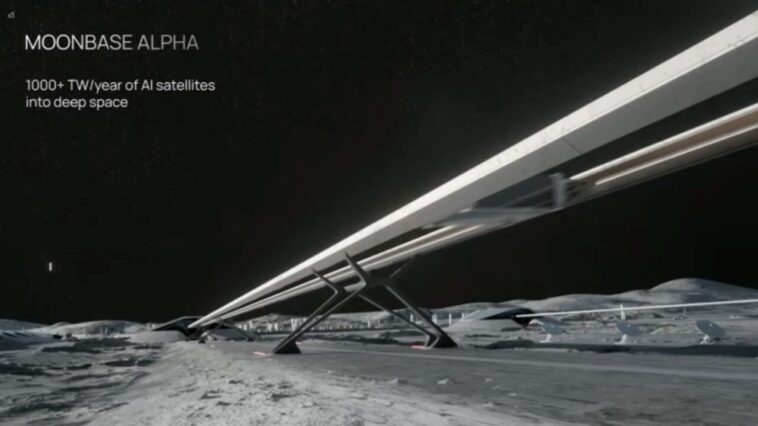
Musk has already outlined plans to build AI data centers in orbit — one of the most obvious synergies between SpaceX and xAI. But during a recent all-hands meeting, he went further.
“What if you want to go beyond a mere terawatt per year?” Musk asked employees. “To do that, you have to go to the moon… I really want to see a mass driver on the moon that is shooting AI satellites into deep space.”

In Musk’s vision, Earth-orbit data centers are just the beginning. The next step is an even larger computational infrastructure deployed into deep space. The mechanism? A lunar industrial base that manufactures advanced space-based computers and launches them across the solar system using a massive maglev-style mass driver.
It’s less an incremental roadmap, more a science fiction manifesto.

The Slide at the End of the Deck
Longtime Musk observers noticed something familiar about the moment.
The Moon base slide appeared at the end of the presentation — a position Musk often reserves for grand visions. At SpaceX events, that’s traditionally where Mars renderings appear and Musk speaks about multi-planetary humanity.
But there’s a twist: the lunar vision comes just as SpaceX appears to be stepping back from its long-promised Mars colonization narrative.
If Mars once unified SpaceX’s mission, the Moon now seems to anchor a broader story — one that folds AI into the cosmic ambition.
Read More: Elon Musk’s SpaceX officially acquires Elon Musk’s xAI, revealing plans for data centers in space
Enter the Kardashev Scale
To frame the shift, Musk invoked the Kardashev Scale, a 1960s concept that measures civilizations by energy consumption.
In that model, advanced civilizations first harness all the energy available on their home planet. Then they move outward, capturing increasing portions of their star’s energy.
With a Moon base producing AI infrastructure in space, Musk suggests the company could tap “maybe even a few percent of the sun’s energy” to train and operate AI systems.
“It’s difficult to imagine what an intelligence of that scale would think about,” Musk told staff. “But it’s going to be incredibly exciting to see it happen.”
The metaphor is doing heavy lifting. It reframes xAI not as another lab racing toward AGI, but as a step in humanity’s ascent toward cosmic-scale energy use.
Why the Narrative Matters
Musk has long understood the power of narrative in recruiting and motivating talent.
SpaceX’s Mars ambition — unveiled nearly a decade ago — wasn’t just a business plan. It was a founding myth. “Occupy Mars” shirts became symbols of purpose. The Red Planet unified rocket development, signaled ambition to government contractors, and offered employees a sense of participating in something historic.
Now that Mars colonization appears less central — and Tesla Optimus robots are no longer marching across Starship slides — a new story is emerging.
This time, it’s not one million people living on Mars. It’s solar system–scale AI computation.
Read More: SpaceX Crosses 10,000 Starlink Satellites Milestone
The Business Reality Check

There was always a practical problem with Mars: no one was paying for it.
Plans announced in 2016 to adapt the Dragon spacecraft for Mars landings were quietly shelved after costs mounted. Starship, once framed primarily as a Mars colonization vehicle, has increasingly focused on more revenue-generating missions — launching Starlink satellites and fulfilling NASA contracts to land astronauts on the Moon.
That pivot reflects economic gravity.
A multi-planetary civilization is inspiring. But $4 billion NASA contracts and a global satellite network pay the bills.
Where AI Fits In
Unlike Mars colonization, there is at least a plausible economic logic to combining SpaceX’s launch capabilities with AI infrastructure.
If terrestrial data center demand continues to surge — and if energy constraints and costs escalate — orbital computing platforms could become attractive in the 2030s. Some experts argue it’s technically feasible, if not yet economical.
Building and launching satellites from the Moon, however, requires an even larger leap.
Mass-producing advanced chips in lunar factories would demand:
-
Dramatically cheaper space transport
-
Reliable supply chains for raw materials
-
On-site manufacturing of precision electronics
-
A self-sustaining lunar settlement
In other words, nearly every one of Musk’s long-term ambitions would need to succeed first.
Read More: Reports say Elon Musk is considering a merger between SpaceX, Tesla, and xAI
The Stretch Goal
Which may be the point.
This is not the near-term roadmap. It’s the stretch goal.
For retail investors who embrace bold, meme-friendly futures, such a narrative could help position SpaceX shares as the next Tesla-style phenomenon once public markets enter the picture.
For engineers — whether in aerospace or AI — the shift may feel disorienting. But it also offers differentiation.
As one departing executive reportedly remarked, “All AI labs are building the exact same thing, and it’s boring.”
A lunar mass driver launching solar system–scale AI infrastructure is many things. It invites skepticism. It raises practical objections. It borders on the surreal.
But it is not the same thing.
And it is not boring.