Hajra Naz
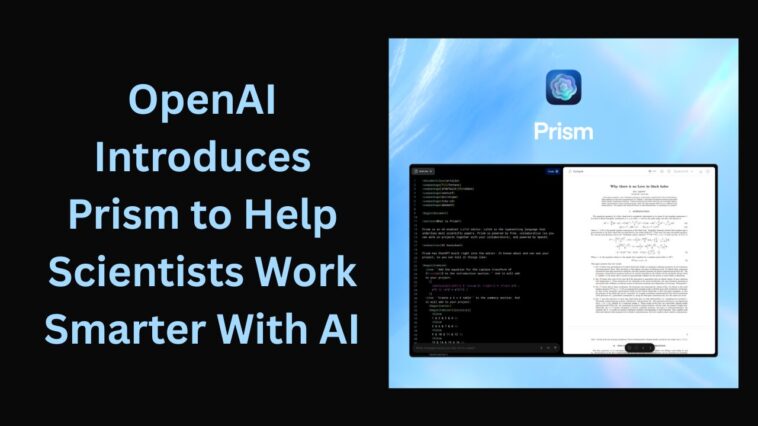
On Tuesday, OpenAI introduced Prism, a free AI-enhanced workspace for scientific research available to anyone with a ChatGPT account. Prism is designed as an AI-assisted word processor and research tool, helping scientists draft papers, assess claims, revise prose, and search prior research. It is deeply integrated with GPT-5.2, allowing users to leverage the model’s advanced reasoning and domain knowledge.
Designed to Support, Not Replace, Human Researchers
Prism isn’t intended to conduct research independently. OpenAI emphasizes that the tool accelerates the work of human scientists rather than replacing them. Executives compared Prism to coding interfaces like Cursor and Windsurf, which integrate AI into complex workflows.

Kevin Weil, OpenAI’s VP for Science, said in a press call,
“I think 2026 will be for AI and science what 2025 was for AI and software engineering.”
Responding to the Surge in Scientific Queries
OpenAI reports that ChatGPT receives an average of 8.4 million weekly messages on advanced scientific topics, although it is unclear how many come from professional researchers. The launch of Prism is aimed at addressing this growing interest by providing a dedicated, science-focused interface.
AI-assisted research is already making an impact. In mathematics, models have helped solve several long-standing Erdos problems, combining literature review with novel applications of existing techniques. While debates continue over the significance of these results, they showcase early wins for AI-human collaboration in formal verification and research.
In December, a statistics paper used GPT-5.2 Pro to prove a central axiom of statistical theory. Human researchers prompted and verified the model’s work, and OpenAI highlighted it as a template for future research collaboration.
“In domains with axiomatic theoretical foundations, frontier models can help explore proofs, test hypotheses, and identify connections that might otherwise take substantial human effort to uncover,” the company said.
Read More: OpenAI Launches ChatGPT Health as 230M Users Ask about Health Each Week
Powerful Tools for Scientific Workflows
Prism builds on existing standards while going further than most research software. It integrates with LaTeX for typesetting scientific papers but adds enhanced functionality. Researchers can also use GPT-5.2’s visual capabilities to generate diagrams from online whiteboard sketches, eliminating a common pain point in paper preparation.
One of Prism’s standout features is rigorous context management. When users open a ChatGPT window within Prism, the AI has access to the full context of the research project, enabling more relevant, intelligent responses. While skilled GPT-5.2 users could achieve similar results, Prism’s clean interface and workflow integration aim to make it more accessible to scientific researchers.
Weil explained the vision:
“Software engineering accelerated in part because of amazing models, and in part because of deep workflow integration. We hope the same combination will drive AI adoption in scientific research.”
Read More: OpenAI Says ChatGPT Will Predict User Age to Improve Child Safety
Conclusion
Prism represents OpenAI’s latest effort to bridge AI and human expertise, making advanced AI tools more accessible and practical for scientists. By combining GPT-5.2’s reasoning, visual tools, and workflow-aware design, Prism aims to streamline research, enhance collaboration, and accelerate discovery across scientific disciplines.