Hajra Naz
Key Takeaways
-
OpenAI could generate $25 billion in ad revenue by 2030 if its ad rollout succeeds.
-
Ads will appear at the bottom of ChatGPT answers, non-intrusive and conversation-relevant.
-
Google and Meta dominate the market now, but OpenAI could siphon high-intent commercial queries.
-
Success depends on user adoption, innovative ad formats, and competing with established tech ecosystems.
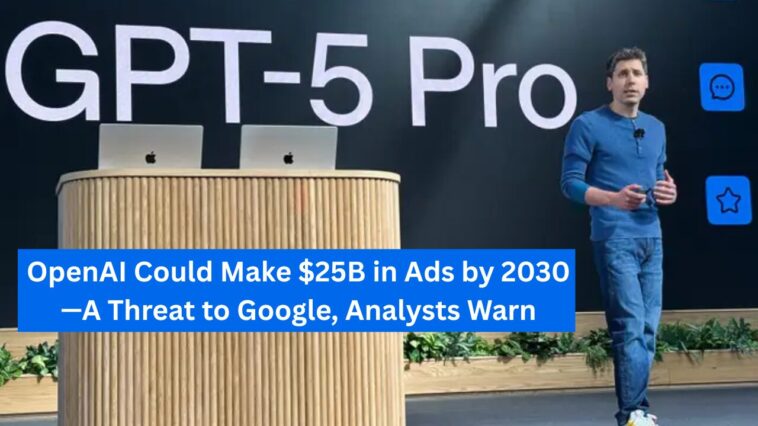
OpenAI is preparing to make a major move into digital advertising, and it could shake up Google’s long-dominant search business. According to Evercore ISI analyst Mark Mahaney, the startup could generate $25 billion in annual ad revenue by 2030 if it executes its strategy successfully.
ChatGPT Starts Testing Ads
OpenAI announced last Friday that ads will soon appear for both free and ChatGPT Go users. The company emphasized that its advertising will follow strict principles: ads will be clearly labeled, and user conversations will not be shared with advertisers.

Mahaney sees a clear growth path. In a note to investors, he wrote:
“A path to generating several billion dollars in ad revenue in 2026, going to $25B+ by 2030, seems reasonable.”
This projection is based on ChatGPT’s expected scale, the proven success of performance marketing platforms, and the overall size of the digital ad market.
Read More: Elon Musk’s xAI launches massive gigawatt AI supercluster to compete OpenAI and Anthropic
OpenAI’s Rapid Revenue Growth
OpenAI is already seeing impressive revenue growth. CFO Sarah Friar recently revealed that the company’s annualized revenue topped $20 billion in 2025, up from just $2 billion in 2023. However, questions remain about OpenAI’s profitability and whether it can sustain its business model long-term.
Advertising is seen as one potential way for OpenAI to strengthen both its top line and bottom line.
A Threat to Google and Meta
Mahaney highlighted the scale of the market OpenAI is entering. Google’s Search and YouTube businesses likely generated nearly $300 billion in ad revenue in 2025, while Meta pulled in roughly $180 billion. These operations are highly profitable, with operating margins around 40%.
ChatGPT, with almost 1 billion weekly users, sits on a goldmine of high-intent data. Users frequently share detailed information about their needs and interests—exactly the type of information advertisers pay a premium for.
How OpenAI Plans to Integrate Ads
The initial ads will appear at the bottom of ChatGPT responses, tailored to the user’s conversation. Mahaney suggests this could strike the right balance: unobtrusive for users, yet highly valuable to advertisers.
“OpenAI’s move directly challenges this core revenue stream by offering an alternative, highly engaging platform for users to discover products and services,” Mahaney wrote.
If OpenAI develops a conversational ad format where users research and discuss potential purchases inside ChatGPT, advertisers may shift a portion of their budgets. Mahaney calls this “high-intent engagement”—advertising that could rival Google for commercial queries.
Read More: 5 Confidential Matters to Never Disclose to ChatGPT
Competition and Challenges
Despite the opportunity, OpenAI faces hurdles. Google has built a vast ecosystem over the years, including its Chrome browser and ingrained habits like using Google search for answers. Winning users away from Google will not happen overnight.
Even so, OpenAI’s experiment represents a potential paradigm shift in digital advertising, combining AI-driven insights with direct, user-friendly engagement.