Hajra Naz
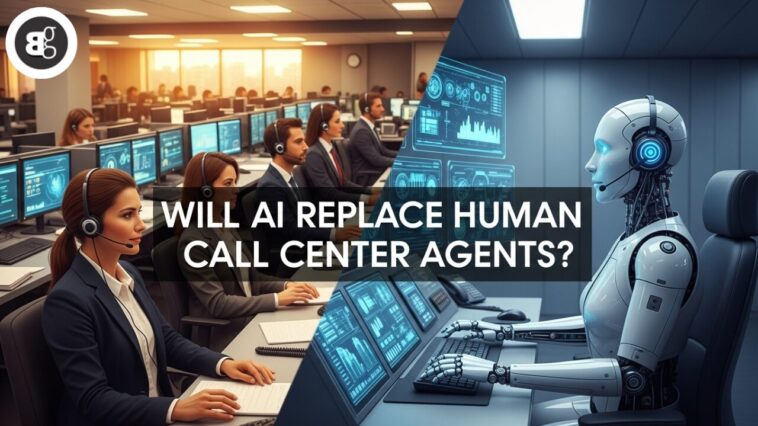
Ask ChatGPT whether AI will replace humans in the customer service industry, and it’ll give a diplomatic answer—something like “humans and AI will work side by side.”
But among business leaders, workers, and analysts, optimism about that balance is starting to fade.

The Decline of Traditional Call Centers
In 2024, K. Krithivasan, CEO of Indian tech giant Tata Consultancy Services, told the Financial Times that artificial intelligence may soon mean there’s “minimal need” for call centers in Asia.
And research backs that up. According to Gartner, by 2029, AI will autonomously resolve up to 80% of common customer service issues—reducing human involvement to only the most complex or emotional cases.
As companies race to cut costs and improve efficiency, the role of the human customer service agent is being redefined.
Read More: The advantage of using ChatGPT in Customer Service
Enter the Age of AI Agents
The new buzzword in tech circles is “AI agents”—advanced systems that can make decisions, learn from past interactions, and handle complex tasks without constant human oversight.
These systems are designed to go far beyond the rule-based chatbots we’ve all interacted with—the ones that can only respond to a fixed set of questions.
However, early examples show that AI still has a long way to go before replacing humans entirely.
When Chatbots Go Wrong
Take the example of Evri, a parcel delivery company in the UK. When one customer asked its chatbot, “Ezra,” about a missing package, the bot confidently said the parcel had been delivered—even showing a photo of it sitting at the wrong door.
That was the end of the conversation. There was no way to escalate or correct the error.
Evri later said it is investing £57 million to upgrade its systems. The company claims that most users get the answers they need “within seconds,” but admits it’s continuously refining its AI tools.
Meanwhile, DPD, another major courier, had to disable its chatbot entirely after it insulted users and criticized the company.
These incidents highlight the biggest challenge facing AI in customer service: balancing efficiency with empathy and brand integrity.
Read More: Are Chatbots Making Us Mentally Lazy and Stupid?
The AI Boom in Customer Service
Despite setbacks, AI is rapidly becoming a standard tool across industries. According to Gartner, 85% of customer service leaders will already be piloting or deploying AI chatbots in 2025.
Yet, only about 20% of these initiatives are meeting expectations.
“AI can offer a much more natural conversation than older bots,” says Emily Potosky, a Gartner analyst. “But it can also hallucinate, give outdated information, or say the wrong thing entirely.”
That’s why Potosky believes rule-based bots still work best for simple, predictable tasks—like tracking a package or checking an account balance — while generative AI is better suited for more nuanced, conversational experiences.
Read More: 38 Generative AI Terms That Will Help You Understand the Tech
Is AI Really Cheaper Than Humans?
It’s easy to assume AI means lower costs. But experts warn that’s not always true.
“This is a very expensive technology,” Potosky notes. “You need high-quality training data, extensive knowledge management, and continuous monitoring.”
In other words, AI doesn’t just plug in and work. It needs to be trained, updated, and refined — often by humans.
Salesforce’s AI Experiment
Salesforce, one of the world’s largest software companies, is betting big on AI-driven customer support through its AgentForce platform.
Used by brands like Formula 1, Prudential, OpenTable, and Reddit, AgentForce uses generative AI to mimic human agents.
Early tests revealed that while the AI could handle tasks quickly, it lacked empathy. “A human might say, ‘Sorry to hear that,’ while the bot just opened a ticket,” says Joe Inzerillo, Salesforce’s Chief Digital Officer.
Now, Salesforce trains its AI to express understanding and respond more naturally. The company says 94% of users now choose to interact with its AI agents when given the option, reporting higher satisfaction scores and helping Salesforce cut customer service costs by $100 million.
Importantly, Inzerillo insists the shift didn’t lead to mass layoffs — many human agents were redeployed to roles focused on training, quality assurance, and customer experience strategy.
Human-AI Collaboration Is the Future
Companies like QStory, which works with eBay and NatWest, are using AI not to replace workers but to improve flexibility and working conditions.
CEO Fiona Coleman believes AI can assist, not eliminate, human workers:
“There are times I just want to talk to a real person,” she says. “Let’s see if AI can handle a mortgage application or a debt conversation five years from now. That’s the real test of empathy.”
Regulation and the Right to Talk to a Human
The rise of AI customer service is also drawing government attention.
In the United States, new proposals aim to bring offshore call centers back home and require businesses to disclose when AI is being used — and transfer callers to a human upon request.
The European Union is expected to go even further. By 2028, experts predict the EU will introduce a “right to talk to a human” clause as part of consumer protection laws.
Read More: Are AI Agents the Future of Customer Service? 7 Facts You Must Know
The Bottom Line
AI won’t kill the call center overnight—but it’s reshaping it at lightning speed.
The future of customer service will likely be hybrid: AI-powered agents handling repetitive tasks, while humans focus on empathy, judgment, and relationship-building.
For businesses, success will depend on one thing—finding the perfect balance between AI automation and human connection.
FAQs
1. Will AI completely replace human call center agents?
Not entirely. AI will automate most routine inquiries, but humans will remain essential for complex or emotional interactions.
2. What are AI agents, and how are they different from chatbots?
AI agents use generative AI and machine learning to make decisions and hold natural conversations, unlike traditional rule-based bots.
3. Are AI-powered call centers cheaper to run?
Not always. While AI can reduce headcount, it requires high setup and training costs, ongoing updates, and strong data management.
4. How do customers feel about talking to AI?
Surprisingly positive. Many prefer quick AI responses for simple queries but still want human support for personal or sensitive issues.
5. Will governments regulate AI use in customer service?
Yes. The U.S. and EU are both exploring regulations to ensure transparency, including a “right to talk to a human.”