Hajra Naz

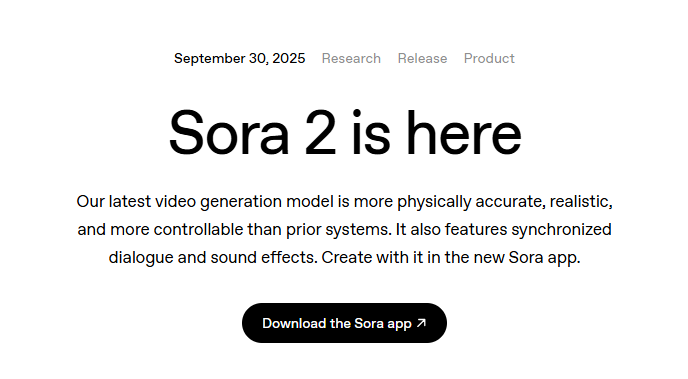
On Tuesday, OpenAI announced Sora 2, the upgraded version of last year’s Sora model. This new AI tool can generate both realistic video and audio with better accuracy than before. Alongside the model, OpenAI also launched a connected social app called Sora, which works like TikTok or Instagram Reels.
In the Sora app, users can create and share AI videos of themselves, their friends, or completely new scenes. The platform is built around short-form video content with an algorithmic feed similar to TikTok.

What Makes Sora 2 Different?
OpenAI says Sora 2 is much more advanced at following the laws of physics, making generated videos look natural and believable. Earlier models often broke reality. For example, in older versions, if a basketball player missed a shot, the ball could magically teleport to the hoop. In Sora 2, the ball rebounds off the backboard, just like in real life.
Public demo clips from OpenAI show:
-
Beach volleyball games
-
Skateboard tricks
-
Gymnastics routines
-
Cannonball dives
These examples highlight Sora 2’s realism compared to past video models.
Read More: OpenAI launched Sora: A Text-to-Video Generator
The “Cameos” Feature
The new Sora app introduces an upload yourself feature called Cameos. Users can drop themselves into any AI-generated scene. To use this, you need to record a short video and audio clip for identity verification.
Key highlights of Cameos:
-
You can appear in AI videos with your friends.
-
You can grant permission to others to use your likeness.
-
Multiple users can appear together in shared AI scenes.
OpenAI believes that this feature will make Sora 2 more fun, social, and viral.
Sora App Availability
-
Platform: iOS app (U.S. and Canada first).
-
Access: Invite-only at launch.
-
Free use: No charge at launch except for generating extra videos in high-demand times.
-
ChatGPT Pro users: Can try Sora 2 Pro without an invite.
-
Parental Controls: Parents can set scroll limits, block personalization, and control DMs.
OpenAI says it plans to roll out the app to more countries soon.
Privacy and Safety Concerns
The launch of a social platform powered by AI video raises serious safety and ethical issues.
-
Users can revoke access to their likeness anytime, but risks remain.
-
Non-consensual and deepfake-style videos could still happen.
-
AI platforms face ongoing criticism for a lack of strict laws and protections against misuse.
OpenAI has promised strong safety and moderation tools, but experts warn these controls can only be as effective as the user’s technical knowledge.
Competition in AI Video
OpenAI’s move comes as rivals also push into AI social video. Meta recently launched a new “Vibes” video feed inside its Meta AI app. Other platforms like Runway AI, Pika Labs, and Stability AI are also racing to dominate this space.
With TikTok under regulatory pressure and YouTube Shorts rising, OpenAI’s Sora could reshape the AI + social media landscape.
Conclusion
Sora 2 shows how far AI video generation has advanced in just one year. With realistic physics, social sharing, and Cameos, OpenAI is combining creativity with community. But questions about safety, privacy, and misuse will determine how successful this new app becomes.
FAQs
1. What is OpenAI Sora 2?
Sora 2 is OpenAI’s new AI video and audio generator, designed to create realistic short videos.
2. How is Sora 2 better than the first version?
It follows real-world physics more accurately, making videos more natural and less glitchy.
3. Is the Sora app free to use?
Yes. It’s free at launch, but extra video generation may cost money during high demand.
4. How can I join the Sora app?
Right now, it’s invite-only and available on iOS in the U.S. and Canada. ChatGPT Pro users can try the Sora 2 Pro model without an invite.
5. What are the risks of using Sora Cameos?
The Cameos feature allows you to add your likeness in AI videos. However, misuse could lead to deepfake-style content if permissions are abused.