Hajra Naz
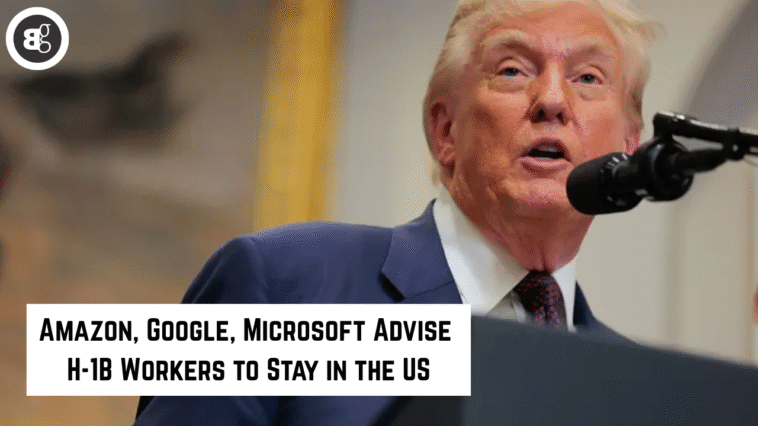
Big tech firms are reacting fast to new changes in U.S. visa rules. President Donald Trump signed a new order that adds a $100,000 fee for employers who file H-1B visa applications. The rule starts at 12:01 a.m. Sunday.
Right after the news, Amazon, Google, and Microsoft sent emails to staff. They told workers on H-1B visas to stay in the United States. Anyone already overseas was told to come back before the order takes effect.

What Companies Are Saying
Business Insider shared memos from Amazon and Microsoft. Google also sent a similar note to its employees. Microsoft did not comment, but reports say all three companies are worried about travel problems for their workers.
Read More: Microsoft Teams Levels Up with Advanced AI Agents
Why H-1B Visas Matter
H-1B visas let U.S. companies hire skilled workers from other countries. Most of these jobs are in tech, like software, data, and AI.
Government data shows Amazon gets the most H-1B visas this year, followed by Tata Consultancy Services, Microsoft, Meta, and Apple. Google is in sixth place. That is why this change matters so much in Silicon Valley.
The White House Response
The White House says the rule is only for new visa applications. It does not affect people who already have an H-1B or those who are renewing.
Press Secretary Karoline Leavitt posted on X:
“H-1B visa holders can leave and re-enter the country to the same extent as they normally would.”
Even so, companies are worried. They don’t want workers stuck outside the U.S. if there is confusion about the new policy.
Bigger Picture
Critics say the high fee could hurt startups and small firms. Only big tech companies may be able to afford the cost. Experts also warn that global talent may start moving to other countries like Canada or the UK, where rules are friendlier.
Read More: Microsoft Invests $30B in UK to Boost AI Growth
FAQs
1. What changed with the new H-1B rule?
Employers now must pay $100,000 for each new H-1B application.
2. Does this affect current H-1B holders?
No. It only affects new applications, not renewals.
3. Why are tech firms telling workers not to travel?
They fear re-entry problems when the rule starts.
4. Which companies use H-1B visas the most?
Amazon, TCS, Microsoft, Meta, Apple, and Google.
5. What could happen in the long run?
Smaller firms may struggle to hire talent, and workers may move to other countries with easier visa systems.