
 Hajra Naz
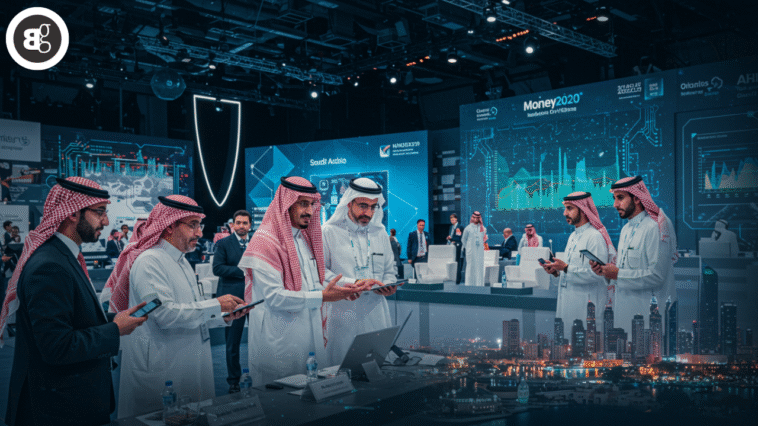
RIYADH:The Saudi edition of Money20/20 Middle East this week highlighted just how quickly artificial intelligence (AI) is moving from hype to reality in the Kingdom’s financial sector.
With more than 450 fintech firms and over 1,050 global investors gathering under the theme “Where Money Does Business,” the event underscored how central AI has become to Saudi Arabia’s Vision 2030 goals. It also revealed how urgent conversations around regulation, infrastructure, and talent have become as the Kingdom ramps up adoption.

From Hype to Hard Deployment
The message across panels was clear: AI is no longer an experiment. It is now embedded in nearly every layer of finance—fraud detection, customer onboarding, compliance, credit scoring, and risk modeling.
While AI promises faster growth and stronger financial performance, it also invites greater scrutiny. For Saudi Arabia, the challenge now is to scale adoption while maintaining trust, ensuring regulatory alignment, and safeguarding data integrity.
Read More: Saudi Arabia Presents AI Strategy at Arab Forum 2025
AI’s Economic Promise for Saudi Arabia
According to PwC, the Kingdom is projected to reap nearly $135.2 billion from AI by 2030, equivalent to about 12.4% of GDP. This potential is fueling urgency, with nearly all financial-sector leaders reporting increased pressure to deploy AI in just the past six months.
Regulators are responding. The Saudi Central Bank (SAMA) has expanded its sandbox programs and introduced clearer guidelines, aiming to balance innovation with strong consumer protections and data governance frameworks.
Collaboration is Key
Khalid Al-Sharif, CEO of Abdul Latif Jameel Finance, stressed that the next stage of AI adoption in finance depends on coordination.
“Regulators must issue workable standards, financial institutions must document and monitor models, and technology providers must build for local requirements rather than import generic systems,” he said.
Al-Sharif also pointed to the importance of empowering small and microbusinesses through programs like Abdul Latif Jameel Finance’s Bab Rizq Jameel Microfinance. Since 2004, the program has issued loans to nearly 300,000 beneficiaries, 81% of them women. “Empowering entrepreneurs and women-led enterprises is essential to Vision 2030,” he added.
Dyna.Ai’s Expansion in Saudi Arabia
Among the big announcements at Money20/20 was Singapore-based Dyna.Ai’s decision to expand into the Kingdom with the launch of its Agentic AI Suite and Arabic-first AI employees.
These digital teammates—including an AI credit underwriter, knowledge partner, and recruiter adviser—are designed to boost compliance, streamline operations, and enhance customer service.
“AI Employees are advanced digital teammates that augment human workers,” said Tomas Skoumal, Dyna.Ai’s chairman and co-founder. “They deliver faster, more accurate, and personalized experiences while collaborating directly with human staff.”
Built with Arabic capabilities from day one, the suite was developed to understand local dialects, cultural nuances, and regulatory requirements unique to Saudi Arabia.
Read More: InnoVista Announces National Agentic AI Hackathon 2025 With Rs. 3 Million Prize Pool
Opportunities and Challenges Ahead
While announcements like Dyna.Ai’s reflect confidence in the Saudi market, challenges remain:
-
Talent shortages: There are not enough AI specialists and data scientists to meet demand, though universities are rapidly scaling training programs.
-
Infrastructure gaps: High-performance computing, sovereign data centers, and faster data processing are needed to support AI growth.
-
Regulatory certainty: Sandboxes and ethical frameworks exist, but binding rules around algorithmic transparency, bias mitigation, and privacy are still in development.
Without enforceable guidelines, industry experts warn that trust in AI systems could be undermined before they reach full adoption.
More Than a Showcase
Money20/20 is more than just a conference. It’s one of the few platforms where regulators, legacy banks, fintech startups, and investors align on priorities.
This year, major announcements included Google Pay’s launch in Saudi Arabia, Alipay+ acceptance by 2026, and significant capital market reforms—all signaling the speed of Saudi Arabia’s financial modernization.
For startups like Dyna.Ai, the event is a stress test—an opportunity to prove that their products can deliver on Saudi-specific expectations for speed, compliance, cultural alignment, and scale.
Execution Phase
Saudi Arabia’s AI story is now moving into what many experts call the execution phase. The ambitions are clear:
-
Billions of dollars in AI-driven GDP impact
-
A digitally transformed financial ecosystem
-
A workforce of 20,000 AI specialists by 2030
What remains is turning these ambitions into measurable outcomes. For Saudi Arabia, success will depend on building trust, closing infrastructure gaps, nurturing talent, and ensuring AI works for both the economy and the people.
FAQs
1. Why is AI important to Saudi Arabia’s Vision 2030?
AI is projected to contribute $135.2 billion to the economy by 2030, helping diversify income beyond oil and modernize key sectors like finance.
2. What role does the Saudi Central Bank play in AI adoption?
The Saudi Central Bank (SAMA) runs sandbox programs, sets guidelines, and ensures AI innovations align with consumer protection and data governance.
3. What are the biggest challenges for AI adoption in the Kingdom?
Key challenges include a shortage of AI talent, infrastructure limitations, and the need for stronger regulations on bias, transparency, and data privacy.
4. How are startups like Dyna.Ai supporting Saudi Arabia’s AI growth?
Dyna.Ai is introducing Arabic-first AI employees that integrate into financial workflows, boosting compliance, efficiency, and customer engagement.
5. What’s next for Saudi Arabia’s AI journey?
The focus is now on execution: scaling AI responsibly, training 20,000 specialists, and ensuring AI models serve both economic and social goals.