
 Hassan Khan
In a world that’s more digitally connected and digitally vulnerable than ever before, one thing is clear: being technologically self-sufficient is no longer optional. It’s survival. We’re diving into something many have been curious about: Who’s actually leading the charge toward tech independence?
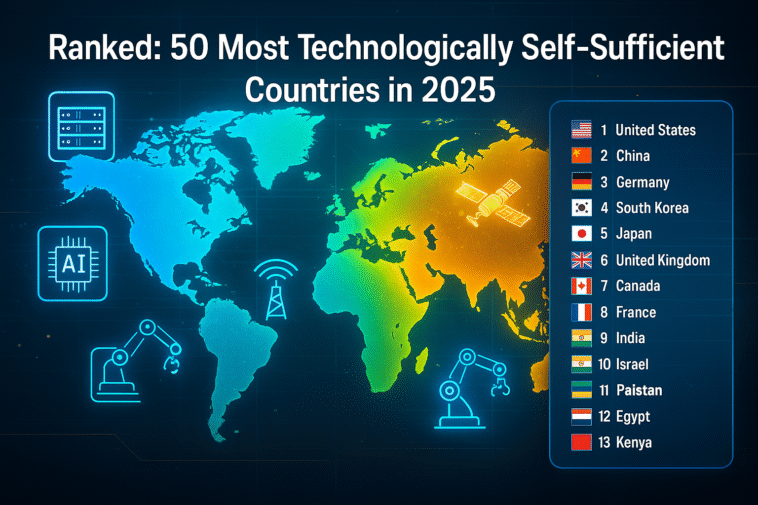
We’ve put together a full list Ranked: 50 Most Technologically Self-Sufficient Countries in 2025 we’ll break down how these countries are securing their future through smart policies, homegrown innovation, and strong local ecosystems.

What Does “Tech Self-Sufficiency” Really Mean?
Being technologically self-sufficient doesn’t mean cutting ties with the rest of the world. It’s not about isolation.
It means being capable of building, owning, and controlling your essential technologies so you’re not completely dependent on imports, foreign companies, or global politics.
Think of it like this:
Growing your own vegetables doesn’t mean you’ll never visit a grocery store. It just means that when the store runs out, you won’t go hungry.
In tech terms, that includes:
-
Designing and producing your own semiconductors
-
Owning your cloud infrastructure and cybersecurity
-
Running services like e-governance, digital payments, and data centers independently
Look at China after facing tech sanctions, they doubled down on chip manufacturing.
India is pushing local startups through Digital India.
And Estonia? They’ve practically turned their government into an app.
It’s not about cutting off the world it’s about being prepared.
Why Tech Independence Matters More Than Ever in 2025
2025 isn’t the easiest year to be globally dependent on tech.
From ongoing conflicts to trade restrictions and unstable supply chains, it’s been one wake-up call after another.
Remember the chip shortage? Or the cyberattacks during the Russia, Ukraine conflict?
When countries rely too much on others for vital tech, a single disruption can bring everything to a halt from defense systems to hospitals.
That’s why nations are now prioritizing:
-
Local chip production
-
Data privacy laws
-
AI research centers
-
Homegrown digital infrastructure
Tech independence isn’t just about innovation anymore.
It’s about national security. It’s about control. And most importantly, it’s about resilience.
Ranked: 50 Most Technologically Self-Sufficient Countries in 2025
Here’s the list you’ve been waiting for. We ranked countries based on:
-
Local tech investment
-
Semiconductor & hardware manufacturing
-
AI & software development
-
Cybersecurity frameworks
-
Education & talent pipelines
Top 10 Technologically Self-Sufficient Countries
-
United States: Still the leader in cutting-edge innovation, from chips to AI
-
China: A powerhouse in homegrown hardware, AI, and cloud services
-
Germany: Known for engineering, now leading in Industry 4.0
-
South Korea: Dominating chip manufacturing and 5G rollout
-
Japan: Robotics, consumer tech, and resilient infrastructure
-
India: Booming startup culture and software development
-
United Kingdom: Leading in AI, fintech, and cyber legislation
-
Canada: Research-heavy, ethical AI leadership, strong universities
-
France: Investing deeply in digital education and regulation
-
Israel: Small in size, huge in cybersecurity and defense tech
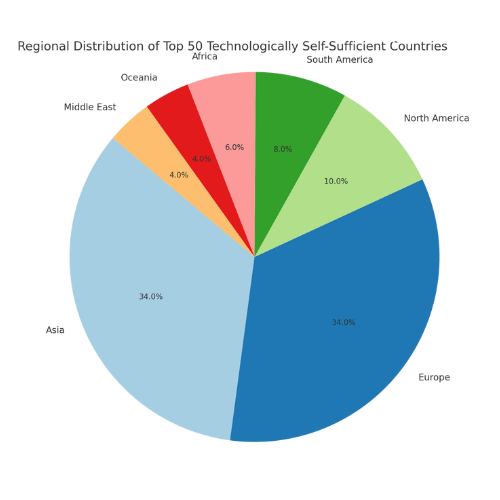
Need the top 50 list? See table below:
| # | Country | Region | Key Sectors (Examples) | GDP (USD Trillions) | Tech Self-Sufficiency Score |
|---|---|---|---|---|---|
| 1 | United States | North America | AI, Semiconductors, Cloud | 26.7 | 98 |
| 2 | China | Asia | Telecom, AI, Robotics | 17.7 | 95 |
| 3 | Japan | Asia | Robotics, Electronics | 4.2 | 92 |
| 4 | Germany | Europe | Industrial Tech, AI | 4.3 | 90 |
| 5 | South Korea | Asia | Semiconductors, 5G | 1.8 | 89 |
| 6 | United Kingdom | Europe | AI, Fintech | 3.1 | 87 |
| 7 | France | Europe | AI, Aerospace | 3.0 | 86 |
| 8 | Canada | North America | AI, Clean Tech | 2.1 | 85 |
| 9 | India | Asia | IT Services, AI | 3.7 | 84 |
| 10 | Israel | Middle East | Cybersecurity, AI | 0.5 | 83 |
| 11 | Sweden | Europe | Telecom, Green Tech | 0.7 | 82 |
| 12 | Singapore | Asia | Fintech, IoT | 0.5 | 81 |
| 13 | Finland | Europe | Telecom, Clean Tech | 0.3 | 80 |
| 14 | Netherlands | Europe | AI, Semiconductor Tools | 1.0 | 79 |
| 15 | Switzerland | Europe | Health Tech, R&D | 0.9 | 78 |
| 16 | Australia | Oceania | Clean Tech, Robotics | 1.7 | 77 |
| 17 | Norway | Europe | Green Energy, IoT | 0.6 | 76 |
| 18 | Italy | Europe | Automotive, IoT | 2.1 | 75 |
| 19 | Taiwan | Asia | Chips, Semiconductors | 0.8 | 94 |
| 20 | Austria | Europe | Engineering, AI | 0.6 | 73 |
| 21 | Spain | Europe | Green Tech, Data | 1.6 | 72 |
| 22 | Denmark | Europe | Clean Tech, AI | 0.4 | 71 |
| 23 | Belgium | Europe | Healthcare Tech | 0.7 | 70 |
| 24 | Ireland | Europe | Fintech, Data Centers | 0.5 | 70 |
| 25 | United Arab Emirates | Middle East | AI, Fintech | 0.5 | 69 |
| 26 | Brazil | South America | Agritech, Fintech | 2.1 | 68 |
| 27 | Russia | Europe/Asia | Cybersecurity, Space Tech | 1.9 | 67 |
| 28 | Malaysia | Asia | Electronics, AI | 0.4 | 66 |
| 29 | Thailand | Asia | Automation, Electronics | 0.5 | 65 |
| 30 | Poland | Europe | IT Services, AI | 0.9 | 64 |
| 31 | Portugal | Europe | Green Tech, AI | 0.3 | 63 |
| 32 | Saudi Arabia | Middle East | Smart Cities, Robotics | 1.1 | 62 |
| 33 | South Africa | Africa | Fintech, Energy Tech | 0.4 | 61 |
| 34 | Vietnam | Asia | Electronics, Manufacturing | 0.4 | 60 |
| 35 | Pakistan | Asia | Freelance Tech, AI | 0.3 | 59 |
| 36 | Philippines | Asia | Outsourcing, IT | 0.4 | 58 |
| 37 | Indonesia | Asia | Fintech, E-commerce | 1.3 | 57 |
| 38 | Turkey | Europe/Asia | Defense Tech, IoT | 1.1 | 56 |
| 39 | Mexico | North America | Manufacturing, AI | 1.5 | 55 |
| 40 | Argentina | South America | BioTech, Software | 0.6 | 54 |
| 41 | Colombia | South America | Fintech, Startups | 0.3 | 53 |
| 42 | Chile | South America | Renewables, Data | 0.3 | 52 |
| 43 | Ukraine | Europe | IT Services, AI | 0.2 | 51 |
| 44 | Bangladesh | Asia | Freelance Tech, IT | 0.4 | 50 |
| 45 | Egypt | Africa | Fintech, Data Centers | 0.5 | 49 |
| 46 | Greece | Europe | Tourism Tech, AI | 0.3 | 48 |
| 47 | New Zealand | Oceania | Clean Tech, Health Tech | 0.3 | 47 |
| 48 | Czech Republic | Europe | Engineering, AI | 0.3 | 46 |
| 49 | Hungary | Europe | Automotive, IoT | 0.2 | 45 |
| 50 | Nigeria | Africa | Fintech, Agritech | 0.5 | 44 |
How Are These Countries Actually Doing It?
Becoming self-sufficient isn’t magic. It’s smart strategy and long term thinking. Here’s how the top players are doing it:
Investing in Education
Countries like Finland and South Korea embed STEM early in school curriculums. This leads to a generation ready for high tech innovation.
Supporting Local Startups
India’s Startup India initiative has helped launch thousands of homegrown tech companies some now competing on the global stage.
Public + Private Collaboration
In the U.S., the government works directly with tech giants like Apple, Google, and NVIDIA to develop everything from AI to quantum computing.
Digital Sovereignty Laws
The EU is shaping global policy with laws that force companies to store data locally and respect digital rights.
Even smaller countries are stepping up with AI strategies, innovation hubs, and training bootcamps.
It’s not just about who has the most money. It’s about who has the clearest vision.
Can Small Nations Engage?
Yes and they already are.
You don’t need a huge population to become a tech leader.
Just look at:
-
Estonia: Runs nearly all government services online and offers global e-residency
-
Singapore: A global hub for fintech, smart cities, and green tech
-
UAE: Investing heavily in AI and robotics under its “Vision 2030”
They prove that digital leadership is about smart policies, not just big budgets.
So even if your country isn’t in the top 10 there’s plenty of hope. And opportunity.
Conclusion: It’s Time to Build Our Own Future
In 2025, being dependent on others for your tech is risky.
The countries topping this list didn’t get there overnight. They made intentional decisions to invest in their people, their infrastructure, and their innovation pipelines. So whether you’re a startup founder, tech student, or just someone curious about where the world is headed remember this:
The future belongs to those who build it themselves.
Your country’s next big breakthrough might come from you.
So don’t wait. Start learning. Start building. Start supporting local. Because tech independence starts at home with awareness, effort, and a vision for something better.
So Share this blog with a friend who’s passionate about tech 🙂
FAQs: Technologically Self-Sufficient Countries
1. What is meant by technological self-sufficiency?
It means a country can build and manage its own digital infrastructure from chips to AI without relying too much on foreign tech.
2. Why is being technologically self-sufficient important?
Because when crises hit like war, pandemics, or sanctions countries that depend too much on others suffer the most. Independence builds stability and growth.
3. Is my country on the list of 50 Most Technologically Self-Sufficient Countries?
Scroll up to check! And even if it’s not many countries are rising fast thanks to smart investments and policy shifts.