Hajra Naz
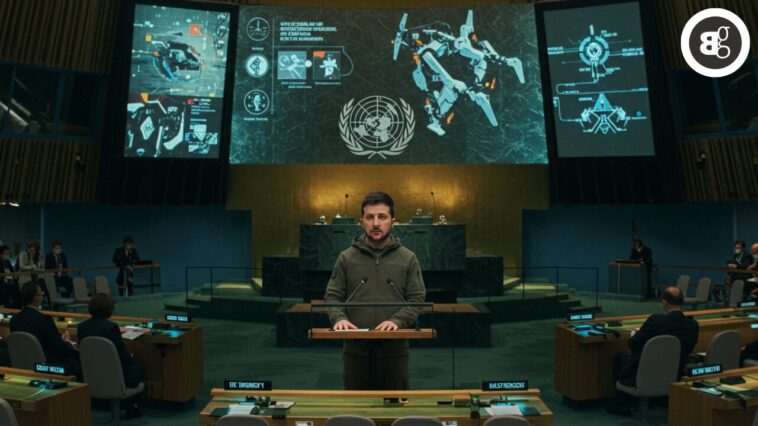
On September 24, at the UN General Assembly, Ukrainian President Volodymyr Zelenskyy made one of the strongest appeals yet for the world to create global rules on military AI.
“Weapons are evolving faster than our ability to defend ourselves,” Zelenskyy warned world leaders.
For him, this isn’t just theory. Ukraine has been fighting Russia for more than three years in a war that has turned into one of the most technologically advanced conflicts in modern history. From autonomous drones to AI-driven targeting systems, digital warfare is no longer science fiction—it’s shaping the battlefield every single day.

His message to the UN was clear: create rules now before AI weapons spiral out of human control.
Read More: United Nations Includes AI as Key Global Challenge in Upcoming Meeting
Why AI Weapons Are a Global Threat
Unlike nuclear or chemical weapons, AI-powered weapons don’t require rare materials, huge factories, or decades of research. Instead:
-
Algorithms spread fast. Code can be copied, shared, and upgraded almost instantly.
-
Drones are cheap. Small groups can build and deploy drones using basic tools.
-
Barriers are low. This means more countries, and even non-state actors, can join the race.
That’s why Zelenskyy warned of a fast-moving AI arms race that could destabilize the world.
“There are now tens of thousands of people who know how to professionally kill using drones. Stopping such an attack is harder than stopping any gun or bomb,” he said.
A Gap in International Law
Global treaties have banned or restricted dangerous weapons before, like landmines or chemical arms. But when it comes to lethal autonomous weapons systems (LAWS), the rules don’t exist.
-
UN efforts have stalled. Big military powers resist binding treaties.
-
Current laws are outdated. Most are based on post-WWII agreements.
-
Voluntary rules exist. The U.S. has AI ethics principles, and the EU has guidelines for “trustworthy AI,” but there’s no enforcement.
Right now, nothing stops countries from developing and using AI-powered kill systems.
Read More: 7 Terrifying AI Risks That Could Change the World
From Science Fiction to Battlefield Reality
For decades, autonomous weapons were something out of Terminator or Black Mirror. Not anymore.
-
Modified quadcopters now drop grenades.
-
Long-range kamikaze drones can fly hundreds of miles.
-
Russia’s Lancet drones reportedly use semi-autonomous targeting.
-
Ukraine uses AI to scan satellite imagery and battlefield data in seconds.
-
Both sides deploy drone swarms for surveillance and strikes.
What once looked like science fiction is now a daily reality.
The New Arms Race
Zelenskyy warned that military AI could spark a faster, deadlier arms race than nuclear weapons.
-
If one nation proves that AI weapons win wars, others will copy it.
-
The speed of AI development makes regulation harder than ever.
-
Without rules, autonomous kill systems could spread across the globe.
“We are now living through the most destructive arms race in human history—because this time, it includes artificial intelligence,” Zelenskyy said.
He ended with a chilling question: If we can’t even stop old threats, how will we survive new ones?
Read More: Google’s AI Policy Change: No More Ban on Weapon Use?
FAQs
1. Why is AI in warfare more dangerous than traditional weapons?
Because AI can operate at machine speed, replicate easily, and act without human oversight, it makes conflicts harder to control.
2. What is a lethal autonomous weapon system (LAWS)?
It’s a weapon that can identify, select, and attack targets without direct human input.
3. Has the UN taken action against AI weapons?
Talks have happened, but major powers have blocked binding treaties. So far, only voluntary guidelines exist.
4. How are AI drones being used in Ukraine’s war?
Both Ukraine and Russia use AI-assisted drones for surveillance, strikes, and targeting, with increasing autonomy.
5. Could AI weapons trigger a new arms race?
Yes. Many experts warn that once one country gains an advantage, others will rush to match it, creating a rapid AI arms race.