Hajra Naz
Artificial intelligence is transforming how software is built—from bug fixes and documentation to entire codebases written by machines. With advanced models like GPT-4o and Claude Sonnet evolving rapidly, developers everywhere are asking:
Is programming still a viable career path—or is AI coding them out of a job?

The Fear: Are Programmers Becoming Obsolete?
The fear isn’t unfounded. Today’s AI tools are not only fast—they’re shockingly effective.
-
Anthropic CEO Dario Amodei has suggested that AI may soon write 90% of all code.
-
Amazon CEO Andy Jassy has admitted that AI will reduce Amazon’s need for software engineers.
-
A survey revealed that 30% of coders fear being replaced by AI.
For newcomers, this feels like a seismic shift. Entry-level coding jobs—once the gateway to lucrative careers—may be the first casualties of automation.
What Can AI Do in Programming Today?
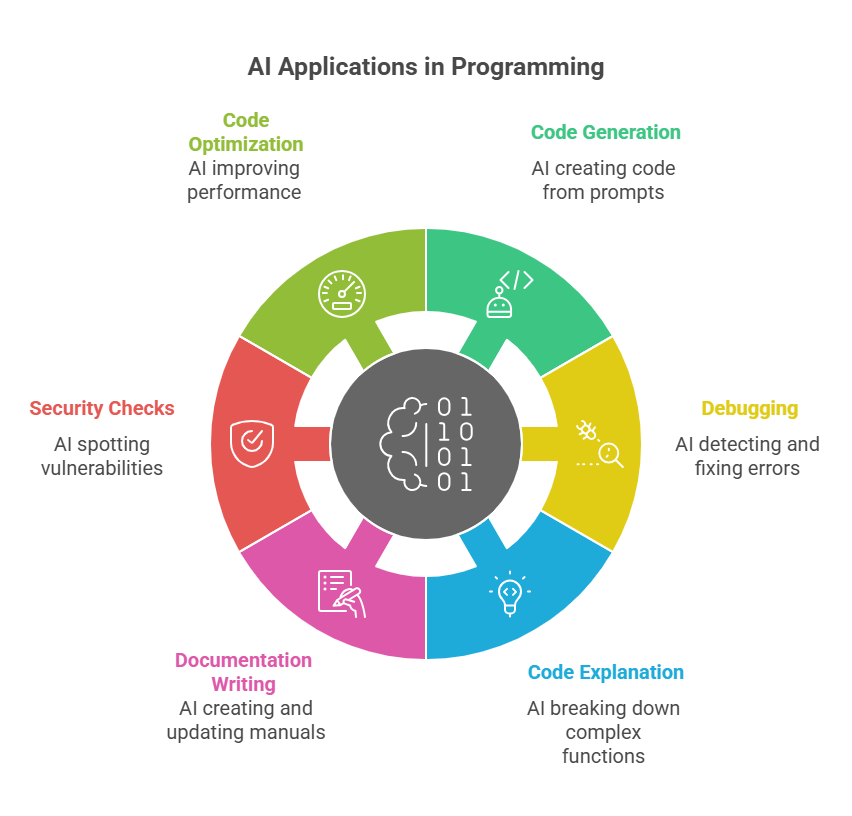
Generative AI is already embedded in many stages of the coding workflow. Current uses include:
-
Code generation—auto-creating code from prompts
-
Debugging—detecting and fixing errors
-
Code explanation—breaking down complex functions
-
Documentation writing—creating and updating manuals
-
Security checks—spotting vulnerabilities
-
Code optimization—improving performance
Research backs this up. A study on GitHub Copilot showed that developers complete tasks 55% faster with AI assistance.
But while AI shines at repetitive and logic-driven tasks, it still struggles with context, nuance, ethics, and strategy.
Read More: Future-Proofing Your Career Against AI: 8 Strategies for Programmers
Entry-Level Jobs: Most at Risk
The biggest threat is at the bottom of the career ladder.
According to The Washington Post, jobs titled computer programmer dropped by nearly 30% in two years, while software developer roles declined by only 3%.
The distinction matters: programmer roles tend to be more entry-level, focused on writing boilerplate code—exactly the kind of work AI can handle.
That raises a big question: If junior roles disappear, where will tomorrow’s senior engineers come from?
How AI Is Reshaping Programming Roles
Here’s how the developer landscape is shifting:
| Role | Pre-AI Focus | Post-AI Transformation |
|---|---|---|
| Junior Developer | Writing boilerplate code, basic tests | Prompting AI, reviewing machine-generated code |
| Mid-Level Dev | Refactoring, feature implementation | Strategic automation, managing AI workflows |
| Senior Engineer | Architecture, mentorship, planning | AI integration, oversight, system strategy |
| QA Engineer | Manual and automated testing | AI-powered test frameworks and anomaly checks |
| Tech Writer | Manual documentation creation | Auto-generated docs reviewed for clarity |
Evolving, Not Erasing
AI isn’t erasing programming—it’s transforming it.
Programmers are still needed to:
-
Understand AI-generated code
-
Debug flawed logic or unsafe suggestions
-
Ensure compliance and ethical standards
-
Design resilient, large-scale systems
This is where the concept of the “human-in-the-loop” comes in. AI can accelerate coding, but it still requires human oversight for quality, safety, and creativity.
New Careers in the AI-Powered Development Era
Instead of eliminating jobs, AI is spawning entirely new roles:
-
Prompt Engineers—specialists in crafting effective queries for AI tools
-
AI Project Managers—leaders of hybrid human-AI teams
-
Model Trainers—experts who fine-tune AI models with domain data
-
Legacy-AI Integrators—engineers connecting traditional systems to AI workflows
We’re also seeing new methodologies emerge, such as “vibe coding”—low-stress software development through AI prompts. Critics call it lazy. Fans call it the future.
As Tesla’s AI Director Andrej Karpathy predicts:
“The programmers of tomorrow won’t maintain massive codebases—they’ll manage and manipulate data for neural networks.”
Key Skills to Stay Relevant
So what does it take to survive and thrive in this new era? Developers will need to master skills that AI can’t easily replicate:
| Future-Proof Skill | Why It Matters |
|---|---|
| Systems thinking | Designing scalable, resilient architectures |
| Prompt engineering | Getting the best results from AI tools |
| AI model knowledge | Knowing model strengths, limits, and risks |
| Ethics & compliance | Ensuring safe and fair development |
| Creative problem-solving | Tackling challenges AI can’t address |
| Communication | Bridging business and technical perspectives |
Myth or Reality: Will AI Replace Programmers?
So, will AI replace programmers? The answer is more nuanced.
- In the short term, programming jobs won’t disappear. But entry-level roles will shrink as AI handles routine tasks.
- In the long term, the job will look very different. Programmers will act as supervisors, architects, and strategists—not line-by-line coders.
The real question isn’t “Will AI replace programmers?” It’s “How will programmers adapt?”
Final Takeaway: Adaptation is survival.
Learning to code is still valuable. But expectations are shifting.
The future belongs to developers who embrace AI as a partner, not a threat.
- They’ll guide, review, and supervise AI outputs.
- They’ll focus on creativity, strategy, and ethics—not just syntax.
AI can write code. But it can’t match human insight, innovation, or responsibility.
The best programmers of tomorrow won’t fear AI. They’ll shape it.
Bottom line: AI isn’t replacing programmers. It’s replacing old definitions of programming. The career isn’t ending. It’s evolving.