
 Hajra Naz
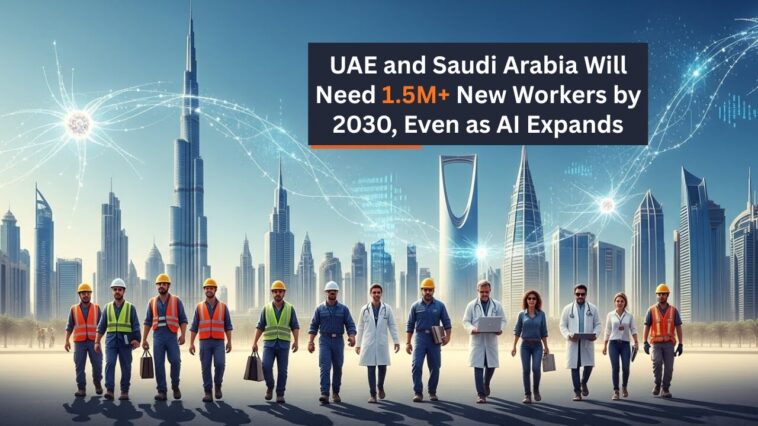
The rapidly expanding economies of the United Arab Emirates and Saudi Arabia will demand over 1.5 million more workers by 2030, despite embedding artificial intelligence across industries, according to a major global workforce study released in 2025. The results contradict the popular belief that AI-based automation will lead to the elimination of jobs.
Rather, the report observes that in the Gulf, economic growth is outstripping the productivity returns from automation, perpetuating — and in some cases heightening—demand for human workers.

AI Is Changing Jobs, Not Eliminating Them
Though artificial intelligence is changing how businesses and governments work, the study says it’s altering—but not eliminating—jobs. The primary impact of automation is on routine, repeatable, and administrative activities, which in turn allows human resources to focus their time on supervision, technical skills, decision-making abilities, interacting with customers, etc.
Because of that, much of the Gulf economy is seeing AI emerge more as a productivity booster than a labor killer. In industries that are being digitally transformed, we see new positions created alongside the legacy ones, leading to net job creation, not reduction.
Read More: UAE President Meets Elon Musk to Discuss AI and Advanced Technology
Saudi Arabia: Vision 2030 Fuels Workforce Expansion
In Saudi Arabia, demand for labour is coming from the ambitious Vision 2030 reform program to restructure the country’s economy. Massive investments are underway across:
-
Construction and infrastructure
-
Tourism and entertainment
-
Manufacturing and industrial zones
-
Logistics and transport
-
Renewable energy and technology hubs
The study estimates that without productivity gains from AI, Saudi Arabia would need approximately 650,000 additional workers to meet its expansion goals. Even after factoring in automation and efficiency improvements, a substantial labour gap is still projected to remain by the end of the decade.
This highlights a critical reality: while AI can increase output per worker, it cannot fully compensate for the sheer scale of Saudi Arabia’s economic transformation.
UAE Workforce Growth Among the Fastest Globally
The UAE is projected to experience even faster labour market growth. According to the report, the country’s workforce could expand by 12.1 per cent by 2030, placing it among the fastest-growing labour markets covered in the study.
Saudi Arabia’s workforce is forecast to grow by 11.6 per cent over the same period. By contrast, workforce growth in developed economies remains far slower, with projections of:
-
United States: 2.1 per cent
-
United Kingdom: 2.8 per cent
This contrast underscores how demographic trends, infrastructure investment, and economic diversification are positioning the Gulf as a global outlier in labour demand growth.
Digital Transformation Is Creating Jobs in the UAE
The study notes that the UAE’s aggressive push into technology, AI, and digital government services is generating employment rather than eroding it.
As public institutions and private companies modernize operations, hiring is rising across a broad range of sectors, including
-
Manufacturing and advanced production
-
Education and training services
-
Retail and e-commerce
-
Healthcare and life sciences
-
Financial services and fintech
-
Software development and IT services
AI tools are being deployed to handle repetitive processes, but human workers remain central to system oversight, implementation, compliance, innovation, and customer-facing functions.
Key Sectors Driving Hiring Across the Gulf
According to the report, strong hiring demand is expected to persist across both countries in sectors such as
-
Construction and real estate development
-
Transport, logistics, and supply chains
-
Healthcare and elder care
-
Hospitality and tourism
-
Retail and consumer services
-
Education and vocational training
-
Energy, including renewables
-
Financial services and banking
-
Information technology and cybersecurity
Many of these sectors require a mix of manual skills, technical expertise, and interpersonal capabilities that AI systems cannot fully replicate.
Implications for Migrant Workers, Including Pakistanis
The findings carry particular significance for Pakistani workers, millions of whom are currently employed in Saudi Arabia and the UAE. These workers are heavily represented in construction, transport, retail, healthcare, technical trades, and service-sector roles.
The study suggests that overseas employment opportunities in the Gulf are likely to remain strong, especially for workers who possess:
-
Trade and vocational skills
-
Technical and engineering training
-
Digital literacy and basic AI familiarity
-
Experience in service and customer-facing roles
As Gulf economies evolve, workers who invest in reskilling and upskilling will be better positioned to access higher-value roles and more stable employment.
AI Will Boost Productivity — But Humans Will Remain Essential
The report ends by stating that AI will bring substantial productivity gains but will be unable to solve the shortfall in manpower due to fast-paced economic growth and massive development across the Gulf region. Rather, the next phase of growth will come down to how well governments, employers, and workers adapt.
The nations that invest in education, technical training and digital skills — and the workers who take advantage of these opportunities to put their money on the future through reskilling — will be the main winners as A.I. changes how work is done, not by replacing human labor at scale but by complementing and augmenting it.
In the Gulf, at least for the rest of this decade, economic ambition—not automation—will remain the dominant driver of job creation.


