Hajra Naz
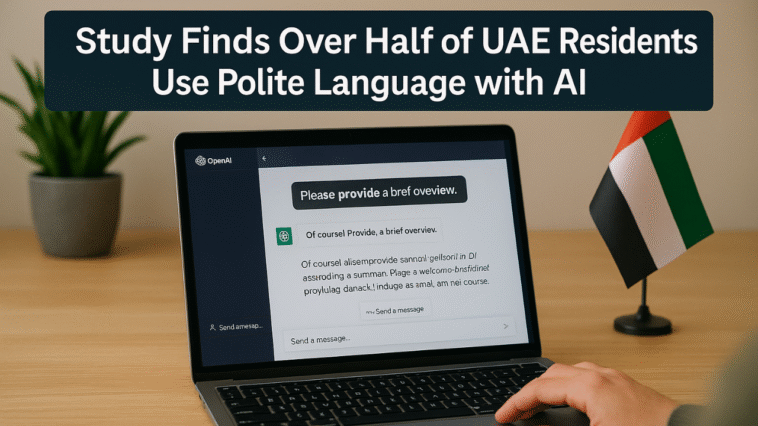
When it comes to manners in the digital age, the United Arab Emirates stands out as the most courteous nation on the planet—at least toward artificial intelligence.
A global YouGov survey found that 55.5% of UAE residents say “please” or “thank you” to AI. They do this when talking to virtual assistants. They do it when asking chatbots questions. They even do it when using AI customer service. This is the highest rate among 17 countries in the survey. More than 12,000 AI users took part.

Politeness Leaders and Laggards
Only two other countries crossed the 50% threshold: Mexico at 54.1% and India at 50.2%. Meanwhile, at the other end of the spectrum, Denmark (31.1%), the United States (32.3%), and Sweden (33.2%) recorded the lowest politeness rates toward AI.
Politeness Gap Between Men and Women
In the UAE, women are more likely to be polite to AI. About 58.9% of women use polite words when speaking to AI. For men, the number is 54.1%. This shows that manners still matter, even with machines. Cultural expectations may also play a role.
The Global Politeness Rankings
Percentage of people who “always” or “often” say ‘please’ or ‘thank you’ to AI:
-
UAE: 55.5%
-
Mexico: 54.1%
-
India: 50.2%
-
Indonesia: 47.9%
-
Italy: 47.4%
-
Australia: 45.8%
-
UK: 45.4%
-
Spain: 43.0%
-
Canada: 41.8%
-
France: 41.6%
-
Poland: 41.1%
-
Hong Kong: 40.4%
-
Singapore: 36.3%
-
Germany: 34.4%
-
Sweden: 33.2%
-
US: 32.3%
-
Denmark: 31.1%
Read More: OpenAI and UAE Plan Massive Data Center Bigger Than Monaco
Sam Altman’s Lighthearted Observation
Even AI leaders have noticed this phenomenon. In April 2025, OpenAI CEO Sam Altman jokingly remarked that he sometimes wonders how much money the company has spent on electricity powering polite exchanges—like people typing “please” and “thank you” to ChatGPT.
AI Adoption in the UAE is Almost Universal
According to Omar bin Sultan Al Olama, UAE Minister of State for Artificial Intelligence, Digital Economy, and Remote Work Applications, AI usage in the UAE is far higher than many people realize.
Speaking at the Capital Market Summit in Dubai in May 2025, Al Olama said:
“I heard that only 33% of people use AI daily. I found that quite amusing, because I believe AI usage is closer to 100% in the UAE or in other advanced countries. Today, what answers your questions is mostly Google; this is an AI-powered search engine. We consume content on platforms like YouTube, Facebook, and others. AI is embedded in everything we do.”
His warning was clear:
“Those who are left behind are going to be at a loss, rather than those who adopt it.”
Why Politeness Toward AI Matters
While AI systems do not have feelings, politeness in AI interactions could have indirect benefits:
-
Habitual Courtesy: Saying “please” and “thank you” reinforces real-world manners.
-
Better Human-AI Collaboration: Using respectful language might help encourage more mindful, intentional communication.
-
Setting Standards for AI Responses: Developers could use patterns in polite requests to fine-tune how AI models respond in customer service and education.
As AI becomes more embedded in daily life — from voice assistants in homes to chatbots in workplaces — the etiquette of human-AI communication is becoming an intriguing cultural marker. The UAE’s top ranking suggests that in some societies, good manners extend beyond human-to-human interaction — even to machines that don’t technically care.