Hajra Naz
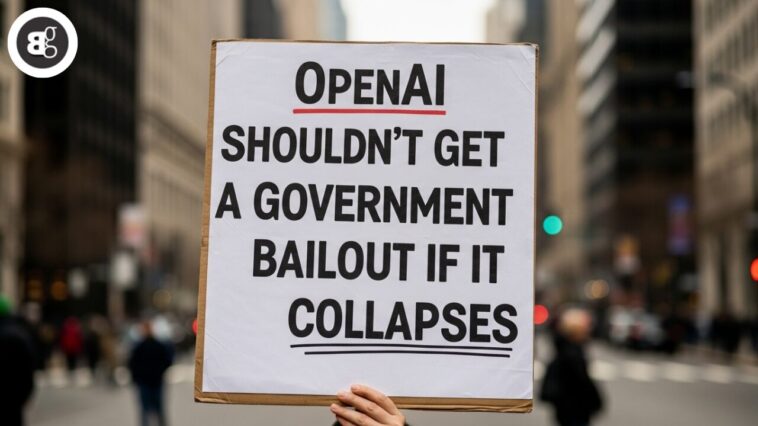
OpenAI is spending big to build the future of AI. In 2025, the company has committed nearly $1.4 trillion to build and operate massive AI data centers worldwide.
CEO Sam Altman confirmed this figure in a post on X (formerly Twitter). He said OpenAI expects to hit a $20 billion annual revenue run rate by the end of this year. By 2030, Altman predicts that revenue could climb into the hundreds of billions. But questions remain about how OpenAI will pay for such an enormous expansion.

OpenAI CFO Walks Back “Government Backstop” Comment
The controversy began when OpenAI CFO Sarah Friar spoke at a Wall Street Journal event. She mentioned that she wanted the U.S. government to “backstop” OpenAI’s infrastructure loans. That means if OpenAI defaulted, taxpayers would cover the losses — a move that would make financing cheaper.
She explained that OpenAI sometimes uses older chips because they’re cheaper to finance. However, the company’s long-term goal is to use the latest and most powerful AI chips for its models.
Friar said OpenAI was looking to build an “ecosystem” involving banks, private equity firms, and possibly the government to fund its massive AI projects.
When asked what kind of help she wanted from Washington, she said:
“A guarantee that allows the financing to happen. That can really drop the cost and increase the amount of debt available.”
She even suggested that the U.S. government views AI as a national strategic asset.
Read More: Sam Altman Reveals OpenAI Hits $20B ARR and $1.4 Trillion in Data Center Deals
Public Backlash and Clarification
After the comments went viral, many tech leaders and users on X criticized the idea of a taxpayer-backed AI bailout. Soon after, Friar issued a clarification on LinkedIn:
“OpenAI is not seeking a government backstop for our infrastructure commitments. I used the word ‘backstop’ and it muddied the point.”
She emphasized that OpenAI intends to fund its growth independently, without government guarantees.
Altman and U.S. Officials Respond
Former Trump administration AI czar David Sacks responded on X. He said,
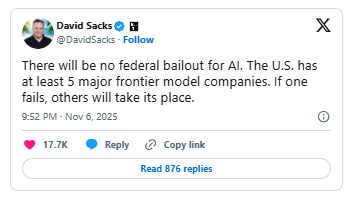
Sacks added that the government is focused on streamlining permits and boosting power generation, not funding private AI firms.
Altman echoed those views in his own post. He wrote:
“We do not have or want government guarantees for OpenAI data centers. Governments should not pick winners or losers. Taxpayers should not bail out companies that fail.”
Altman confirmed that OpenAI has discussed loan guarantees — but not for itself. Instead, they were part of broader conversations about semiconductor manufacturing in the U.S. He said OpenAI and other firms have responded to government initiatives to support chip fabrication plants, though OpenAI hasn’t applied for any formal program.
Read More: Sam Altman says it would be a failure if OpenAI isn’t run by an AI CEO first
OpenAI’s Next Moves and Revenue Vision
Despite the controversy, Altman remains confident. He said OpenAI is exploring new business areas, including
-
Enterprise AI tools for companies (with over 1 million business users already)
-
Consumer AI devices, including a rumored palm-sized device developed with Jony Ive’s io
-
AI robotics and scientific discovery platforms
-
A potential move into AI cloud services, selling compute power directly to businesses
Altman believes these ventures will drive the company’s next wave of growth. He also noted that OpenAI may raise more equity or take new loans to fund its global AI infrastructure expansion.
Altman said.
“We feel good about our prospects, OpenAI is building for the long term — without government bailouts.”