Hajra Naz
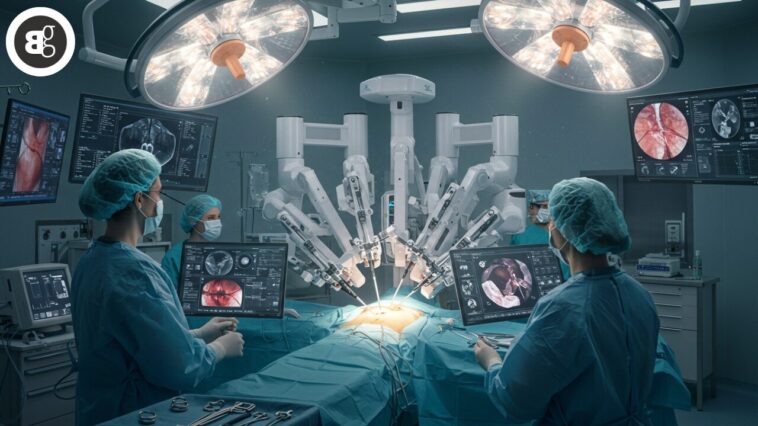
Imagine a world where surgeons are guided by artificial intelligence (AI) to perform life-saving procedures with the precision of world-class experts. Picture advanced robotic telepresence bringing surgery to remote corners of the globe.
This is not a distant dream. The convergence of AI and surgical robotics is already transforming how we think about healthcare. It promises safer, faster, and more accessible surgery for millions of patients.

The Global Rise of AI in Surgery
From the U.S. to Asia, hospitals are racing to adopt AI-driven surgical systems.
-
The da Vinci Surgical System is already used in thousands of hospitals worldwide.
-
Companies like Intuitive Surgical, Medtronic, and CMR Surgical are pushing boundaries with robotic-assisted platforms.
-
By 2030, the global surgical robotics market is expected to exceed $25 billion, driven by AI integration and increasing demand for minimally invasive surgery.
The question is no longer if AI will reshape surgery, but how fast it will happen.
AI Vision: Superhuman Surgical Precision
One of the greatest contributions of AI in the operating room is enhanced vision.
Traditional keyhole surgery is limited by smoke, flat images, and poor visibility. AI now solves these issues:
- Removes smoke instantly for a crystal-clear field
- Enhances 3D depth perception
- Highlights blood vessels and tumor margins
- Distinguishes healthy vs. diseased tissue
Some AI platforms even overlay 3D MRI images onto the patient’s body during surgery, providing real-time navigation for tumor removal. This is like giving surgeons X-ray vision with data-driven guidance.
Read More: How Technology Has Benefited the Healthcare Sector?
AI That Learns From Every Cut
AI doesn’t just perform—it learns.
-
Every robotic movement, video, and outcome creates massive datasets
-
AI identifies mistakes, predicts risks, and offers corrections
-
Systems now recognize surgeon skill levels with over 99% accuracy
With millions of surgeries recorded, AI can reveal hidden patterns: why some patients recover faster, what techniques lower complication risks, and how to reduce operating time. This level of insight is revolutionizing surgical education and quality control.
AI-Powered Training: Virtual Surgeons of the Future
Surgeons of tomorrow may train more in virtual reality (VR) than on real patients.
-
AI simulators now replicate live surgery with real-time feedback
-
Trainees practice on digital twins of patients before actual procedures
-
Mistakes are corrected instantly, and training is repeated until mastery
This shift mirrors Formula One racing, where drivers spend most of their practice time in simulators before entering real tracks. In medicine, this could dramatically improve safety, speed up training, and ensure surgeons enter operating rooms with near-perfect preparation.
Ethics and Patient Trust: The Human Question
With AI guiding surgeries, one question looms large: Will patients trust machines with their lives?
-
Some patients may hesitate to undergo AI-assisted operations.
-
Transparency about AI’s role in surgery will be critical.
-
Ethical debates will intensify around liability: If something goes wrong, who’s responsible—the surgeon or the algorithm?
Healthcare leaders stress that AI should assist, not replace human judgment. The surgeon remains in command, while AI serves as a co-pilot.
Read More: ChatGPT in Healthcare: Revolutionizing Patient Care
Cybersecurity and Data Protection in AI Surgery
Another challenge is cybersecurity.
Surgical robots and AI platforms rely on massive amounts of sensitive patient data. Hackers targeting medical devices could cause catastrophic risks.
Hospitals must invest in:
-
End-to-end encryption for surgical data
-
AI firewalls to protect against cyberattacks
-
Compliance with HIPAA and GDPR for patient privacy
Without strong security, the future of AI surgery could face major setbacks.
AI and the Global Surgery Crisis
The World Health Organization (WHO) warns that 5 billion people lack access to safe surgery.
AI and robotics could bridge this gap:
-
Reduce training time from years to months
-
Enable remote telesurgery with AI-assisted robots
-
Allow skilled technicians to perform tasks under the surgeon’s supervision
This means a surgeon in London could guide a robotic procedure in Africa in real time—something already being tested with 5G-powered telemedicine.
Read More: Are Chatbots Making Us Mentally Lazy and Stupid?
Case Study: Robotic Surgery in Action
-
In India, AI-assisted robotic surgery has reduced hospital stays by 30%, cutting costs for patients.
-
In the U.S., robotic prostate surgery now accounts for over 85% of procedures, with lower complication rates.
-
In China, government investment in digital health and AI surgery is accelerating nationwide adoption.
These real-world examples show that AI surgery is not just theoretical—it’s happening right now.
The Road to Autonomous Surgery
Some experimental procedures have already been performed entirely by AI on cadavers.
While widespread autonomous surgery may take 5–10 years, early successes show enormous potential. Stable procedures like eye and brain surgery are likely to lead the way.
Still, full autonomy faces hurdles:
-
Adapting to human unpredictability (like breathing or bleeding)
-
Regulatory approval and patient trust
-
Integration with existing hospital systems
The Economics of AI Surgery
Healthcare costs are rising globally. AI could help lower them.
-
More surgeries, fewer errors = reduced hospital stays
-
Shorter recovery times = lower long-term costs
-
Remote access = less need for expensive international treatment
The key is building scalable, affordable business models that don’t just serve wealthy hospitals but also reach low- and middle-income countries.
Preparing for an AI-Driven Surgical Future
The fusion of AI and robotics in surgery represents one of the biggest healthcare revolutions in history.
It can:
-
Make high-quality surgery accessible worldwide
-
Reduce the global surgeon shortage
-
Save millions of lives through safer, faster procedures
But success will require balance—human expertise enhanced by AI precision, not replaced by it. The surgeon’s compassion, decision-making, and responsibility remain irreplaceable.
Read More: Blockchain in Healthcare: Latest Market Research Report for Strategic Advantage
The bottom line
The AI surgery revolution is underway. From vision-enhancing robots to AI-driven simulators and global telesurgery, the future of medicine is being written in algorithms as much as in medical journals.
FAQs
1. Will AI replace human surgeons?
No. AI will remain a tool that supports surgeons. Human oversight is essential.
2. Is AI surgery safe today?
Yes. Many hospitals already use AI-assisted systems with excellent safety records. Full autonomy is still years away.
3. How does AI reduce training time for surgeons?
AI simulators provide instant feedback and patient-specific practice, dramatically shortening the learning curve.
4. What are the risks of AI in surgery?
Cybersecurity threats, ethical concerns, and over-reliance on technology are key challenges.
5. Which surgeries are best suited for AI and robotics?
Minimally invasive procedures, brain surgeries, prostate operations, and tumor removals benefit most today.