
 Hajra Naz
San Francisco-based Perplexity AI has introduced a bold new experiment in the relationship between AI platforms and journalism. The company recently announced Comet Plus, a $5-per-month subscription tier that not only promises smarter AI-powered browsing but also shares revenue directly with publishers whose work fuels its answers.
How Perplexity Comet Plus Works
At the heart of this initiative lies a $42.5 million fund reserved for early publishing partners. Perplexity says this fund will expand as more subscribers join Comet Plus. The economics are simple yet ambitious: publishers keep 80% of subscription revenue, while Perplexity retains 20% to cover compute power and operational costs.

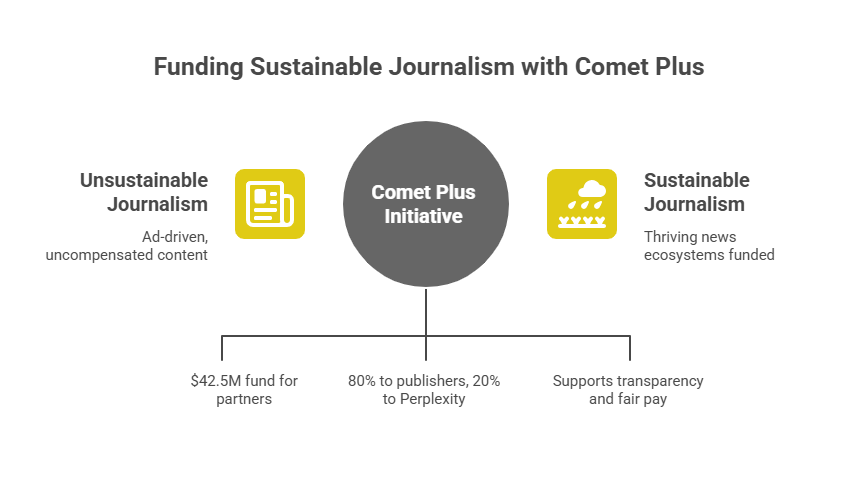
This marks a departure from the ad-driven internet era, where publishers competed for clicks, impressions, and algorithmic visibility. It also addresses growing concerns that AI search engines were exploiting journalism for free, providing answers without compensation or traffic redirection.
Jessica Chan, Perplexity’s Head of Publisher Partnerships, positioned the move as a shift toward sustainable digital media ecosystems. In a Digiday interview, she explained:
“Perplexity only succeeds if journalism succeeds. We’re committed to funding more thriving news ecosystems for the AI age. Anything that supports fair compensation and transparency — we’re open to it.”
Read More: Say Goodbye to Tabs? Perplexity Launches Comet, Its New AI-Powered Browser
Revenue Allocation Model
So, how exactly are payouts calculated? Perplexity divides engagement into three measurable categories:
-
Direct Visits – when a user clicks through to a publisher’s site.
-
Citations in AI Answers – when publisher content is referenced directly in on-screen AI responses.
-
AI Agent Usage – when content supports task-based actions, such as research or e-commerce.
In short: human visits, search citations, and agent actions.
This design acknowledges the blurred lines between reading, searching, and task completion in the modern web. It also signals a recognition that publisher value extends beyond pageviews to how their work shapes AI-driven interactions.
Read More: AI Search Startup Perplexity Offers $34.5B Surprise Bid for Google Chrome
Perplexity’s Framing of the Problem
On its blog, the company emphasized its mission:
“As the web has evolved beyond information to include knowledge, action, and opportunities, excellent content from publishers and journalists matters even more. Users are tired of low-quality clickbait, endless blue links, and no real answers.”
In other words, Comet Plus isn’t just a subscription tier—it’s a strategic bet on quality content.
Legal Backdrop: Innovation or Peace Offering?
The timing is no accident. Perplexity is currently under legal fire from global publishers, including The New York Times, Dow Jones (The Wall Street Journal), Forbes, Condé Nast, and Japan’s Nikkei and Asahi Shimbun. These lawsuits allege that Perplexity used copyrighted content without authorization.
Against this backdrop, Comet Plus could be seen as both innovation and negotiation. On one hand, it creates a tangible revenue stream for journalism in the AI era. On the other, it may serve as a peace offering designed to ease lawsuits, rebuild trust, and avoid prolonged litigation.
The core argument from publishers has been consistent: AI tools divert traffic that would otherwise generate ad revenue. Perplexity’s counter is that Comet Plus creates a transparent system of monetization, measurement, and partnership.
Shaping the Future of AI and Publishing
This shift may represent the next phase of digital media economics. Google traditionally rewarded publishers with traffic referrals, while early AI platforms provided answers with little or no redirection. Now, Perplexity is embedding publishers directly into the AI-powered search experience.
If successful, this 80/20 revenue split could establish a new model for AI-driven news monetization. Rather than being sidelined by technology, publishers may finally find themselves compensated for the real value their content delivers in generative AI ecosystems.
Read More: Perplexity Launches Live Earnings Call Coverage for Indian Companies
Why It Matters
The move is significant for both Perplexity and the media industry. If Comet Plus scales effectively, it could become a reference model for fair partnerships between AI companies and journalism.
Whether it is remembered as a genuine innovation or a legal defense mechanism will depend on execution. But one thing is clear: Comet Plus is forcing the industry to rethink how AI platforms and publishers coexist in the digital economy.
FAQs
1. What is Perplexity’s Comet Plus?
Comet Plus is a $5 monthly subscription service from Perplexity AI. It offers enhanced AI-powered browsing and shares subscription revenue with participating publishers.
2. How does the revenue share work?
Publishers receive 80% of subscription income, while Perplexity keeps 20% for infrastructure costs. Payments are based on direct visits, AI citations, and agent-driven usage.
3. Why did Perplexity launch Comet Plus now?
The launch comes amid lawsuits from major publishers accusing Perplexity of unauthorized content use. Comet Plus aims to address those concerns by providing a sustainable, transparent payment model.
4. Who are the publishers involved?
Early partners haven’t been fully disclosed, but lawsuits involve outlets such as The New York Times, Dow Jones, Forbes, Condé Nast, and Japanese media giants Nikkei and Asahi Shimbun.
5. Could this model change digital media economics?
Yes. If widely adopted, Comet Plus could establish a new framework for AI-era monetization, ensuring that journalism is compensated when powering AI search engines and generative tools.