Hajra Naz
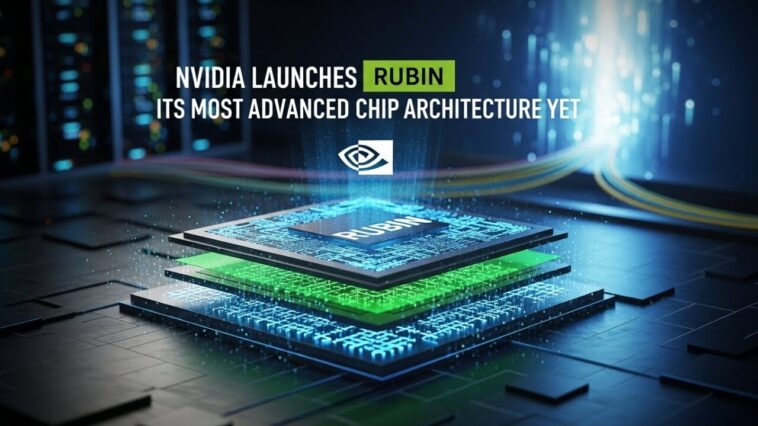
At the Consumer Electronics Show (CES), Nvidia CEO Jensen Huang officially introduced Rubin, the company’s next-generation computing architecture that he described as the new benchmark for AI hardware. The platform is already in production and is expected to scale significantly in the second half of the year, underscoring Nvidia’s accelerating pace in the global AI arms race.
“The amount of computation required for AI is exploding,” Huang told the CES audience. “Vera Rubin was designed specifically to address that challenge. And today, I can say it is in full production.”

From Blackwell to Rubin: Nvidia’s Relentless Upgrade Cycle
First revealed in 2024, Rubin represents the next step in Nvidia’s aggressive hardware roadmap. It will succeed the Blackwell architecture, which itself replaced Hopper and Lovelace—a rapid cadence that has helped transform Nvidia into the world’s most valuable company.
This continuous evolution has allowed Nvidia to stay ahead of rising AI workloads, particularly as models grow larger, more autonomous, and more computationally demanding. Rubin is designed not just as an incremental upgrade but as a foundational platform for the next era of AI systems.
Widespread Adoption Across Cloud and Supercomputing
Even before its full rollout, Rubin has already been adopted by nearly every major cloud provider. Nvidia confirmed that Rubin-based systems will be used by partners including Anthropic, OpenAI, and Amazon Web Services, reinforcing the architecture’s central role in large-scale AI development.
Beyond the cloud, Rubin will also power high-profile scientific infrastructure. The architecture has been selected for HPE’s Blue Lion supercomputer and the upcoming Doudna supercomputer at Lawrence Berkeley National Laboratory, positioning it at the core of both commercial AI and advanced research computing.
Read More: Nvidia’s message to Google: Nice try, we’re still on top
Why It’s Called Rubin: A Six-Chip Architecture Built for Scale
Named after astronomer Vera Florence Cooper Rubin, whose work reshaped our understanding of dark matter, the Rubin architecture is composed of six interconnected chips designed to function as a tightly integrated system.
At its core is the Rubin GPU, but Nvidia has expanded the architecture well beyond graphics processing. Rubin also includes:
-
A new Vera CPU, optimized for agentic AI and reasoning-based workloads
-
Enhanced BlueField networking, addressing data movement and security bottlenecks
-
Next-generation NVLink, dramatically increasing interconnect bandwidth between chips
Together, these components are designed to remove the infrastructure constraints that increasingly limit modern AI systems.
Solving AI’s Growing Memory and Storage Bottlenecks
One of Rubin’s most significant upgrades targets a growing pain point in AI development: memory pressure. As models take on long-term tasks and agentic workflows, their reliance on key-value (KV) cache memory has increased dramatically.
Nvidia’s Senior Director of AI Infrastructure Solutions, Dion Harris, explained that traditional architectures struggle to scale under these demands.
“As you enable agentic AI and long-running tasks, the KV cache becomes a major stress point,” Harris said. “We’ve introduced a new storage tier that connects externally to the compute device, allowing storage to scale far more efficiently.”
This approach gives developers more flexibility while reducing memory bottlenecks that can slow training and inference at scale.
Performance Gains That Redefine AI Economics
As expected, Rubin delivers major gains in both speed and efficiency. According to Nvidia’s internal benchmarks:
-
Rubin is 3.5× faster than Blackwell for AI training
-
It is 5× faster for inference workloads
-
Peak performance reaches 50 petaflops
-
Inference compute per watt improves by up to 8×
These gains are critical at a time when energy consumption and operational costs are becoming central concerns for AI labs and cloud providers alike.
Rubin Arrives as AI Infrastructure Spending Explodes
Rubin’s debut comes amid fierce global competition to build AI infrastructure. Demand for Nvidia’s chips has surged as companies race to secure not just hardware but also the power, cooling, and data center capacity required to run advanced AI systems.
During an earnings call in October 2025, Huang estimated that $3 trillion to $4 trillion will be spent on AI infrastructure over the next five years—a figure that underscores why platforms like Rubin are being positioned as long-term, foundational investments.
Read More: Trump Says ‘No One Gets Nvidia’s Most Advanced Chips,’ But Huang Warns China Will Win The AI Race
A Platform Built for the Next Phase of AI
More than just a faster chip, Rubin reflects Nvidia’s belief that AI is moving into a new phase—one defined by autonomous agents, persistent memory, and large-scale reasoning systems. By addressing compute, storage, networking, and efficiency in a single architecture, Nvidia is betting that Rubin will define how AI systems are built for years to come.
As AI workloads continue to scale beyond today’s limits, Rubin positions Nvidia not just as a chipmaker but as the architect of the infrastructure powering the future of artificial intelligence.