Hajra Naz
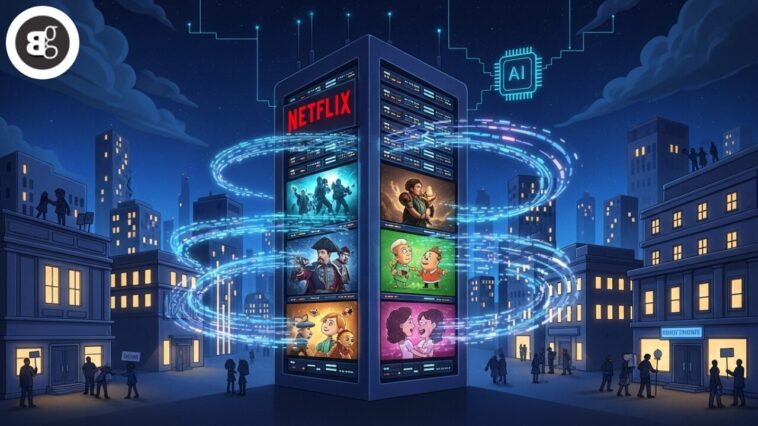
As Hollywood continues to debate how to use AI in filmmaking, Netflix is moving forward with its own approach. In its latest quarterly earnings report, the company said it is “very well positioned to effectively leverage ongoing advances in AI.”
Netflix doesn’t plan to make AI the center of its content creation. Instead, it sees AI as a helpful tool that can make creative teams more efficient.

AI as a Tool, Not a Replacement
“It takes a great artist to make something great,” said Netflix CEO Ted Sarandos during Tuesday’s earnings call. “AI can give creatives better tools to improve the overall TV and movie experience, but it doesn’t automatically make you a great storyteller.”
Earlier this year, Netflix used generative AI for the first time in a show called The Eternaut to create a scene of a collapsing building. Since then, other productions like Happy Gilmore 2 have used AI to make characters look younger, while the team behind Billionaires’ Bunker used AI to plan wardrobe and set designs before filming.
Sarandos added, “We’re confident that AI will help us and our creative partners tell stories better, faster, and in new ways. We’re all in on that — but we’re not chasing novelty just for the sake of it.”
AI Concerns in Hollywood
AI continues to be a hot topic in entertainment. Many artists and actors worry that large language models (LLMs) have been trained on their work without permission. They fear that this could harm their jobs or creative rights.
Most studios, including Netflix, seem focused on using AI for special effects and production tools rather than replacing human actors. Still, these behind-the-scenes uses could affect jobs in visual effects.
The Sora Controversy
The debate intensified after OpenAI released Sora 2, a new model that can generate realistic videos and audio. Critics say Sora lacks proper safeguards to stop people from creating fake videos of actors or public figures.
This week, the actors’ union SAG-AFTRA and actor Bryan Cranston called on OpenAI to add stronger protections against deepfakes.
When asked how Sora might affect Netflix, Sarandos said it’s possible that content creators could feel the impact, but he’s not too concerned about the movie and TV industry overall.
“We’re not worried about AI replacing creativity,” he told investors.
Netflix’s Latest Financial Results
In the same earnings report, Netflix revealed that its quarterly revenue grew 17% year-over-year to $11.5 billion. However, this number still fell short of the company’s forecast.
FAQs
Q1: How is Netflix using AI in filmmaking?
Netflix utilizes AI to support creative teams — for example, by creating visual effects, pre-visualizing sets, and accelerating editing — rather than to replace writers or actors.
Q2: What did Netflix’s CEO say about AI and creativity?
Ted Sarandos said AI can enhance creativity by giving artists better tools, but it can’t replace true storytelling talent.
Q3: Has Netflix used AI in any of its shows or movies?
Yes. AI was first used in The Eternaut for a collapsing building scene and later in Happy Gilmore 2 to make characters appear younger.
Q4: Why are actors and artists concerned about AI?
They worry that AI models trained on their work without consent could lead to deepfakes or take away creative jobs.
Q5: What is Sora 2, and why is it controversial?
Sora 2 is OpenAI’s new video and audio generation model. It sparked criticism for lacking safeguards to prevent people from making fake videos of real actors.