Hajra Naz
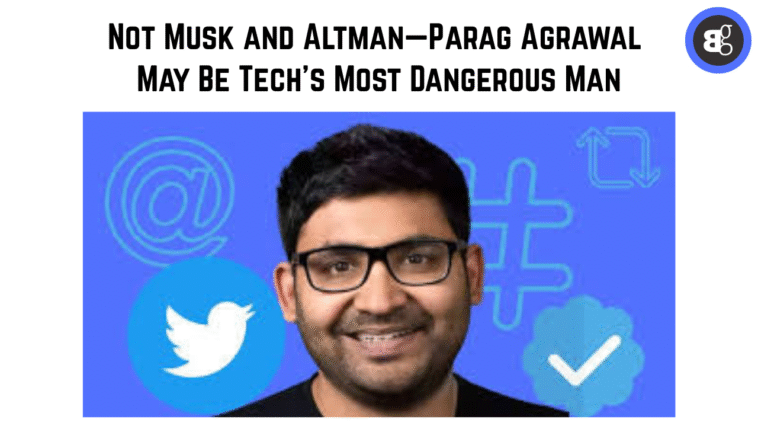
When people talk about the most dangerous man in tech, names like Elon Musk and Sam Altman dominate the headlines. Musk, the billionaire who reshaped industries, and Altman, the OpenAI chief behind ChatGPT and the AGI race, are both obvious candidates.
But the real disruptor? The quiet operator Musk once fired: Parag Agrawal.

Musk vs. Agrawal: A Bitter Fallout
Elon Musk’s $44 billion takeover of Twitter (now X) was one of the messiest acquisitions in Silicon Valley history.
-
Musk accused Twitter of being “riddled with termites” (fake accounts and bots).
-
Twitter’s board sued Musk to close the deal.
-
When the ink dried, Musk arrived with a sink to mark his chaotic takeover.
Within hours, Musk fired Twitter’s top executives—including CEO Parag Agrawal—escorting them out of the building and later refusing to pay Agrawal’s $40 million severance.
What looked like a crushing defeat turned out to be the beginning of a bigger story.
Agrawal’s Quiet Rebound
While Musk turned Twitter into X, Agrawal didn’t disappear. Instead, he went underground—coding, reading research papers, and meeting investors over coffee in Palo Alto.
In 2023, he quietly launched Parallel Web Systems, an AI research startup designed to solve one of AI’s biggest blind spots: accurate, real-time web intelligence.
By 2024, Parallel shocked Silicon Valley with its bold mission:
“We’re building infrastructure for the web’s second user — AI agents.”
Not just chatbots. Not just LLMs. But a fundamental reengineering of how AI researches the internet.
Read More: Global AI Show 2025: The World’s Premier Artificial Intelligence Event in Abu Dhabi
The AI Accuracy Crisis
The problem Agrawal identified is staggering:
-
ChatGPT-5 fails. 59% of live web data pulls.
-
Google Gemini “hallucinates” facts in 23% of queries.
-
Anthropic Claude fabricates sources in 7 out of 10 tests.
This accuracy gap is costing businesses billions of dollars in misinformed decisions, false citations, and compliance risks.
Agrawal’s solution? Throw out the “one model fits all” approach.
Parallel Web Systems: Agrawal’s AI Moonshot
Instead of a single LLM, Parallel built eight specialized research engines:
-
Ultra1x → delivers results in under 60 seconds (speed).
-
Ultra8x → deep-dives for 30 minutes, analyzing with surgical precision.
-
Every response comes with confidence scores and verifiable citations
Result: AI that doesn’t just “guess”—it proves.
Benchmark Accuracy (2025)
| AI Model | Accuracy Rate | Notes |
|---|---|---|
| Parallel Web Systems | 58% | Verifiable citations and confidence scores |
| GPT-5 (OpenAI) | 41% | Fails on fresh/live data pulls |
| Google Gemini | 23% | High hallucination rate |
| Anthropic Claude | 7% | Frequent fabrication of sources |
In less than a year, Parallel hit:
-
$450M valuation
-
Millions of daily queries
-
Double-digit millions in revenue
Why Parag Agrawal Is a Threat
Agrawal isn’t just another startup founder. His Twitter legacy gave him:
-
Insider knowledge of large-scale recommendation systems
-
Experience leading AI and machine learning teams
-
Credibility to attract talent from Google, Stripe, and Airbnb
-
Backing from top-tier investors like Khosla Ventures
He’s been called tech’s “quiet disruptor”—and for good reason. While Musk grabs headlines and Altman battles regulators, Agrawal is building infrastructure that could redefine the future of AI agents.
Parag Agrawal: The Man Behind the Mission
-
Stanford PhD in Computer Science
-
Gold Medalist at the International Physics Olympiad (2001)
-
Twitter CTO (2017) → AI recommendation engine for 250M+ daily users
-
Twitter CEO (2021–2022) → youngest CEO of an S&P 500 company at 37
-
Fired by Musk (2022) → refused severance, ousted overnight
-
Founder, Parallel Web Systems (2023– ) → building AI for web agents
Read More: Innovators and Visionaries of the Forbes Asia 100 To Watch 2025
Timeline: Parag Agrawal’s Rise
| Year | Milestone |
|---|---|
| 1984 | Born in Ajmer, India |
| 2001 | Wins Gold at International Physics Olympiad |
| 2005 | Graduate of IIT Bombay, Rank 77 in IIT JEE |
| 2012 | Completes PhD at Stanford (Data Management) |
| 2011 | Joins Twitter as a software engineer |
| 2017 | Becomes CTO, leads AI/ML and Project Bluesky |
| 2021 | Becomes CEO after Jack Dorsey resigns |
| 2022 | Fired by Musk during $44B takeover |
| 2023 | Founds Parallel Web Systems |
| 2024 | Raises $30M, launches Parallel research engines |
| 2025 | Valued at $450M, emerging as an OpenAI challenger |
Personal Life
-
Married to Vineeta Agarwala, general partner at Andreessen Horowitz
-
Two children (born 2018, 2022)
-
Lives in the U.S., enjoys skiing, cricket, and hiking
-
Celebrates Indian traditions while thriving in Silicon Valley
Final Word: The Real Wild Card
Elon Musk reshaped Twitter into X. Sam Altman became the face of the AI gold rush.
But Parag Agrawal? He may have just built the foundation for AI’s next evolutionary leap—reliable, citation-backed web intelligence for AI agents.
If Parallel succeeds, the man Musk humiliated could become the one who defines the future of AI itself.