Hajra Naz
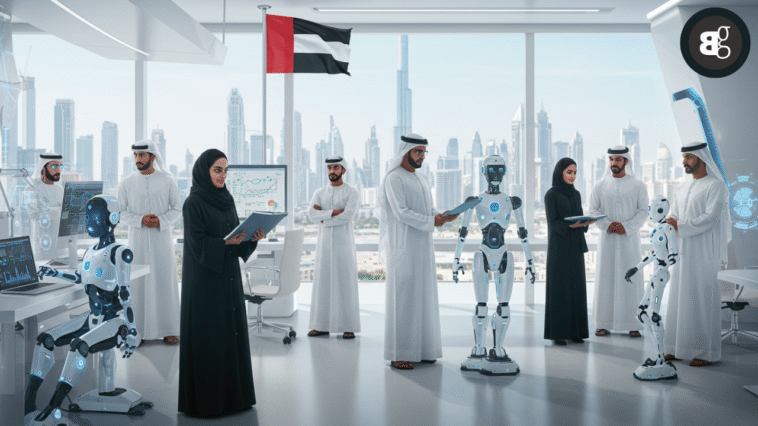
Major corporations across the UAE and the wider Gulf Cooperation Council (GCC) are rapidly reimagining how work gets done as artificial intelligence (AI) adoption accelerates. But contrary to fears of mass layoffs, most firms are opting to merge responsibilities, restructure teams, and reshape workflows instead of eliminating jobs, according to a new study.
The report, Redefining Work: AI & the Future of Talent, released by recruitment and HR consultancy Cooper Fitch, found that 55% of companies in the GCC are consolidating roles as AI transforms business operations. Rather than triggering mass redundancies, employers are reallocating tasks and shifting responsibilities to make better use of both human and machine capabilities.

“It’s more like a merger of roles and responsibilities than job cuts,” explained Dr. Trefor Murphy, founder and CEO of Cooper Fitch, in an interview.
“In fact, 60% of surveyed companies said AI will have minimal impact on jobs. At present, AI is primarily affecting junior, graduate, administrative, data-entry, report-writing, and automation-focused roles.”
Read More: 5 Innovations Shaping the Future of GCC Economies
AI Reshaping Workflows, Not Just Jobs
AI is not wiping out entire jobs. Instead, it is taking over repetitive and low-value tasks. This shift is forcing companies to redesign workflows and adjust job requirements. It also highlights where human judgment matters most.
About 31% of employers in the GCC expect some roles to disappear in the next 12 to 24 months. These changes will mainly affect repetitive positions such as transcription, junior analytics, and administrative support. So far, only 7% of companies report actual job losses. This shows that large-scale disruption from AI is not happening yet.
Expectations vs. Reality: A Productivity Gap
The study also highlights a disconnect between employer expectations and employee perceptions.
With the rise of AI, boards and executives are placing increased pressure on staff to deliver faster, more efficient results. Employees, however, report that the technology is still in its early stages and not yet capable of meeting these performance demands.
Dr. Murphy said.
“Employers believe that because they’ve implemented AI tools, staff should now be able to work faster and produce more, but many employees are finding that the technology often requires additional oversight and manual correction. In some cases, it’s not yet making workflows more efficient.”
Despite this, optimism remains. Employees view AI as a powerful tool for the future, but one that will require significant investment in training, upskilling, and integration strategies before its full potential is realized.
AI Skills Shortage Across the GCC
One of the biggest challenges highlighted by the study is the shortage of AI expertise across the region.
“AI adoption is fragmented,” Dr. Murphy noted. “In many companies, you’ll see sales using AI for one thing, finance for another, and HR for something else, but there’s little unified strategy.”
The study found that multinational companies are far ahead of regional players: 42% of global firms operating in the GCC have scaled AI at an enterprise level, compared to just 7% of GCC-owned businesses.
Investment levels also vary widely. Among surveyed firms:
-
41% spend less than $500,000 annually on AI initiatives
-
19% invest between $500,000 and $5 million
-
8% allocate more than $5 million
This fragmented approach, combined with limited technical expertise, is leading to gaps in implementation, employee burnout, and mismatched expectations.
Read More: Top Emerging Technology Trends in GCC Countries in 2025
Regional and Global Context
The GCC results mirror global patterns. PwC estimates that AI could add $15.7 trillion to the global economy by 2030. The Middle East could capture about 2% of this value, or $320 billion. Within the GCC, the UAE and Saudi Arabia are leading. Both countries have national AI strategies to transform their economies into innovation-driven powerhouses.
Still, there is a challenge. Without coordinated adoption and proper reskilling, the gap between AI’s promise and its real impact will remain wide.
Conclusion
The Cooper Fitch study makes one thing clear. AI is reshaping work in the region, but not through mass layoffs. Instead, it is driving role consolidation, restructuring workflows, and raising productivity demands. The biggest hurdle is the skills gap. Companies must build unified strategies and prepare employees to thrive in this fast-changing environment.
FAQs
1. Is AI replacing jobs in the UAE and GCC?
Not on a large scale. Only 7% of firms reported job losses. These were mainly in narrow, repetitive roles such as transcription, data entry, and junior analysis. Most firms are merging tasks instead of cutting entire positions.
2. Which roles are most affected by AI?
The impact is strongest on junior, admin, data-entry, report-writing, and automation-heavy jobs. Decision-making and people-focused roles remain safe for now.
3. How much are companies in the region investing in AI?
Around 41% of companies spend less than $500,000 a year. Another 19% invest between $500,000 and $5 million. Only 8% put in more than $5 million, showing that enterprise-level adoption is still rare.
4. Why are employees skeptical about AI’s impact on productivity?
Workers say AI tools are still immature. Instead of cutting workloads, they often require reviews, corrections, and manual oversight. This adds pressure instead of easing it.
5. What’s the biggest challenge for AI adoption in the GCC?
The key issues are a shortage of skilled AI talent, fragmented use across departments, and weak unified strategies. Multinationals are ahead, but many local firms need to catch up to stay competitive.