
 Hajra Naz
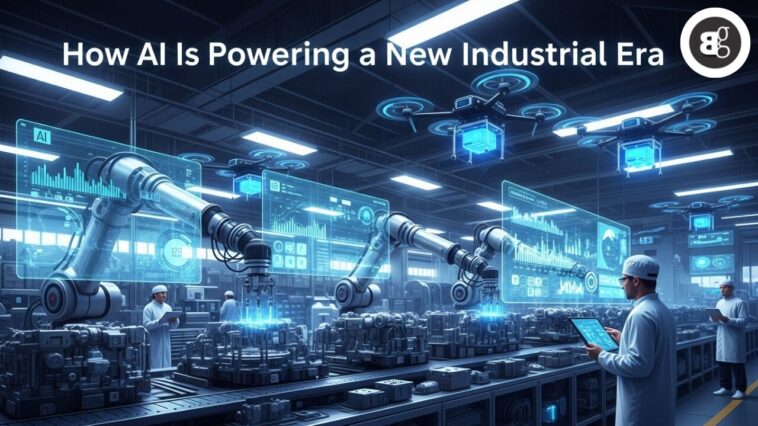
Two headline-making events recently signalled a seismic transformation. Amazon announced layoffs of over 30,000 employees, its biggest cut ever. The company says the move is part of a pivot toward automation and artificial intelligence (AI).
At the same time, NVIDIA—the chipmaker behind the processors powering nearly every major AI model—surpassed a market cap of $4 trillion, becoming the most valuable publicly traded company ever.

A New Industrial Revolution Driven by Algorithms
These events aren’t isolated. They mark the dawn of a new industrial era—one not powered by steam, electricity, or the internet, but by algorithms that can think, learn, and create. AI is now reshaping economies, industries, and societies at breakneck speed.
For countries like Pakistan, this presents both a historic opportunity and a grave warning: they must act swiftly or risk being left behind in a world re-engineered by machine intelligence.
Read More: Will AI Destroy the World or Redefine It? The Truth Beyond the Fear
Power Shift: Intelligence Beats Labor
AI capabilities are fast becoming the key determinant of economic and military power. Countries that control hardware, data, and algorithms now hold unprecedented influence. NVIDIA’s $4 trillion rise proves value creation has moved away from physical goods to intelligent computation.
Wealth is migrating toward nations and companies that can harness and export intelligence—via chips, AI models, and autonomous systems—rather than mass labour or raw materials.
Opportunity and Risk for Pakistan
In Pakistan, where millions of young people join the workforce each year, this industrial AI wave is both a challenge and an opportunity. The challenge: avoid mass unemployment as skills become obsolete. The opportunity: with its youth and tech potential, Pakistan could become a global hub for AI-driven innovation and services—if it acts strategically.
The transformation must begin in the classroom. AI is changing education worldwide by enabling personalised, adaptive learning. In the US and China, AI tutors, automated grading, and intelligent platforms are already becoming common.
For Pakistan, where educational inequality persists, AI offers a unique chance to close the urban-rural divide. Digital devices and intelligent learning platforms could deliver high-quality education at scale.
But this won’t happen automatically. Pakistan needs a policy that integrates AI literacy, computational thinking, teacher training, and a national education data infrastructure. Without it, the next generation won’t have the tools to compete.
Healthcare, Business, Agriculture: All Ripe for AI
In healthcare, AI systems are already diagnosing cancer, predicting outbreaks, and speeding drug design. In Pakistan, where hospitals are under-resourced, AI could be a leapfrog technology. Mobile diagnostic tools using AI could help rural doctors detect illnesses early. Predictive analytics could optimise hospital logistics and drug supply, improving outcomes.
In the private sector, businesses are being restructured around data. AI is becoming the central nervous system of companies—driving decision-making, marketing, customer engagement, supply chains and product design.
Agriculture remains Pakistan’s largest employer and a cornerstone of food security. Here too, AI has huge potential: precision farming, water-use optimization, crop analytics, and climate-smart agriculture could all get a boost.
Strategic Priorities for National Action
To seize the industrial AI wave, Pakistan must treat it as a national survival priority. The steps are clear:
-
Develop a national AI strategy aligned with Vision 2050 and the knowledge economy agenda.
-
Invest heavily in human capital—integrate AI ethics, data literacy, and computational thinking from schools through universities.
-
Build digital infrastructure—high-speed connectivity, data centres, cloud platforms, and access to modern GPUs.
-
Promote AI entrepreneurship through tax incentives, startup accelerators, and a dedicated AI Innovation Fund co-investing in high-impact projects (in precision medicine, agriculture, energy, and finance).
Concrete infrastructure is being developed: a University of Applied Engineering in Haripur with a centre for AI, a second at Karachi University, and another in Samrial near Sialkot. A Rs. 40 billion project to build a network of centres of excellence in AI across Pakistan has already been submitted to the Ministry of IT and awaits approval.
Read More: Why Some People Love AI, While Others Hate It—the Answer Lies in Human Psychology.
Don’t Wait—Act Now
In sum: delay is defeat. The AI revolution won’t wait. The window to catch up is narrow but still open. By investing in education, research, digital infrastructure, and entrepreneurship, Pakistan can transform disruption into a national renewal.
FAQs
1. What is meant by “AI: the new industrial wave”?
It refers to a major shift in how industries operate—where artificial intelligence and smart algorithms drive productivity, value creation, and growth, rather than traditional manual labour and manufacturing.
2. Why is AI now a critical factor in global competitiveness?
Because AI combines hardware, data, and models to create intelligent systems, control over these gives nations and companies unprecedented economic, strategic, and technological power.
3. How can Pakistan benefit from the AI wave?
By leveraging its youthful population, building AI skills, investing in digital infrastructure, and using AI to leapfrog sectors like education, healthcare, agriculture, and services.
4. What risks does AI pose for countries behind the curve?
Those that don’t adapt risk mass unemployment, lost economic opportunity, and being dominated by others who control AI technology and innovation.
5. What are concrete steps to prepare for the AI industrial era?
Key steps:
- Develop a national AI strategy
- Integrate AI and data literacy in education
- Build digital infrastructure (cloud, data centres, GPUs)
- Promote AI startups
- Support industry-academia partnerships