Hajra Naz
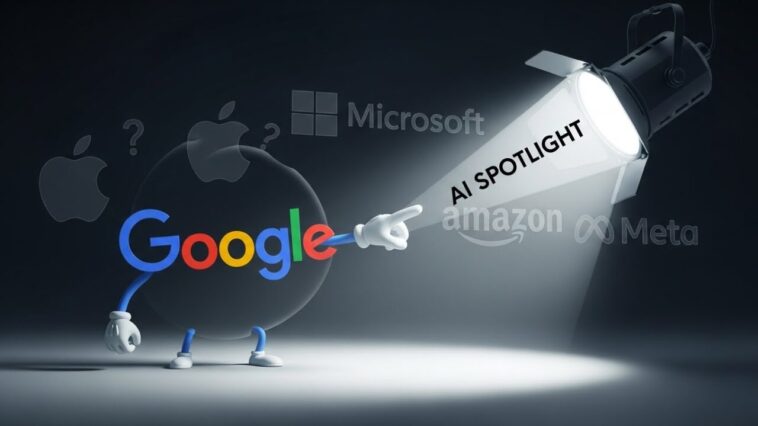
Google just shook up the fast-moving AI race again. Its biggest competitors are noticing.
On November 25, Nvidia posted on X. The company congratulated Google. “We’re delighted by Google’s success—they’ve made great advances in AI, and we continue to supply to Google,” Nvidia wrote.

They added, “NVIDIA offers greater performance, versatility, and fungibility than ASICs,” referring to Google’s application-specific chips. Nvidia highlighted that its GPUs remain more flexible than Google’s custom Tensor chips.
OpenAI CEO Sam Altman also commented on Google’s progress. He wrote on X, “Congrats to Google on Gemini 3! Looks like a great model.” His acknowledgment shows that even AI rivals pay attention to Google’s innovations.
The social media posts came amid growing excitement about Google’s Gemini 3 model. This includes the chips Google made to power it. Salesforce CEO Marc Benioff tried the model and shared his experience. He wrote on X, “The leap is insane—reasoning, speed, images, video… everything is sharper and faster. It feels like the world just changed, again.” He added that he will not go back to using ChatGPT.
Meta is now reportedly in talks with Google to purchase Tensor chips, according to The Information. This comes after Anthropic said in October that it plans to significantly expand its use of Google’s AI technology. Google’s chips are now attracting attention from multiple major AI players.
Shares of Google went up nearly 8% last week. Nvidia’s stock fell slightly by over 2%.
The stakes go beyond bragging rights or individual sales. AI is shaping the world, from technology to finance. Investors, including billionaires and everyday 401k holders, watch this race closely. Which company leads, and which vision wins, could influence nearly every American’s life.
Nvidia’s public comments suggest confidence in their technology. Google’s chips differ from Nvidia’s, so they are not a direct substitute. Yet the fact that OpenAI and Nvidia publicly recognized Google’s advancements is significant.
“They’re in the lead for now, let’s call it, until somebody else comes up with the next model,” said Angelo Zino, senior vice president and technology lead at CFRA, to CNN.
Google and Meta did not respond to requests for comment. Nvidia declined to comment.
The Leader for Now
Google is not an AI underdog. Gemini is one of the world’s most popular AI chatbots. Google is also one of the few companies known as a “hyperscaler,” capable of offering cloud-based computing power on a massive scale. Google has been using AI in products like Search and Translate since the early 2000s.
Still, Google was largely unprepared for ChatGPT’s launch in 2022. Management reportedly issued a “code red” after ChatGPT’s rapid rise, according to The New York Times. ChatGPT now has at least 800 million weekly active users. Google’s Gemini app has 650 million monthly active users.
Gemini 3 launched on November 18. It quickly reached the top of AI benchmark leaderboards. It excels in text generation, image editing, image processing, and turning text into images. Gemini 3 outperforms ChatGPT, xAI’s Grok, and Anthropic’s Claude in these areas. Over one million users tried Gemini 3 within the first 24 hours. They accessed it via Google’s AI coding program and tools that connect digital services to other apps.
Usage patterns vary. Ben Barringer, global head of technology research at Quilter Cheviot, explains that different AI models serve different purposes. Models like xAI and Perplexity rank higher than Gemini 3 for search performance in some benchmarks.
“It doesn’t necessarily mean Alphabet will be the end-all in AI,” Zino said. “They’re just another piece of the AI ecosystem, which continues to grow larger and more complex.”
More Chip Competition
Google’s Tensor chips have been in development long before the recent AI boom. Nvidia still dominates the AI chip market. The company reported 62% year-over-year sales growth in the October quarter. Profits rose 65% compared to last year.
Nvidia’s dominance comes from its powerful graphics processing units (GPUs). GPUs can perform massive amounts of complex calculations quickly. Google’s Tensor chips are application-specific integrated circuits (ASICs). They are designed for narrower, specialized workloads. While both GPUs and Tensor chips can train and run AI models, GPUs are more versatile.
Nvidia also provides full technology packages for data centers. These include GPUs, networking chips, and a software platform. Developers can optimize their code to make better use of Nvidia’s chips. This creates long-term customer retention. Even Google is a client of Nvidia.
“If you look at the magnitude of Nvidia’s offerings, nobody really can touch them,” said Ted Mortonson, technology desk sector strategist at Baird.
Google’s chips are unlikely to replace Nvidia in the near future. However, growing adoption of ASICs, along with competition from AMD, suggests that some companies want to reduce reliance on Nvidia.
Barringer said Google will not be the only AI chip competitor. It is unlikely to reach Nvidia’s level of market dominance. “I think it’s a part of a balance,” he said.
The AI race is intensifying. Tech giants are battling in software, hardware, and AI models. From cloud computing and generative AI to benchmarking and chip development, the competition is reshaping industries. Gemini 3, Tensor chips, and Nvidia GPUs are all part of a rapidly evolving ecosystem. Every move by Google, Nvidia, OpenAI, and Meta influences the AI market.