Hajra Naz
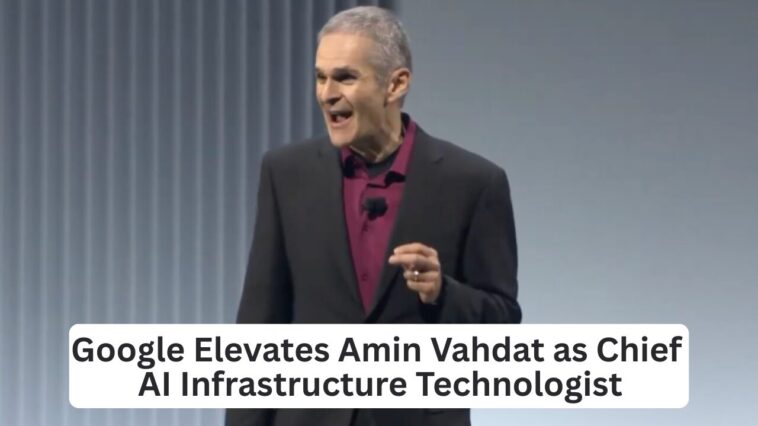
Google has quietly moved a key engineer into the spotlight, promoting Amin Vahdat to the newly created role of chief technologist for AI infrastructure. This position will report directly to CEO Sundar Pichai.
The appointment, first flagged in a memo reported by Semafor and confirmed, underscores how central hardware, networks, and data center design have become to the company’s AI push.

Vahdat is a veteran systems researcher whose career spans Xerox PARC in the early 1990s, academic posts at Duke and UC San Diego, and a 2010 move to Google.
At Google, he has spent years stitching together the low-level technologies—custom chips, sprawling networks, and orchestration software—that let large AI models train and run at scale.
He’s already been a public face for some of that work. Last year, he introduced Google’s seventh-generation TPU, Ironwood, touting pods with thousands of chips and exaflops-level performance.
But much of his influence has been behind the scenes: steering development of the Jupiter interconnect that moves petabits of data across Google’s sites, helping evolve Borg, the company’s cluster manager, and leading efforts on custom CPUs and other data-center hardware.
The new role bundles those responsibilities into a C-level title at a time when Alphabet is committing eye-watering sums to infrastructure—plans that include nearly $93 billion in capital spending by the end of 2025.
For a company competing on both algorithms and the machines that run them, Vahdat’s promotion signals that infrastructure is now a strategic battleground.
Read More: Google is rolling out a way for Android users to share live video
There’s also a human calculus: after more than a decade of building critical systems and teams, elevating a technologist like Vahdat helps both reward and retain talent that would be costly to lose.
Practically, it puts one of Google’s chief architects in closer contact with the top of the company, ensuring that the people who design the machines sit nearer to the people who set the strategy.