Hajra Naz
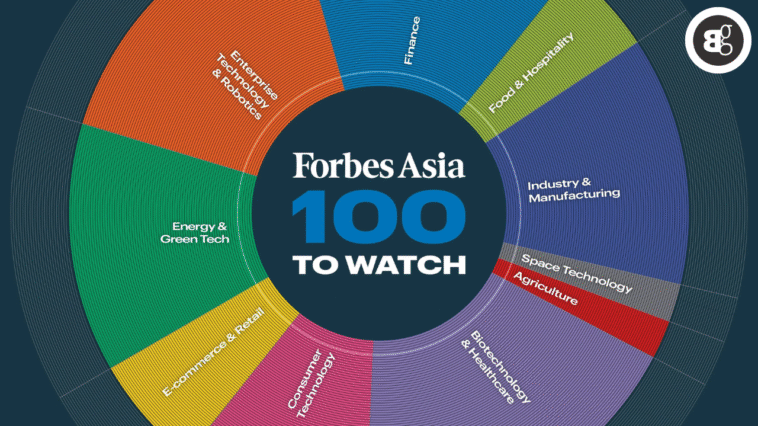
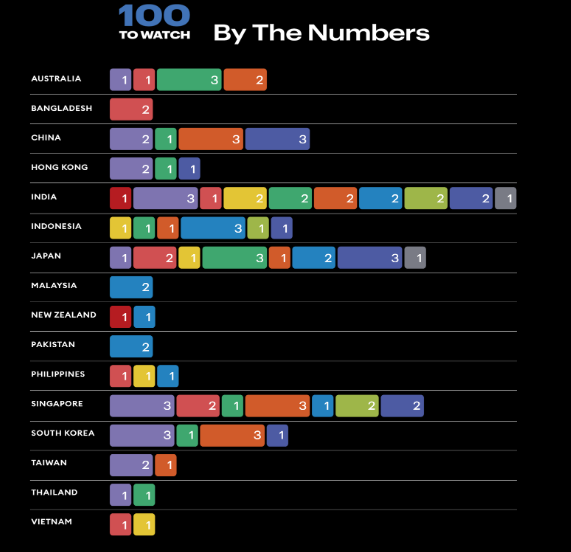
The “Forbes Asia 100 To Watch 2025” list offers a clear view of startups and small companies in the Asia-Pacific. It shows the rising focus on AI and deep tech. This year’s list also reflects stronger Venture Capital (VC) activity in the region. Countries like India, Japan, and Singapore are drawing more risk capital.
The 100 companies on the list have secured nearly $3 billion in funding. That’s a sharp rise from the $2 billion raised by last year’s group. These enterprises are not only raising capital. They are shaping the future with new technology and strong leadership vision.

Key Technological Focus Areas
The 2025 list is heavily populated by companies in fast-rising sectors such as biotechnology, spacetech, and green tech. The largest segment, biotechnology and healthcare, accounts for 18 companies, followed closely by enterprise technology and robotics with 16.
Artificial Intelligence (AI) underpins many of the innovations on this year’s list, demonstrating its pervasive impact across various industries.
Read More: Top Emerging Technology Trends in GCC Countries in 2025
AI Model Validation and Development
Companies like Datumo (formerly SelectStar) in South Korea, led by David Seyeop Kim, are crucial for the AI ecosystem by helping companies assess their AI models and validate the reliability of large language models (LLMs).
India’s Neysa, co-founded by Sharad Sanghi, operates a cloud-based platform for training, testing, and deploying AI models, aiming to be a one-stop solution for generative AI services.
Deep Learning and High-Performance Computing
Singapore’s HPC-AI Tech, with You Yang as CEO, develops high-performance computing technologies to accelerate deep learning training and is known for its open-source platforms Colossal-AI and Open-Sora.
Robotics and Automation
- Augmentus from Singapore, led by Daryl Lim, develops AI-powered industrial robotic systems that minimize the need for extensive coding, enabling robots to analyse spatial information and generate optimal toolpaths.
- Linkerbot from China, founded by Alex Zhou, stands out with its development of metallic five-fingered robot hands that emulate human movement and function, suitable for humanoid robots and industrial arms.
- Noetix Robotics, also from China, with Zhang Shipu as CEO, made headlines for its N2 humanoid robot, which finished second in a robot half-marathon, and plans to sell 2,000 units this year.
- LexxPluss in Japan, under Masaya Aso, addresses labor shortages with its autonomous mobile robots for transportation and towing.
- Venti Technologies (Singapore), led by Heidi Wyle, focuses on self-driving technologies for complex industrial environments like ports and airports.
AI-Enhanced Business Solutions
- Japan’s Loglass, steered by Tomoya Fukawa, offers cloud-based AI tools for streamlined business planning by analysing sales, budgeting, and personnel data. Singapore’s AlphaLife Sciences, with Sharon Chen as CEO, uses a cloud-based medical writing tool, AuroraPrime, to help pharmaceutical companies draft clinical documents at speed.
- Vision and Digital Transformation: DexForce Technology (China), led by Jia Kui, develops AI-based 3D vision software for robots and manufactures humanoid robots used in automotive and manufacturing industries. MetAI from Taiwan, headed by Daniel Yu, creates software to convert 2D warehouse floor plans into interactive 3D environments for logistics optimisation.
Read More: Businesses at Risk as Employees Turn to Unauthorized AI Tools at Work
Innovations in Biotechnology and Healthcare
The healthcare sector is seeing significant technological advancements, particularly in diagnostics, remote care, and advanced therapies.
- Wearable Health Tech: Aevice Health (Singapore), founded by Adrian Ang, develops non-invasive, wearable devices like the AeviceMD smart stethoscope for remote management of respiratory diseases.
- Advanced Cancer Therapies: South Korea’s Aimed Bio, led by Nam-Gu Her, is developing potent antibody-drug conjugates (ADCs) for targeted cancer therapy. China’s Base Therapeutics, under Xu Tianhong, uses gene-editing technologies to develop treatments for advanced tumors, with its flagship product NK510 set for clinical trials. Immunofoco (China), led by Sun Minmin, is advancing immunotherapy treatments for cancer tumors, preparing for Phase 2 clinical trials.
AI in Medical Diagnostics and Management
- Cloudphysician (India), co-founded by Dhruv Joshi, offers AI-based software to monitor ICU patients, with its digital agent AINA analysing video feeds to detect risks.
- FaceHeart (Taiwan), led by David Wu, specialises in AI-powered contactless measurement of vital signs from video scans of a patient’s face.
- Health2Sync (Taiwan), with Ed Deng as CEO, provides a comprehensive platform for diabetes patients to track health data and share it with doctors.
- Heidi Health (Australia), led by Thomas Kelly, uses an AI-powered medical scribe to generate clinical notes from patient consultations, operating in Australia and the UK.
- MedySapiens (South Korea), led by Sanggoo Kang, utilises AI-powered genomics for rapid diagnosis of over 220 rare genetic diseases in newborns.
- Tricog Health (India), headed by Charit Bhograj, offers AI-powered cardiac diagnostics, including real-time analysis of ECGs and echocardiograms.
- Genetic and Disease Treatment: GenEditBio (Hong Kong), with Zhu Tian at the helm, aims to treat rare diseases using gene-editing technologies. Nuevocor (Singapore), led by Yann Chong Tan, is developing medicines for genetic cardiomyopathies and has received FDA clearance for clinical trials of its NVC-001 treatment.
- Microbial Genome Innovation: Japan’s bitBiome, under Yuji Suzuki, leverages AI to sequence microbial genomes, developing new enzymes for drugs and cosmetics, and building a massive database of 2.4 billion genome sequences.
Advancements in Energy and Green Technology
This sector sees a strong drive towards sustainable solutions and efficiency.
- Waste Management and Recycling: Aetech (South Korea), led by Taehyung Park, developed Atron, an AI-powered robot that doubles recycling efficiency by automating waste sorting. Indonesia’s Rekosistem, with Ernest Christian Layman as CEO, offers digital waste management services, helping businesses achieve waste-free targets.
Sustainable Fuels and Batteries:
- Aether Fuels (Singapore), led by Conor Madigan, is developing technologies to convert waste carbon feedstock into sustainable aviation and shipping fuels.
- ElectraLith (Australia), with Charlie McGill as CEO, has patented technology for water- and chemical-free extraction of lithium for batteries.
- Sicona Battery Technologies (Australia), led by Christiaan Jordaan, produces new anode materials for lithium-ion batteries that offer higher energy density and faster charging.
- India’s Vecmocon Technologies, incubated at IIT Delhi and led by Peeyush Asati, builds intelligent software and hardware for electric vehicles (EVs), including battery-management systems.
- Carbon Management: Japan’s Asuene, headed by Kohei Nishiwada, offers a cloud-based CO₂ emissions management and carbon accounting platform for businesses.
- Next-Generation Energy: Enecoat Technologies (Japan), under Naoya Kato, is developing next-generation solar cells with perovskite-structured compounds for higher conversion rates. Startorus Fusion (China), led by Chen Rui, aims to build a nuclear fusion power plant by 2032 to produce clean energy.
Read More: AI’s Hidden Climate Cost: How Our Digital Habits Shape the Planet
Space Technology and Consumer Tech
- Earth Observation and Propulsion: India’s GalaxEye, co-founded by Suyash Singh, is launching its “Drishti Mission” observation satellite with multi-sensors for all-weather Earth imaging. Japan’s Pale Blue, led by Jun Asakawa, develops water-plasma propulsion systems for small satellites.
AI-Driven Consumer Tools
-
- AI Hay (Vietnam), with Duc Tran as CEO, offers a Vietnamese chatbot and app based on a proprietary large language model, primarily used by students for academic guidance.
- Notta (Japan), led by Zhang Yan, provides AI-based software for speech-to-text transcription in 58 languages, generating instant summaries and insights.
- Blinq (Australia), led by Jarrod Webb, is modernising networking with its digital business cards and personal QR codes, attracting 2.5 million users globally.
Fintech Innovations
Technology is rapidly transforming financial services, especially in payment solutions and lending.
- B2B Payments and Treasury: Singapore’s Finmo, led by David Hanna, offers a B2B platform for global payments and treasury management with real-time payments and FX risk management.
- Lending and Credit: Finnable (India), co-founded by Nitin Gupta, provides online personal loans to salaried professionals using proprietary algorithms for credit assessment. Japan’s Fivot, with Shogo Abe as CEO, uses AI to offer fast loans to startups, alongside a personal savings app.
- Payment Infrastructure: Hong Kong’s KPay, led by Davis Chan, provides offline and online payment collection services for small merchants, supporting 18 currencies. Malaysia’s Soft Space, under Joel Tay, offers contactless mobile payments and e-wallet services, with its SoftPOS technology enabling smartphones to accept payments directly.
- Mortgage and Expense Management: Indonesia’s Ringkas, co-founded by Ilya Kravtsov and Leroy Pinto, uses AI to make mortgage financing more efficient and accessible, prequalifying candidates and enabling mortgage transfers. Monit (Indonesia), led by Rizki Aditya, helps companies manage finances with corporate debit cards and automated reporting.
Read More: Biggest Fintech Success Stories in Pakistan
Conclusion
The “Forbes Asia 100 To Watch 2025” list highlights Asia-Pacific’s rise as a hub of tech innovation. Visionary leaders and strong investments drive this growth.
From AI-powered robotics to gene therapies and clean energy, these companies stand out. Their founders and CEOs lead efforts to solve local issues and fuel global progress.
The focus on deep tech is growing. Rising VC funding signals a bright future for startups and the transformative technologies they are building.