Hajra Naz
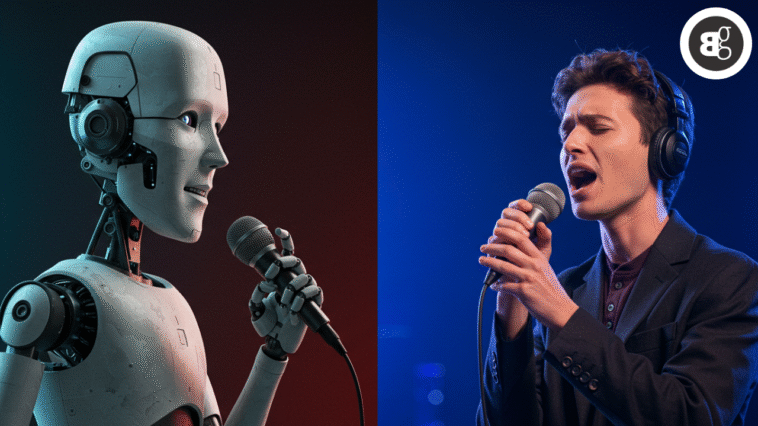
LONDON (AP) — Is that gritty track you just streamed a new release from The Velvet Underground—or the fabricated creation of a virtual band like Velvet Sundown?
Velvet Sundown isn’t real. It’s a fictional rock group born entirely from artificial intelligence—complete with AI-generated music, lyrics, vocals, and album art. And its very existence is stirring fresh debate in the music world. As AI continues to infiltrate creative industries, musicians, listeners, and platforms alike are grappling with a growing question: Where’s the line between human-made and machine-made music? And perhaps more importantly, should creators and platforms be more transparent about it?

The AI Invasion in Music Creation
AI isn’t new in music production. For years, producers have relied on computer software to edit, mix, and master tracks. But tools like Suno and Udio have radically lowered the barrier to entry. Now, virtually anyone can generate a full-fledged song using just a few written prompts.
The implications are enormous. According to a report by Goldman Sachs, the global music industry could reach $153 billion by 2030—with AI playing a major role in reshaping its structure and revenue flow. Music creation is no longer the exclusive domain of trained artists with expensive studio gear; it’s available to hobbyists, content creators, and even pranksters.
Yet, as more AI-generated songs enter the streaming universe, many listeners are left wondering: How can you tell if what you’re hearing was created by a human or a machine?
1. Do a Background Check
One of the first and most effective ways to investigate a track’s origin is to look into the artist behind it.
Manuel Mousallam, head of R&D at Deezer, says, “The most obvious cues come from external factors.” In simpler terms—Google the artist.
Start by checking whether the band or artist has a digital presence:
-
Do they have social media accounts?
-
Are there any press mentions, interviews, or live performances?
-
Is their music distributed through known record labels?
If you can’t find any record of live gigs, past concerts on YouTube, or ticket listings for upcoming events, that’s a red flag. Many AI-generated artists don’t (and can’t) perform live. Also, platforms like Suno and Udio allow users to publish their tracks directly, bypassing traditional distribution.
But here’s the catch: you’ll often need to create an account on these platforms to dig deeper. Once inside, you can search by track name or username and browse genres. Still, if you’re missing key details like the song title or artist handle, it can be like finding a needle in a haystack.
2. Look for Song Tags and Labels
Some streaming platforms are beginning to flag AI-generated content—though this is still inconsistent across the board.
Deezer, for example, began tagging AI-created songs in June 2024. Tracks marked as “AI-generated content” display a label on both their app and website. This transparency move is part of a wider campaign to tackle streaming fraud, where scammers upload massive volumes of low-effort AI songs to collect royalties.
Interestingly, Deezer says up to 18% of songs uploaded to their platform daily are now AI-generated. That means nearly 1 in 5 new tracks could be machine-made.
The tagging relies on proprietary in-house tech capable of identifying subtle patterns unique to AI compositions. But the company has yet to release exact data on how many tracks have been tagged since the initiative launched.
3. Use Third-Party Song Scanners
There are now online tools specifically built to detect whether music was created using AI. One such tool is from IRCAM Amplify, a spin-off of the prestigious French institute for sound and music research.
When tested, IRCAM’s scanner provided AI-generation probabilities ranging from 81.8% to 98% for tracks known to be made with Suno. It even identified the correct generator. For human-made MP3s, the scores were notably low, confirming their potential.
However, the tool isn’t perfect. You can’t paste streaming links—only upload files—which limits its use. And the tool itself warns that results aren’t foolproof:
“The AI detector can make mistakes. It is recommended to verify the results.”
Other tools exist that accept both uploads and streaming links (including Spotify), but they’ve shown mixed results. Some flagged AI songs as human-made and vice versa, making them less reliable without manual verification.
4. Examine the Lyrics
Lyrics often expose the machine.
While serious users might write their lyrics to pair with AI-generated instrumentals, many casual creators rely entirely on the AI to do both. The result? Often awkward rhymes, repetitive phrasing, and shallow metaphors.
Lukas Rams, who created three albums with his AI band Sleeping with Wolves using Suno, said one giveaway is recurring vocabulary.
“Suno loves to put ‘neon’ in everything,” he joked. Other overused words include shadows, whispers, and echoes. These clichés are a sign the lyrics may not come from a human pen.
Of course, this isn’t always the case—some human-written songs are just as guilty. But overly generic or formulaic lyrics can raise suspicion.
5. There Are No Easy Answers
The truth? AI is improving so fast that identifying machine-made music by ear alone is no longer reliable.
“Generative models like Suno and Udio are evolving quickly,” said Mousallam. “The old clues—like artificial-sounding reverb or robotic vocals—are becoming less noticeable.” AI vocals can now mimic human emotion, variation, and even regional accents with stunning accuracy.
That means the lines will only blur further.
Just as deepfakes have reshaped video, AI-generated music is pushing us to rethink how we define authenticity in audio. For now, it’s a game of educated guesses, imperfect tools, and digital sleuthing. But as the music industry races to catch up, transparency, regulation, and new forms of digital watermarking may become the only way to know for sure.