Hassan Khan
How to Become a Machine Learning Engineer: Ever noticed how Netflix somehow recommends a series that you end up binge watching all night? Or how Spotify feels like it reads your mind on a random Monday morning? That’s not luck. That’s machine learning doing its thing. And the people behind it? They’re called machine learning engineers. They’re the ones building, tweaking, and teaching these smart systems that power half the apps we use daily.
Now, I know what you’re probably thinking “Sounds cool but this is way out of my league.” Honestly, I used to think the same. Machine learning feels like this big scary mountain reserved for math geniuses and coding wizards. But trust me it’s more like a staircase. One step, then the next. And if you’re curious enough, determined enough, you can climb it too.

No 1. Understand What a Machine Learning Engineer Does
Machine Learning Engineers are problem solvers. Before you dive headfirst into tutorials and math, pause for a second. Do you actually know what a machine learning engineer does? A lot of beginners confuse it with being a data scientist. The difference is subtle but important.
A data scientist usually explores and analyzes data finding patterns, testing ideas. A machine learning engineer, on the other hand, takes those ideas and builds systems that can actually run in the real world. You’re the bridge between theory and working product.
In simple terms, an ML engineer combines programming, statistics, and business understanding to build systems that can predict, recommend, or automate tasks.
Want You Learn Machine Learning Here is the Free Machine Learning Course
Key responsibilities include:
-
Designing algorithms that adapt over time.
-
Training models on large datasets.
-
Deploying models into real world applications (apps, websites, devices).
-
Working closely with data scientists and software engineers.
See More: Machine Learning Engineer
For example: Think about ride hailing apps like Uber. The system predicts your ETA and even matches you with the nearest driver. That’s the work of ML engineers making your life smoother.
It’s not just coding either. You’ll spend time cleaning messy data, making models more accurate, and collaborating with other teams sometimes business folks, sometimes hardcore developers.
If you enjoy solving puzzles, experimenting, and creating things people actually use, this role might be exactly what you’ve been looking for.
No 2. Build a Strong Foundation in Mathematics & Statistics
The part everyone dreads: math. Here’s the deal you don’t need to be Einstein. You just need to know enough to understand the basics of how machine learning works.
The Must know areas are:
-
Linear algebra (vectors, matrices think of them as Lego blocks for ML).
-
Probability and statistics (because ML is basically teaching machines to make predictions).
-
Calculus basics (mostly for understanding how algorithms “learn” through optimization).
Now, before you panic: you don’t need to master advanced proofs. A working knowledge is more than enough when you’re starting out.
Here’s how I approached it: I treated math as a supporting actor, not the main star. Whenever I hit a concept in ML I didn’t understand, I’d pause, watch a 10 minute Khan Academy video, then get back to coding. Over time, things started clicking naturally.
My advice: Don’t sit around for a year studying math before you even touch Python. Learn both side by side. Use math when you need it, and it’ll stick way better.
Read More: Major Updates in Machine Learning, Robotics, and Automation
No 3. Learn Programming (Python Is Your New Best Friend)
Without coding, you can’t really “Do” machine learning. And while there are multiple languages out there, Python is the clear winner. It’s simple, readable, and has a massive ecosystem of ML libraries.
Must Learn Python libraries for ML:
-
NumPy & Pandas: For data handling.
-
Matplotlib & Seaborn: For data visualization.
-
Scikit learn: For machine learning algorithms.
-
TensorFlow or PyTorch: For deep learning.
Here’s a trick that helped me: instead of binge watching Python tutorials, I picked small problems to solve. For example, I once tried writing a little script to predict my monthly expenses based on old data. It was messy, but I learned way more than I would’ve from another two hour video.
The best way to learn coding? Build as you learn. Start small: write a simple program that counts word frequency in a text, then move up to predicting house prices. The more you play around, the faster you’ll feel comfortable.
If you want to learn Python, here’s a free course. Python course
How to start?
-
Begin with basic Python programming (loops, functions, classes).
-
Move into data manipulation with Pandas.
-
Start solving small problems (like predicting house prices with Scikit learn).
Remember, coding is a skill. The more you practice, the better you’ll get.
No 4. Learn Data Handling & Preprocessing
Data is the fuel of machine learning, but raw data is often messy. Here’s a not so secret truth: machine learning isn’t just about fancy algorithms. It’s mostly about data. In fact, engineers often say “Garbage in, garbage out.” If your data is messy, your model will be too.
So what do you actually need to learn?
-
How to collect data (from APIs, databases, or web scraping).
-
How to clean it (fix missing values, remove duplicates, correct errors).
-
How to explore it (finding trends, spotting outliers, making sense of the story hidden in numbers).
Think of yourself like a detective. Raw data is the messy crime scene you need to piece together what actually happened. For example, while working on an e-commerce dataset, you might notice that people who buy running shoes often buy sports socks too. That’s the insight Amazon uses for “frequently bought together.”
The best practice ground? Kaggle. It’s like the gym for data people. Tons of free datasets, challenges, and a community to learn from.
Tools to master:
-
Pandas for data manipulation.
-
Scikit-learn preprocessing tools.
-
SQL for handling databases.
Advice: Don’t underestimate data preprocessing. Many beginners rush to train models without cleaning data, and their results turn out poor. A clean dataset can often make a bigger difference than a complex model.
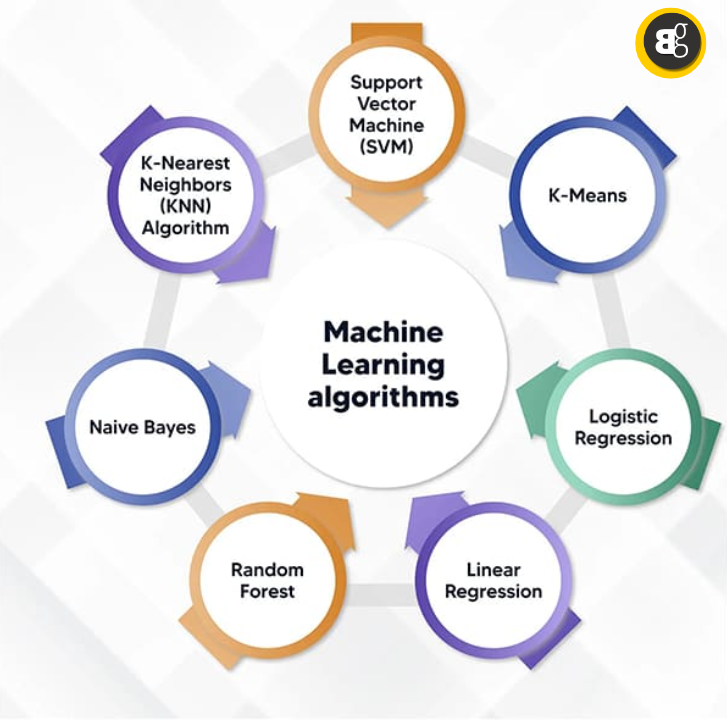
No 5. Master Core Machine Learning Algorithms
Alright, now we get to the meat of it. Machine learning itself. Here’s where you start understanding how algorithms actually “Learn.”
The basics to start with:
-
Supervised learning: teaching machines with labeled examples (like predicting house prices).
-
Unsupervised learning: letting machines group data on their own (like customer segmentation).
-
Neural networks: the foundation of deep learning (image recognition, chatbots, self-driving cars).
 Here’s my advice: don’t just memorize definitions. Instead, focus on why you’d use each method. For example, why logistic regression for predicting yes/no answers instead of linear regression? That kind of thinking is what makes you a problem solver, not just someone who copies code.
The fastest way to learn? Build toy projects. A spam email filter. A movie recommender. A tweet sentiment analyzer. Once you see your code actually “learn,” the excitement will push you to keep going.
No 6. Work on Projects That Solve Real Problems
At some point, tutorials won’t cut it. Employers (and even you yourself) want proof that you can apply what you’ve learned. That’s where projects come in.
Here’s the good news: your projects don’t have to be ground breaking AI innovations. They just need to solve real problems, even small ones. Some ideas:
-
A mini Netflix style recommendation engine.
-
A sentiment analyzer for tweets during cricket matches.
-
Predicting house prices for your local area using public data.
These projects do two things. First, they sharpen your skills by forcing you to connect all the dots. Second, they build your portfolio which is the number one thing recruiters look at.
Pro tip: don’t wait until you’re “Ready.” Start messy, improve later. Even an imperfect project teaches you way more than endless tutorials.
No 7. Build Your Portfolio and Share It
A portfolio is like your personal stage. Instead of saying “I know machine learning,” you show it. And trust me, that makes a huge difference.
Here’s how you can do it
-
Upload your projects to GitHub.
-
Write short blog posts explaining your thought process.
-
Share your work on LinkedIn you’ll be surprised how much engagement beginner projects get.
For example, don’t just post code for your spam filter project. Write a short note: “I built this using Python and Naive Bayes. At first, I struggled with cleaning the dataset, but once I figured it out, the accuracy jumped from 60% to 85%.” That kind of storytelling shows recruiters you can not only code but also think critically.
Read More: Google’s Latest Gemini Model Lets Robots Think for Themselves
No 8. Apply for Jobs, Internships & Keep Learning
Here’s the fun and slightly scary part. Machine learning evolves fast. What’s trending today could be outdated in a year. But that’s not a reason to quit it’s actually what keeps this field exciting.
How do you stay in the loop?
-
Follow communities on Reddit or Twitter (X).
-
Subscribe to newsletters like Towards Data Science.
-
Explore new frameworks like Hugging Face when you’re comfortable.
Don’t stress about learning everything. Pick a few sources, keep experimenting, and stay curious. The real key is to keep learning bit by bit, without burning out.
Conclusion: Become a Machine Learning Engineer
So, there you have it the step by step roadmap. Becoming a machine learning engineer isn’t about being a genius. It’s about staying curious, consistent, and willing to experiment. Start with the basics, build small projects, share your journey, and before you know it, you’ll look back and realize how far you’ve come.
Remember this: every expert you admire was once a beginner, staring at a blank Python file, feeling clueless. The difference is, they didn’t give up. Neither should you.
If this guide helped you, leave a comment, share it with a friend, or check out my other posts. Your journey starts today take that first step.
FAQs
Q1. Do I need a degree to become a machine learning engineer?
Not always. A degree in computer science or data science helps, but many people break in through online courses, bootcamps, and self learning. What matters more is your portfolio.
Q2. How long does it take to become a machine learning engineer?
Depends on your background. If you already code, you could get job-ready in 6 ot 12 months. If you’re starting fresh, give yourself 1 to 2 years. The trick is consistency, not speed.
Q3. What is the salary of a machine learning engineer in 2025?
In the US, beginners often earn around $90k to $110k. With experience, it can jump way higher (think $150k+). Remote opportunities are growing too, so location matters less than it used to.
-