Hajra Naz
Is AI Making Us Lazy and Dumber?
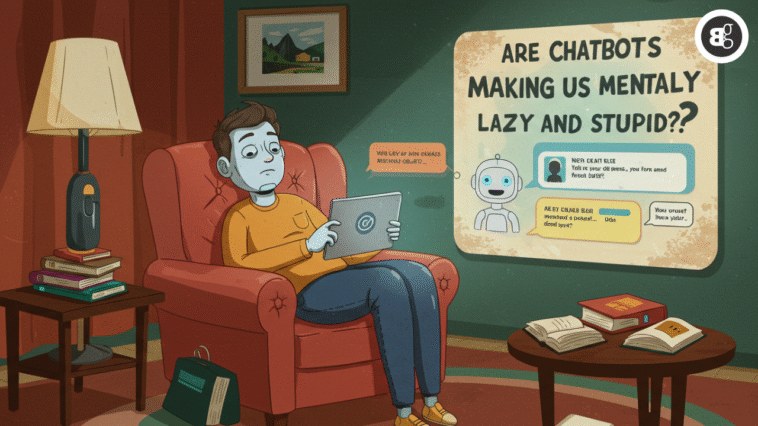
We’ve all seen them, used them, or at least heard of them. Chatbots like ChatGPT or Gemini are everywhere. They help us write emails, answer tricky questions, and even churn out essays. It’s no secret they’re powerful tools, game-changers even. But a really important question is emerging: Is AI making us lazy and dumber? Are these digital helpers making our brains, well, a bit soft? Are they making us mentally lazy or even “dumb”?.
This isn’t just a casual chat; it’s a growing concern for researchers, educators, and even those of us who use AI daily. Some studies are already suggesting alarming trends.

Is Our Thinking Getting Dull?
Many experts point to potential downsides. They worry about what happens when we let AI do too much of our thinking.
Reduced Brain Activity
-
Less Engagement
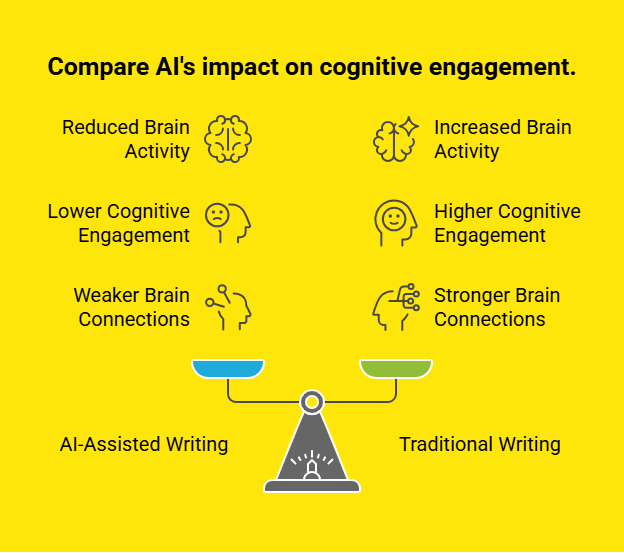
When people use chatbots for writing, their brains show less activity. Research from MIT’s Media Lab found that users had the lowest brain engagement.
-
Lower Brain Signal Activity
EEG headsets in one study showed that students using chatbots had up to 55% less brain signal activity. That’s a huge drop in cognitive engagement.
- Weaker Connections
The MIT study, using dDTF measurements, found weaker connections between different brain parts when students relied heavily on AI. The group using AI had lower levels of mental coordination, focus, and problem-solving.
-
Less “Internally Driven Processing”:
Writing without AI leads to more internally driven processing. Our brains engage in more brainstorming and semantic retrieval. Chatbot users, however, offload some of this “creative burden” to the tool.
Read More: The AI Chatbot Hype: Why AI Chatbots Aren’t Meeting the Expectations
Cognitive Debt and Memory Issues
-
“Cognitive Debt”
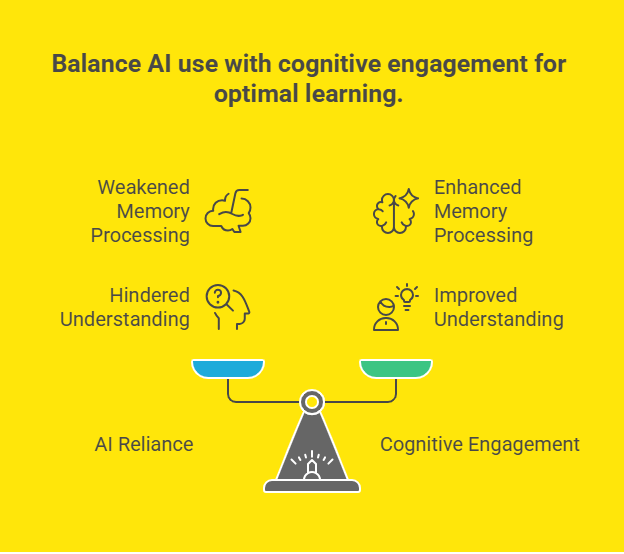
Researchers at MIT introduced the idea of cognitive debt. This is a subtle but accumulating cost to our mental faculties when we outsource too much thinking to AI. This debt can compound over time, much like relying on GPS dulls our sense of direction.
-
Struggling to Remember
People who used ChatGPT for essays really struggled to quote their own writing. They couldn’t remember what they had written.
-
Bypassing Deep Memory Processing
The MIT study showed weaker alpha and theta brain waves in ChatGPT users. These waves are linked to deep memory processing, suggesting AI use bypasses this crucial step. This impacts our ability to retain and recall information, which is key to learning.
-
Hindered Understanding
When students rely on AI to write complex essays, they might bypass the process of synthesizing information from memory. This can hinder their understanding and retention of the material.
Read More: Study Raises Alarms on AI Chatbots Giving Suicide Advice
Declining Critical Thinking and Creativity
-
Thinking Less Critically
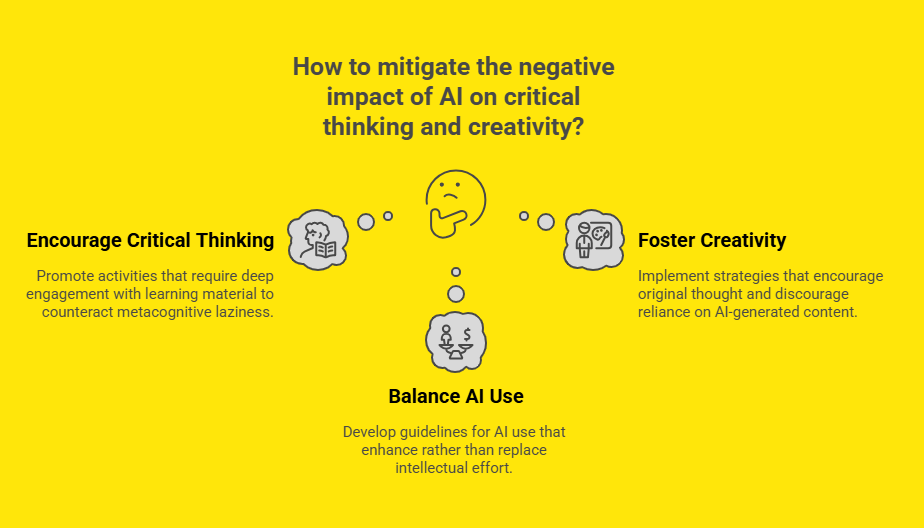
Those who regularly use AI think less critically. A study in Societies found a strong negative correlation between frequent AI use and critical thinking performance. Younger users and those with lower educational attainment were especially affected.
-
“Metacognitive Laziness”:
AI can promote metacognitive laziness. Students offload cognitive and metacognitive responsibilities to the AI. This stops them from deeply engaging with learning material.
-
Loss of Creativity
If everyone relies on chatbots for new ideas, society could lose creativity, among other things. Chatbot-generated essays often lack original thought. They use similar expressions and ideas, making them sound soulless.
-
Avoiding Intellectual Effort
AI makes it easier to avoid the intellectual effort required to internalize key concepts. This effort is crucial for long-term learning and knowledge transfer.
-
“Brain Rot”
Some worry about “cognitive atrophy” or “brain rot” if AI replaces thinking instead of enhancing it.
The Problem of Misinformation and “Hallucinations”
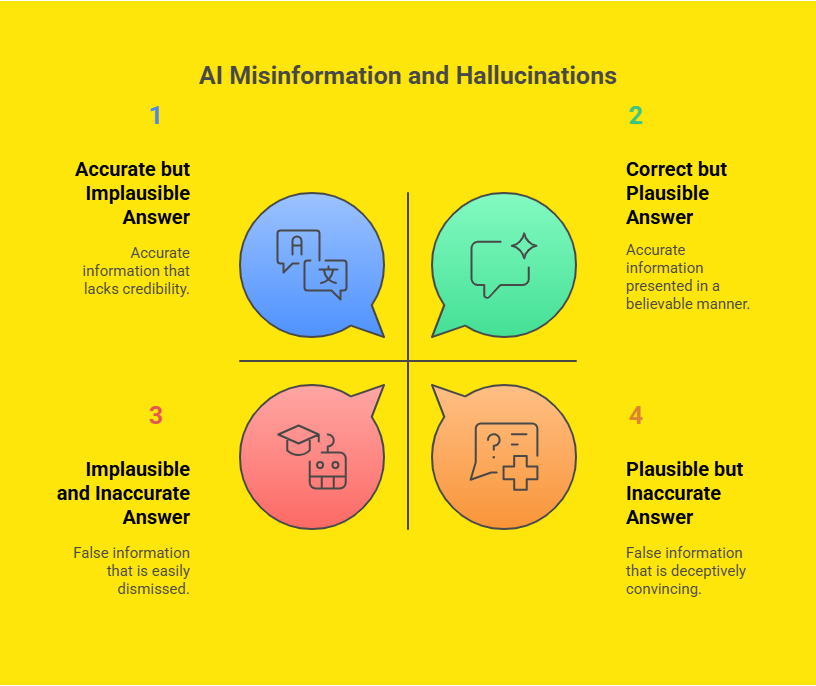
-
Susceptibility to Misinformation
Chatbots can make us more susceptible to misinformation. They give the most plausible answer, which isn’t always correct.
-
Plausible Lies
The problem gets more dangerous when the answer is wrong but sounds plausible enough that you don’t question it. For example, an internet provider’s chatbot gave a RickRoll video link when asked about connecting a box because it was a plausible answer for a stupid question.
-
“Hallucinations”
Bots can make up facts or studies. They present completely false facts or completely misinterpret existing sources. This is a huge problem, especially with technical topics. One user noted ChatGPT was wrong 99.999% of the time or leads you astray on technical topics.
-
“Sloppifying Reality”:
AI generates plausible-sounding text that isn’t necessarily true or connected to any facts. Users often accept AI’s output as fact without verification, which sloppifies reality.
Read More: Chatbots Struggle to Give Safe Health Advice, Study Says
Other Potential Negative Effects
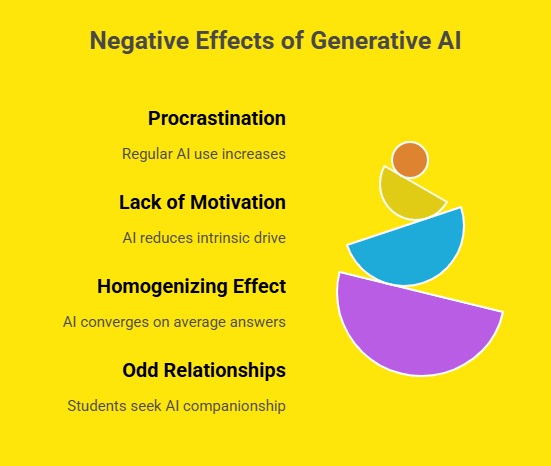
- Procrastination: Those who regularly use AI tend to procrastinate more.
- Lack of Motivation: Using generative AI at work might make people feel productive but less motivated.
- Homogenizing Effect: AI use can have a homogenizing effect, meaning essays or responses converged on the same answer to broad questions. This happens because ChatGPT often takes the average of the entire internet.
- Odd Relationships: Some students are developing odd parasocial relationships with LLMs, turning to them for advice, companionship, and therapy.
The Benefits: A Boost for Productivity?
It’s not all doom and gloom. Many see AI as a powerful tool that can offer significant advantages.
-
Increased Speed and Quality
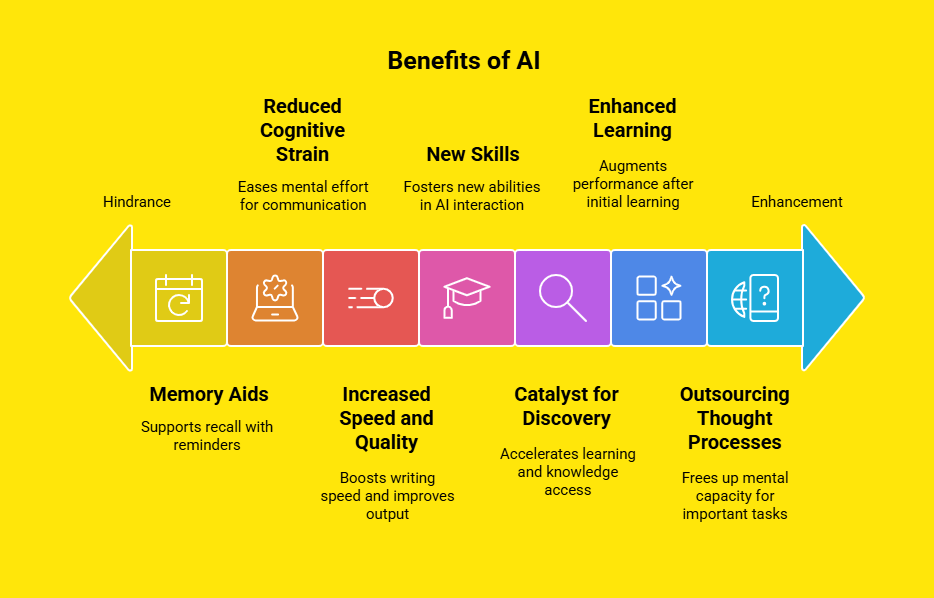
Chatbots can make us about 40% faster at writing tasks. The texts produced are often better. This makes AI a powerful productivity enhancer.
-
Outsourcing Thought Processes
Some experts believe it’s good to outsource certain thought processes. This can free us up to deal with more important things. Humans have always offloaded cognition, from writing things down to using GPS or calendars. AI is the next step.
-
Reduced Cognitive Strain
AI can reduce the maximum cognitive strain required to produce prose. This is beneficial for professional communication, like emails or reports, where the goal is clear information exchange. A CFO, for example, uses ChatGPT to synthesize complex financial data into succinct bullet points for board presentations, finding it efficient for packaging information.
-
Convenience and Access
Chatbots provide direct answers to questions. This avoids the hassle of navigating websites, cookie pop-ups, ads, or subscription walls.
-
Enhanced Learning (When Used Properly)
If you first do the work of learning the thing itself, AI can then augment your performance and make it even better. The MIT study showed that the group who used their brains first, then used an LLM, actually had higher neural connectivity.
-
New Skills
Using AI effectively, understanding its limitations, configuring it, or improving it are new challenges and even new skills.
-
A Catalyst for Discovery
AI can make learning and access to knowledge more efficient and faster for everyone. This can stimulate curiosity and discovery.
-
Memory Aids (with nuance)
While the MIT study showed AI hurting memory for new learning, other digital tools can assist memory. Long-term studies on older adults suggest that seniors using phones to help remember things are less likely to develop dementia. However, this primarily refers to tools like calendar reminders, not generative AI replacing fundamental learning.
Read More: 4 Smart Uses of AI Chatbots for Business Growth in 2025
The Nuance: It’s All About How We Use It
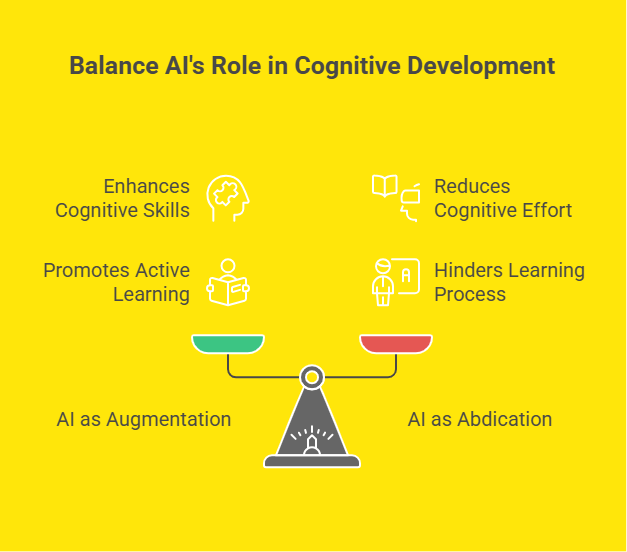
The real impact of AI on our minds often depends on how we use it. Is it a crutch or a tool for augmentation?.
-
Human Tendency to Offload Cognition
Humans have always offloaded cognition. Writing things down, using calendars, or using GPS are all examples. These tools extend what our brains can do by themselves.
-
AI Is Different
However, AI is a bit different from a GPS or a calendar. While a GPS outsources spatial navigation, AI can think for you, potentially leading you to stop thinking altogether. When we let large language models write essays or code for us, we’re giving up something that feels…pretty central to humanness, critical thinking, and creativity.
-
Learning Requires Strain
In learning, mental strain is often a by-product of getting smarter. Minimizing this strain defeats the purpose of long-term conditioning. Our brains, like our bodies, need exercise. The struggle is a feature, not a bug. If students aren’t engaging in mental strain, they won’t learn.
-
Augmentation vs. Abdication
The critical line is between using AI to elevate our thinking (augmentation) or turning over the keys to robots (abdication). We must not let AI replace our thinking instead of enriching it.
How to use AI effectively: Strategies
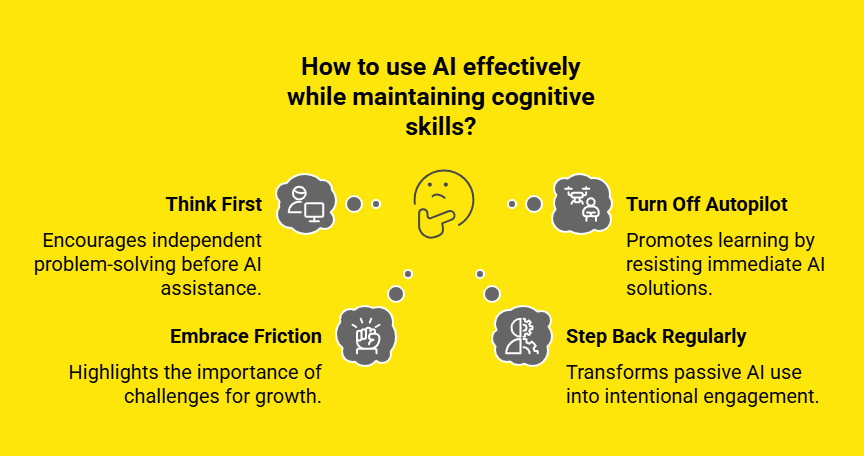
To keep our minds sharp while still benefiting from AI, experts offer some advice:
-
Do Your Own Thinking First
Before consulting a chatbot, wrestle with the problem yourself. Draft your ideas and think through the structure first. Try the thing first before asking AI to do it for us.
-
Turn Off Autopilot
Don’t reflexively turn to AI for answers you could generate yourself. Interrupt this cycle and push through the discomfort of not knowing; that’s where learning happens.
-
Reclaim Friction
Embrace challenging questions or blank pages. Don’t rush to eliminate these obstacles, as growth often requires friction.
-
Step Back Regularly
Ask yourself,
- Why am I using this tool?
- What did I learn?
- What could I do differently next time?
This transforms passive use into intentional engagement.
Read More: 15 Free AI Tools To Boost Productivity and learning in 2025
The Future of Human Thought and Remaining Questions
The impact of AI on our cognition is a relatively new area of study. We need more long-term research, especially to see what happens to young people as they grow up with these tools. We don’t know the effects on college freshmen as they enter the workforce, for instance.
OpenAI, the creator of ChatGPT, has not formally responded to studies like the MIT one, which is disappointing to some. The debate highlights a crucial tension: balancing the utility of AI with the dignity of human thought. Are we using AI to elevate our thinking, or are we turning over the keys to robots?.
The danger isn’t that ChatGPT will replace us. But it can make us stupid—if we let it replace our thinking instead of enriching it. The choice of how we navigate this new technological landscape, for now, is ours.
FAQs
1. Does using chatbots really lower brain activity?
Yes. MIT studies found that students using AI for writing showed up to 55% less brain activity compared to those writing without it.
2. Can chatbots make us forgetful?
They can. People who used ChatGPT for essays often struggled to remember their own writing, showing weaker memory processing.
3. Are chatbots always bad for learning?
Not necessarily. If you first engage your brain—draft ideas, think critically—then use AI, it can actually enhance performance and connectivity.
4. What’s the biggest risk of overusing chatbots?
The main danger is “cognitive debt”—outsourcing too much thinking, which can erode critical thinking, creativity, and memory over time.
5. How can I use AI without getting mentally lazy?
Do your own thinking first, don’t rely on autopilot, embrace challenges, and use AI as a supplement—not a replacement—for your ideas.