Hajra Naz
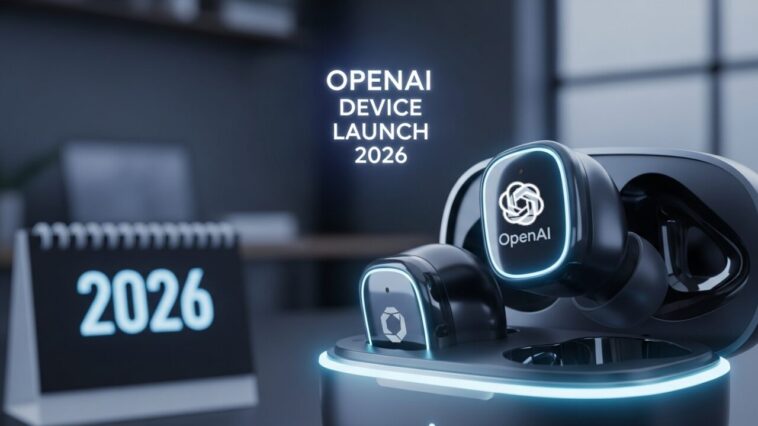
OpenAI fueled intense speculation about its hardware ambitions last year after acquiring io, the startup founded by former Apple design chief Jony Ive. While the company has remained largely silent about what it’s building, OpenAI Chief Global Affairs Officer Chris Lehane said during an Axios-hosted panel at the World Economic Forum in Davos that the company is on track to unveil its first hardware product in the second half of 2026.
OpenAI CEO Sam Altman has previously offered a few hints about the direction of the device, describing it as something more “peaceful and calm” than today’s smartphones. Earlier reports suggest the company is aiming for a screen-free, pocketable device—one that blends into daily life rather than demanding constant attention.

More recent leaks and reports from Asian publications point to a more specific possibility: OpenAI’s first product could be a pair of AI-powered earbuds. The device is reportedly codenamed “Sweet Pea” and is said to feature a distinctive design that sets it apart from existing earbuds on the market. According to these reports, the earbuds may run on a custom 2-nanometer processor and handle AI tasks locally, reducing reliance on cloud-based processing.
Read More: OpenAI Could Make $25B in Ads by 2030—A Threat to Google, Analysts Warn
Manufacturing plans are still taking shape. A report from a major Taiwanese newspaper said OpenAI has explored working with China-based Luxshare, though Foxconn in Taiwan may ultimately become the preferred manufacturing partner. The same report claimed OpenAI is targeting shipments of 40 million to 50 million units in the first year—a notably ambitious goal for a debut hardware launch.
The push into hardware comes as ChatGPT approaches nearly one billion weekly users, even though OpenAI currently depends on third-party devices and platforms for distribution. Launching its own device would give the company greater control over development and distribution, while opening the door to exclusive, purpose-built features that aren’t constrained by existing operating systems.
Still, breaking into a category dominated by products like Apple’s AirPods won’t be easy. Without deep OS-level integration, convincing users to replace the earbuds they already rely on every day could prove challenging.
So far, the broader AI hardware space has struggled to produce a breakout success. Humane’s AI Pin was sold to HP after failing to gain traction, Rabbit’s R1 has cooled off following its initial hype in 2024, and the Friend AI companion necklace quickly drew backlash over its marketing tactics.
Read More: OpenAI Says ChatGPT Will Predict User Age to Improve Child Safety
That said, big tech companies continue to push deeper into wearables. Meta’s Ray-Ban smart glasses have steadily improved and are now selling fast enough that Meta has struggled to meet demand. Amazon, meanwhile, recently acquired Bee, an AI-powered meeting recorder that could evolve into a broader personal companion device.
Whether OpenAI can succeed where others have stumbled remains an open question—but its first hardware launch could become one of the most closely watched AI bets of 2026.