
 Hajra Naz
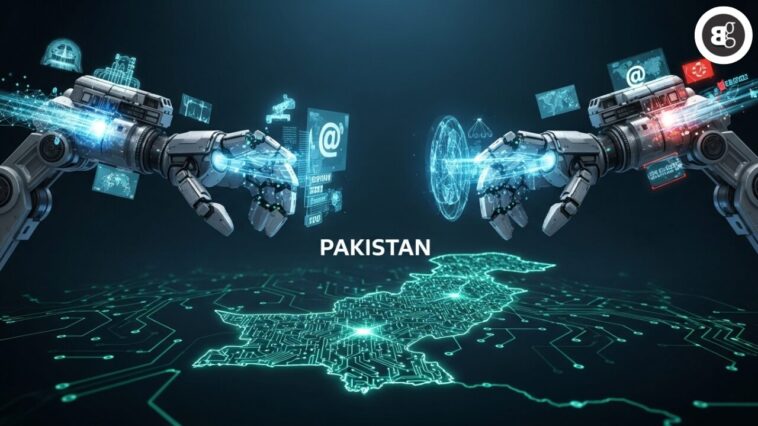
ISLAMABAD: The recently released report by the US-China Economic and Security Review Commission (USCC) offers valuable insights into the complex US-China relationship. It also highlights issues that could have a long-term impact on Pakistan.
The report notes military cooperation between China and Pakistan. It recognizes China’s HQ-9 air defense system, PL-15 missiles, and J-10 aircraft. The commission did not express concern over China’s June 2025 offer to sell 40 J-35 fighter jets, KJ-500 aircraft, and missiles to Pakistan. This indicates the US sees Pakistan as a responsible stakeholder, not fully aligned with either side.

Pakistan imports surveillance technology from China. This includes facial recognition, AI-driven monitoring, and digital ID systems under the Digital Silk Road. These tools support “safe cities” and other security initiatives. Considering Pakistan’s decades-long fight against terrorism, this is a legitimate security measure.
Pakistan’s absence from direct criticism, unlike Russia or Iran, shows that its strategy of balancing China and the US is effective. However, rising US-China hostility over advanced AI and semiconductor technology is concerning.
The USCC recommends that high-performance AI chips be shifted from direct sale to cloud-based rental. Developing countries like Pakistan may then depend on US servers for GPU-powered AI computing. Access would require use-case approvals, and quotas could vary by country. Even commercial firms outside the US would face KYC-style rules to prevent military or surveillance misuse.
The report also flagged China’s acquisition of German robotics firm Kuka. AI-powered robotics is becoming a major global technology battleground.
The Semiconductor Trap
Shifting high-end AI chips from sale to cloud rental shows that technology access is now about control, not commerce. This could create a two-tier world: countries with independent AI infrastructure and those dependent on foreign servers. Data, algorithms, and applications would fall under US oversight.
Technology competition will intensify. Export controls will tighten. Supply chains will fragment. Access to advanced AI, robotics, and semiconductors will be conditional.
Pakistan may soon face a stark choice: reliance on Chinese technology or dependence on Western, mostly American, solutions. Government procurement leans toward Chinese systems, but research institutions still rely on US-based chips.
Pakistan’s National AI Policy and ongoing data center projects risk obsolescence if cloud-only AI chip rental rules arrive before the country secures hardware. Immediate action is required. Pakistan should:
-
Stockpile current-generation AI chips, like Nvidia A100/H100-class GPUs.
-
Invest in AI chip design with open architectures such as RISC-V.
-
Negotiate technology-transfer agreements for semiconductor packaging and testing.
-
Build relationships with emerging chip manufacturers.
-
Join regional tech consortia, like the Asia-Pacific Space Cooperation Organisation.
Failing to act could make Pakistan’s AI ambitions dependent on US permission. Manufacturing competitiveness would rely on Chinese goodwill. Economic development could be constrained by foreign-controlled technology. This is not just an economic issue—it is an existential challenge to sovereignty.
The next two to three years are critical. Today’s accessible technology may face restrictions tomorrow. The USCC report maps the technological fault lines that will shape the 21st century. Pakistan cannot match superpowers in scale or resources. However, it can build a resilient, diversified tech ecosystem to maintain access to multiple sources. The window for decisive action is closing rapidly.
FAQs
Why is Pakistan’s AI strategy important in the US-China tech rivalry?
Pakistan’s balance between China and the US allows it to access technology from both sides without fully aligning, protecting strategic autonomy.
What are the risks of the US moving to cloud-based AI chip rentals?
Pakistan could lose the ability to build independent AI data centers and become dependent on foreign-controlled cloud servers.
How can Pakistan secure its AI and semiconductor future?
By stockpiling GPUs, investing in open-architecture chip design, pursuing tech-transfer agreements, and joining regional tech consortia.
What role does China play in Pakistan’s technology ecosystem?
China provides surveillance tech, military equipment, and AI solutions, supporting security and infrastructure projects.
Why are the next 2–3 years critical for Pakistan?
Technology currently available may be restricted soon, and strategic decisions now will determine Pakistan’s future access to AI and semiconductor capabilities.