Hajra Naz
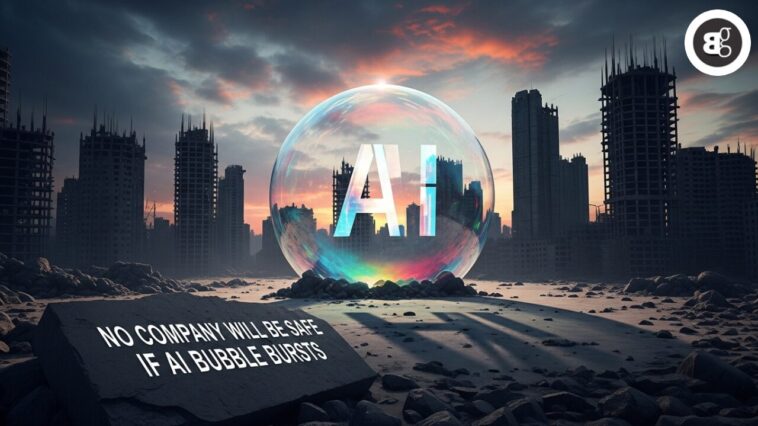
Every company would feel the impact if the AI bubble bursts, Alphabet CEO Sundar Pichai told the BBC.
Speaking exclusively, Pichai said AI investment has been an “extraordinary moment.” Still, he acknowledged some “irrationality” in the AI boom.

The comments come amid fears in Silicon Valley and worldwide. Valuations for AI tech companies have soared recently, and investments have been massive.
Asked if Google would be immune, Pichai said the company could weather a potential storm. But he warned,
“I think no company is going to be immune, including us.”
In a wide-ranging interview at Google’s California headquarters, he also discussed energy needs, slowing climate targets, UK AI investment, AI model accuracy, and AI’s effect on jobs.
Scrutiny on the AI market has never been higher. Alphabet shares doubled in seven months to $3.5 trillion. Investors are confident in Google’s ability to compete with OpenAI and other AI players.
Alphabet focuses on developing specialized AI superchips. These compete with Nvidia, which recently reached a $5 trillion valuation.
Read More: How to Understand the AI Bubble Without Panic?
Analysts are skeptical of the $1.4 trillion of deals around OpenAI, whose expected revenue this year is tiny compared to investments.
Echoing Alan Greenspan’s 1996 warning of “irrational exuberance” during the dotcom boom, Pichai said AI investment cycles can “overshoot.”
He said,
“We can look back at the internet. There was excess investment, but its impact was profound. AI will be the same. It is both rational and partly irrational.”
Jamie Dimon, CEO of JPMorgan, recently warned that while AI investment pays off, some funds could be lost.
Pichai said Google’s “full stack” model – from chips to YouTube data, models, and frontier science – positions it well to handle AI market volatility.
Alphabet is also expanding in the UK. In September, it pledged £5 billion for AI infrastructure and research over two years.
The company plans state-of-the-art research in the UK, including at DeepMind in London. Google may eventually train AI models in the UK, supporting the country’s rise as the world’s third AI “superpower” after the US and China.
Pichai emphasized the “immense” energy needs of AI. AI accounted for 1.5% of global electricity use last year, according to the International Energy Agency.
He called for action to scale energy infrastructure and develop new energy sources to avoid constraining economic growth.
Pichai admitted energy-intensive AI work has slowed some climate progress. Yet, Alphabet still aims for net zero by 2030 through new energy technologies.
Read More: Are We Facing an AI Bubble? Financial Experts Issue Caution
AI will transform work, Pichai said, calling it “the most profound technology” humans have created.
He warned of societal disruption but also new opportunities. Jobs will evolve, and workers must adapt.
“Those who adapt to AI will do better,” Pichai said. Teachers, doctors, and other professionals will remain, but success depends on learning AI tools.
FAQs
1. What did Sundar Pichai warn about the AI bubble?
He said every company, including Google, could be affected if the AI bubble bursts.
2. How is Alphabet preparing for AI market volatility?
By owning a “full stack” of technologies, including chips, models, and data, Google can better manage AI market risks.
3. How is Alphabet investing in AI in the UK?
Alphabet pledged £5 billion over two years for AI research, infrastructure, and DeepMind’s expansion.
4. What are the energy implications of AI?
AI accounted for 1.5% of global electricity use in 2024, requiring new energy sources and infrastructure to scale responsibly.
5. How will AI impact jobs?
AI will disrupt and evolve jobs. Professionals who learn to use AI tools will thrive, while others may need to adapt to new workflows.