
 Huma Siraj
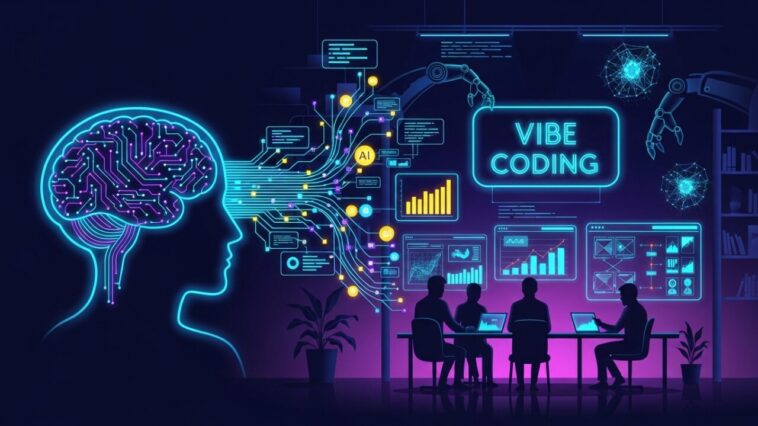
The phrase “Vibe Coding” has been named Collins Dictionary’s word of the year. It really describes a deep shift in how digital products are created by non-technical, or indeed technical, entrepreneurs. Forget years of schooling in programming: an AI will now write the code for you when you tell it what you want.
Vibe coding was invented by Andrej Karpathy, a founding engineer of OpenAI and former director of AI at Tesla. The term itself describes “the use of natural language to help write computer code” thanks to artificial intelligence. As stated by Karpathy, “The hottest new programming language is English.”

You tell the AI that you would want an app that could either track customer orders or plan meals for the week. The AI generates code. You test it, iterate on your instructions, and repeat until it works. No remembering syntax. No cryptic error messages to debug. Just conversation and iteration.
It is pretty popular among entrepreneurs. Riding the vibe coding wave, Swedish AI startup Lovable became a unicorn in July this year. Founders who couldn’t write a single line of code a year ago are launching SaaS products.
But know what you are really dealing with before quitting your work in the expectation of earning millions overnight. It used to take months to get to a functional prototype; today you can start something useful. Pretty much the bare minimum initial investment is needed to start a firm.
On the other hand, an app that supports 10,000 users is quite different from one which supports only 10. Your vibe-coded MVP proves demand and illustrates the idea. When real traffic arrives, it will most likely not scale gracefully.
Expert developers know how to design a server, implement security procedures, and optimize databases. Vibe coding ignores all these underpinnings. You will definitely need real engineering experience when your user base grows and your software starts breaking and you have to rebuild the infrastructure effectively.
Vibe coding is a quick way to test an idea. When you have traction, dedicate money to proper development. The speed of an MVP is revolutionary. Traditional knowledge will be required going from an MVP to enterprise-grade.
Product Market Fit Can’t be Vibe-Coded
The barrier to entry just disappeared. You don’t need to spend six months or $50,000 on developers to build your first version. Create your product during the weekend. Launch on Monday.
Have customer feedback by Friday. At this speed everything about validation is different. Experiments that fail will cost days, not years. Pivots happen based on real user behavior in real time.
But accessible is not the same thing as automatic. You still have to find clients, perfect your offer, and develop a viable company plan in order to succeed. Vibe coding takes care of the technical creation. Everything else is still up to you.
You shouldn’t expect AI to teach you how to sell or solve your market fit problems. It removes one of several hurdles. The business principles remain the same. Your customers still need to pay for solving their problems.
Look For Opportunities to Grow
There’s a limit to how many clients you can take on. There’s a limit to how many hours your crew can work. Service companies have natural boundaries. But what if you took that knowledge and put it into products your customers could use on their own?
This is a great opportunity for agencies who have customer knowledge built up over years. Deep market knowledge becomes your competitive advantage.
Pay attention to what your customers keep asking for. Take note of the problems that arise in every interaction. Then, in vibe code, develop technological solutions that solve those specific problems for them.
A marketing firm might develop an AI tool that builds social media schedules. A design studio could create a brand consistency checker. An SEO consultancy might create software for automated audits.
Use your human skills to build things that work for you while you sleep. Your existing customers become your first customers and beta testers.
Products Become Commodities In an Instant
Product designer Matt Boyle says, “It’s never been easier to ship something terrible.” Products aren’t unique any longer once anyone can build them. The features of your application will no longer differentiate it. The very same AI tools you leveraged today will be used tomorrow by someone else to copy them.
In other words, Kelly Coutinho of Zero100 says, “When anyone can speak to the system, barriers fall, starting costs approach zero, and creativity soars.” But the required pre-condition, she says, is “to make human language the interface, execution the moat, and vibes into enterprise value.”
Your personal brand is front and center. More than offering features, you build a community. Not code repositories, but relationships get you clients. Distribution and trust are your real competitive advantages. Technology simply enables the business. The company itself demands entirely different strengths.
Learn the technique first before expecting results. Typing “make me rich” into ChatGPT is not vibe code. You need to understand how to debug outputs, arrange prompts, and guide the AI toward useful answers. These skills are learned through community, tutorials, and courses.
Before expecting returns, you should invest in education. Instead of thinking like programmers, the best feel coders think like product managers. Business artificial intelligence lecturer Mark James says, “I worry about quality and understanding when people lose touch with the mechanics over time.”
Even if AI does the heavy lifting, you still need to have enough understanding to identify issues, guide changes, and determine when a product is truly ready for consumers. Recognize when the AI is producing junk. Know enough about code structure to interact with actual developers in an efficient manner when necessary.
The most proficient vibe coders are aware of the potential and constraints of their tools. Vibe code: enjoy freely, while keeping an eye on business. Vibe coding democratizes creation. Gone for most of the past decades were barriers sheltering entrenched players. Every entrepreneur overnight acquires technical chops.
The upside is easier creation breeds more competition for attention, trust, and customer loyalty. Other considerations determine who wins once everyone can create. Create your things fast. Test everything. Scale what works.
However, real challenges for real people who have faith in your ability to solve them are the source of enduring success. Even though the code is free, gaining trust from customers is still incredibly expensive. The how is taken care of by vibe coding. You still need to know who and why.


