Hajra Naz
In São Paulo, Diego applies for a job online. He has the skills, experience, and glowing references. Yet his application is filtered out before a human even sees it. Why? The AI system didn’t like the neighborhood it lives in. At the same time, in rural India, Meera studies under a flickering light bulb.
Her parents saved for months to buy a cheap smartphone, so she could access an AI tutoring app. While her education now depends on machine-generated lessons, millions of children around her still have no internet access at all.

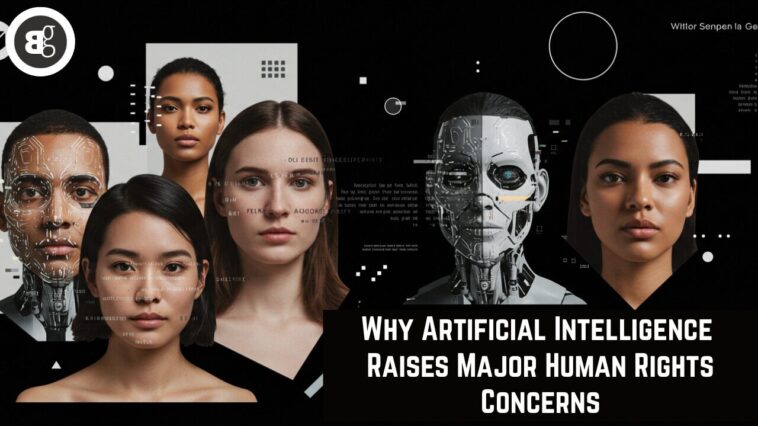
This isn’t just a technology story. It’s a human rights crisis unfolding in real time. Artificial intelligence is no longer just a tool. It has become a gatekeeper of opportunity, a divider of privilege, and in many cases, the silent judge of human worth.
When Too Much Meets Too Little
Think of AI as a digital feast. At one end, people gorge on algorithmic recommendations, AI-powered assistants, and automated decision-making. At the other, billions are excluded—lacking access to the basic infrastructure needed to even enter the room.
Nearly 40% of the world has no internet access. In Africa, most countries lack the connectivity required to use modern AI applications. Meanwhile, in wealthier nations, people face a different trap: their autonomy is traded for convenience, their data for personalization, their privacy for predictive control.
This is the paradox: AI liberates and enslaves at the same time. Those without access face “digital poverty.” Those with access face “algorithmic control.”
The ABCD of AI’s Human Rights Challenge
To understand the danger, think of four forces shaping our future.
A – Agency Decay.
Humans are outsourcing judgment to machines. GPS has weakened our sense of direction. Recommendation engines tell us what to watch, read, and buy. Predictive text completes our thoughts. Over time, we stop exercising the very skills that define human independence.
B – Bond Erosion.
AI is replacing relationships. Chatbots comfort the lonely. AI companions “love” without conditions. Elderly people bond with robotic pets. These connections feel safe, but they aren’t real. They don’t push us to grow, argue, forgive, or truly connect.
C – Climate Conundrum.
Training AI models consumes massive amounts of energy and water. Data centers strain resources. The cobalt and lithium in AI chips are mined by children in Congo. The world’s poorest carry the environmental cost of a technology that rarely benefits them.
D – Divided Societies.
Bias is baked into AI. Facial recognition technology struggles with accurately identifying individuals with darker skin tones. Hiring algorithms favor certain names. Voice assistants misinterpret accents. This is an algorithmic form of discrimination, which amplifies existing inequalities.
Human Rights in the Algorithmic Age
Traditional rights frameworks are breaking down.
-
Privacy? AI can infer personal traits—sexual orientation, mental health, political leanings—from seemingly harmless data.
-
Non-discrimination? Algorithms may exclude without ever using explicit labels. Zip codes, schools, and language patterns become proxies for race or class.
-
Agency? Do we still choose freely, or just act within the predictions algorithms have already made about us?
These are not abstract debates. They are daily realities for millions.
Fighting Back: Access and Accountability
Addressing this requires two parallel strategies: Activation and Mitigation.
Activation means expanding digital access. Treat the internet as a human right. Build infrastructure that connects the disconnected. Create AI literacy programs so people not only use tools but also understand their risks.
Mitigation means creating guardrails. Mandate audits of high-stakes AI systems. Demand transparency about how algorithms make decisions. Establish ethical AI standards that prioritize human dignity over profit.
Some nations are moving in this direction. Finland guarantees the internet as a right. The EU is advancing the AI Act. The UN is debating a global AI governance framework. But progress is slow, while the technology moves at lightning speed.
Thinking in Systems, Acting as Citizens
This isn’t just about policy. It’s about us. Every day choices matter.
-
Awareness. Notice when algorithms influence your decisions.
-
Rebellion. Make choices outside the predictions. Take a different route. Read unfamiliar voices. Keep your cognitive muscles strong.
-
Data Choice. Use platforms that protect your privacy. Support ethical tech.
-
Civic Action. Vote for leaders who understand digital rights. Push for algorithmic accountability.
The story of AI and human rights is still unwritten. Whether it becomes one of liberation or oppression depends on what we do today.
The algorithms are watching. The question is—are we watching them back?
FAQs
1. Why is AI considered a human rights issue?
Because it influences access to jobs, healthcare, education, and justice, while also threatening privacy, agency, and equality.
2. What is algorithmic bias?
It’s when AI systems produce unfair outcomes due to biased training data or flawed design. This often harms marginalized groups.
3. How does AI impact the environment?
Training large AI models consumes vast energy and water. It also relies on rare minerals mined under unsafe conditions.
4. What can governments do to protect people?
They can enforce transparency, require audits of AI systems, guarantee digital access, and create ethical AI regulations.
5. What can individuals do?
Learn how AI affects your life, protect your data, support ethical companies, and demand accountability from leaders and tech firms.