Hassan Khan
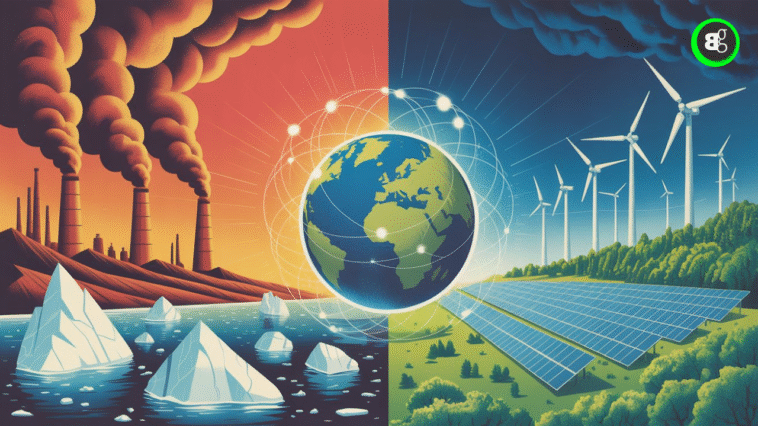
When people talk about climate change, the first images that pop up are usually depressing melting ice caps, scorching summers, and wildfires burning through forests. It feels scary and honestly, overwhelming. Most of us wonder, “What can I possibly do about this?”
Technology, especially Artificial Intelligence (AI), is already stepping in as a quiet partner in this fight. It’s not just tech jargon anymore. AI is being used in very practical ways from predicting extreme weather to making our energy use smarter.

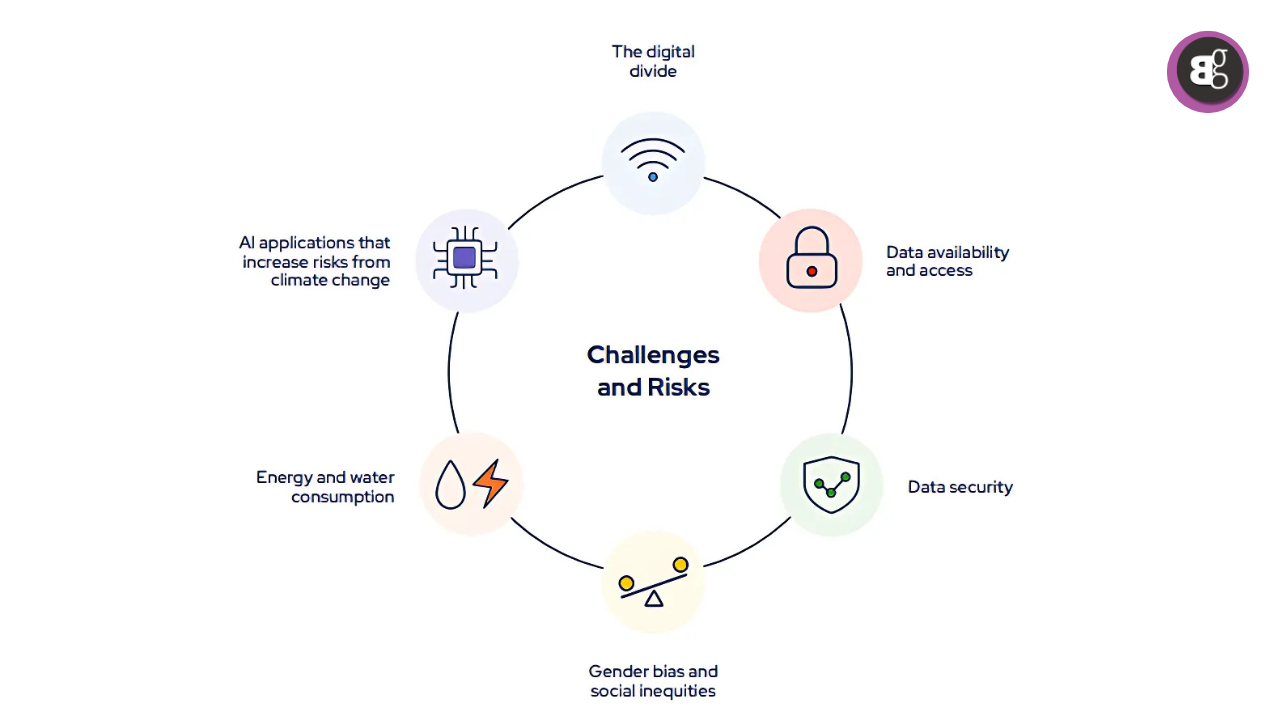
Challenges and Risks
No 1. Smarter Weather Predictions
AI improves climate forecasting by analyzing massive datasets like satellite images and temperature records. This helps predict hurricanes, floods, and droughts with greater accuracy.
Keypoints:
-
AI models give early warnings for extreme weather.
-
Farmers and cities can prepare better for disasters.
-
Works like “Google Maps for climate,” suggesting smarter routes of action.
That’s not just about knowing if you’ll need an umbrella tomorrow. It’s about predicting floods, hurricanes, or droughts days, even weeks, in advance. Farmers can protect crops. Coastal towns can prepare before storms hit. The earlier the warning, the better the chances of reducing damage and saving lives.
See More: The Role of Artificial Intelligence(AI) in the E-commerce Landscape
You could think of it as Google Maps for climate: instead of showing traffic right now, it predic ts where the jams will be and suggests alternate routes.
No 2. Cutting Carbon Waste
AI tracks and minimizes carbon footprints in industries, homes, and cities. Companies like Google use AI to cut energy use in data centers.
Keypoints:
-
Smart grids distribute energy efficiently.
-
AI ensures renewable energy sources are prioritized.
-
Everyday devices (ACs, thermostats, EVs) reduce unnecessary power waste.
Our daily lives driving, powering homes, running factories all add up to a massive carbon footprint. AI is starting to chip away at that.
Take Google, for example. Its data centers used to consume huge amounts of energy, but AI now optimizes cooling systems, slashing energy use. On a city wide level, AI driven “smart grids” manage electricity more efficiently, prioritizing renewable sources like solar or wind.
No 3. Farming That Wastes Less
AI supports eco friendly farming by guiding planting decisions, detecting crop diseases, and improving livestock management.
Keypoints:
-
AI drones identify crop issues early.
-
Predicts soil health, rainfall, and planting schedules.
-
Reduces methane emissions by improving animal health and feed.
Agriculture is responsible for a big slice of global emissions. Yet, it’s also one of the industries where AI is proving incredibly useful.
Farmers are using AI to understand soil conditions, predict rainfall, and figure out the best planting times. Drones powered by AI can scan entire fields, spotting diseases early and saving crops before they’re lost. Even livestock farms are using AI to track animal health, which helps reduce methane emissions.
With the world heading toward 10 billion people by 2050, we need food systems that are both productive and sustainable. AI is helping create exactly that.
Read More: AI’s Hidden Climate Cost: How Our Digital Habits Shape the Planet
No 4. Watching Over Forests and Oceans
AI tools monitor forests and oceans, sending real time alerts about illegal logging, wildfires, and marine damage.
Keypoints:
-
Satellites detect deforestation in real time.
-
AI tracks coral bleaching and ocean temperature changes.
-
Helps policymakers and conservationists act faster.
Forests and oceans act as the earth’s lungs, absorbing carbon and keeping balance in our ecosystem. Sadly, they’re under constant threat from logging, fires, and pollution. AI is now being used as a watchdog.
Global Forest Watch, for instance, uses satellite imagery and AI to detect illegal logging and fires almost in real time, sending alerts to authorities. Similarly, AI is helping monitor coral reefs, ocean temperatures, and even illegal fishing activities.
No 5. Boosting Renewable Energy
AI enhances renewable energy by forecasting demand and optimizing usage of solar, wind, and hydro systems.
Keypoints:
-
Wind turbines adjust automatically with AI.
-
Solar farms balance storage using AI predictions.
-
EV charging stations optimize energy distribution.
Solar and wind energy are vital for the future, but they’re not always predictable. AI helps smooth things out by forecasting energy demand and managing how power is stored and distributed.
For example, wind turbines with AI can automatically adjust their blades to maximize efficiency. Solar farms use AI to predict sunlight hours and optimize storage. Even electric vehicle charging stations rely on AI to manage energy use more effectively.
By making renewable energy more reliable, AI speeds up our shift away from fossil fuels.
No 6. The Flip Side: Challenges of AI
While AI is powerful, it requires high energy for model training and can increase emissions if not powered by renewables.
Keypoints:
-
Large AI models consume significant energy.
-
Access inequality: rich vs. developing nations.
-
Accuracy depends on high quality data and transparency.
Then there’s the question of fairness: will developing nations often hit hardest by climate disasters get access to AI solutions, or will they stay concentrated in wealthier countries?
Finally, AI is only as reliable as the data it’s trained on. Poor data can lead to bad predictions, which can be dangerous when dealing with something as serious as climate change.
AI-Driven Solutions for Advancing Adaptation Action

Conclusion: AI Role in Climate Change
Climate change is the biggest challenge of our lifetime. It’s easy to feel like there’s nothing we can do. But AI shows us that we’re not powerless.
No, AI won’t magically fix everything. But it gives us tools to predict, to prevent, and to protect. The real change comes when we combine those tools with human action: governments enforcing policies, businesses adopting sustainable practices, and everyday people making eco-friendly choices.
Instead of feeling paralyzed, we can feel empowered. AI may be working quietly in the background, but together with human effort, it’s part of the fight for a greener and safer future.
FAQs
1. How does AI help in climate change?
AI helps forecast climate events, optimize energy use, improve farming, and protect ecosystems, making climate action smarter and faster.
2. Can AI cut carbon emissions?
Yes. From smart grids to home devices, AI ensures energy is used more efficiently, cutting down on unnecessary emissions.
3. Is AI enough to solve global warming?
Not alone. AI provides tools and insights, but governments, companies, and individuals still need to act on them.