Hajra Naz
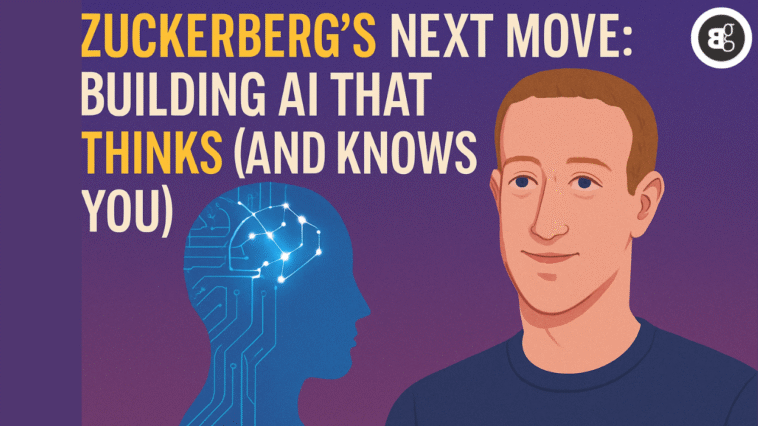
Mark Zuckerberg just laid out his next big bet for Meta: building AI that doesn’t just spit out answers but can think in ways closer to humans.
Right now, even the flashiest AI tools can’t do that. They sort through mountains of data to guess what fits best as a reply. That’s not the same as real understanding or creativity. Meta’s AI lead, Yann Lecun, has pointed out this gap again and again. What we have today is clever pattern-matching, not true reasoning or awareness of the real world.

Zuckerberg wants to change that. His new plan is to build what he calls “superintelligence.” In plain terms, he’s pushing for AI that can reason, adapt, and maybe even spark new ideas on its own. It’s the sort of leap that’s been science fiction until now. And yes, it does sound unsettling. But with Meta’s deep pockets and technical firepower, the attempt feels inevitable.
Zuckerberg says the end goal isn’t just smarter chatbots. It’s something far bigger: giving everyone their own AI companion. Picture an always-on assistant that understands what you care about, helps shape your day, and nudges you closer to who you want to be. It could even join conversations, plan projects, or share your interests.
Parts of this vision feel a bit cold, like using AI to “be a better friend.” Human relationships are messy and real; outsourcing them to a machine seems off. But for Zuckerberg, tech has always been about bridging people and ideas—even if the bridge feels artificial.
Read More = Mark Zuckerberg Unveils Meta’s 5GW AI Data Center Project
To pull this off, Meta’s bringing in top names from other AI efforts. The team now includes Shengjia Zhao, who helped build ChatGPT, and Alexandr Wang, once CEO of Scale AI.
Their mission: create a digital system that mirrors the connections in our brains. A digital mind, built to understand the world the way we do.
Meta’s been laying the groundwork for this for years. Projects like V-JEPA 2 aim to teach computers how to see and predict like humans. Another effort, dubbed “Brain Decoding,” tries to map and translate our neural activity. Even Meta’s old brain-computer interface experiments fed into this push, giving researchers a closer look at how thoughts flow.
Now, Zuckerberg’s ready to throw in “hundreds of billions” to speed things up. He imagines a future where wearable devices—maybe glasses or something even smaller—act as your AI partner. They’d see what you see, hear what you hear, and step in to help whenever you want.
That idea feels both exciting and risky. On one hand, it could mean a daily boost: AI that knows your plans, your habits, and what matters to you. On the other hand, it raises big questions about privacy, control, and what makes someone human.
As Zuckerberg sees it, the next few years will set the direction: whether AI becomes a tool people use to grow or something that replaces whole parts of our lives. He’s betting on the first. But no one knows what happens when you mix billions in funding, cutting-edge brain science, and the dream of building digital minds.
What’s clear: Meta isn’t just playing catch-up anymore. It’s going all in on a future where AI won’t just help us search or chat but could reshape how we think and live.