
 Hassan Khan
For Many Years, Artificial Intelligence (AI) felt like something reserved for Silicon Valley giants complex systems, expensive data teams, and billion dollar budgets. But today, that perception couldn’t be further from the truth. Across local shops, startups, and small firms, AI is quietly becoming the secret weapon for productivity and growth.
According to Intuit’s QuickBooks Small Business AI Report (2024), 68% of small businesses now use AI, and three out of four say it helps them do more with less. What’s even more surprising? Most of these gains come from simple, easy to use tools that anyone can start with no coding or big investment required.

The magic lies in a focused 90-day plan: one problem, one goal, and one clear way to measure success.
Why AI Belongs to Small Businesses Now
AI is no longer a luxury. It’s built into the same apps small businesses already use every day from Microsoft 365 and Google Workspace to Shopify Magic and QuickBooks Smart Tools.
According to Deloitte’s SMB Tech Outlook (2024), small businesses that adopt AI tools see:
-
12% faster task completion
-
9% higher customer satisfaction
-
7% increase in sales within three months
In short, small businesses aren’t playing catch up anymore they’re leading the way in practical AI adoption.
Read More: 90% of Tech Workers Now Use AI on the Job, Google Study Finds
The 90 Day AI Sprint Plan
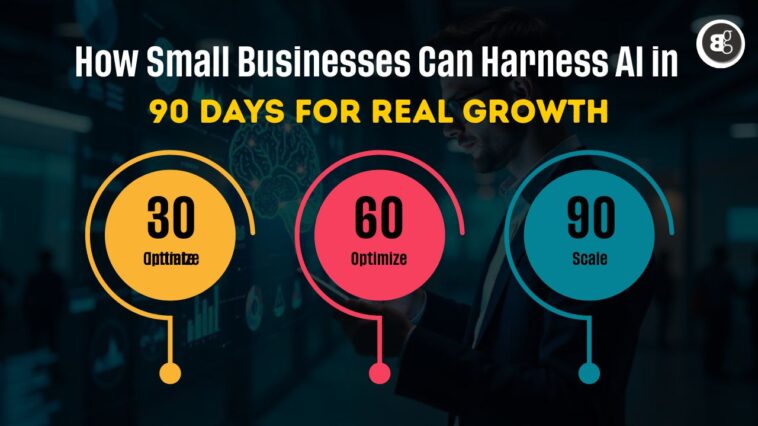
A 90 day plan gives small teams the structure to test AI without confusion or wasted money. The approach is simple: focus on one pain point, use tools you already own, and measure real impact.
Here’s a step by step table showing how to structure your 30–60–90-day AI adoption plan:
AI Implementation Plan: 30-60-90 Day Roadmap
| Phase | Timeline | Key Focus | Actions | Goals / Metrics |
|---|---|---|---|---|
| Phase 1: Initiate | Days 1-30 | Identify one business challenge |
|
|
| Phase 2: Optimize |
Days 31–60 | Measure performance and refine |
|
|
| Phase 3: Scale | Days 61–90 | Expand and evaluate |
|
|
Step 1: Identify One Pain Point
Start by spotting your biggest workflow headache. Maybe your emails pile up, your social media goes silent, or your invoices take forever.
Pick one issue not three and dedicate 90 days to fixing it using AI.
Examples:
-
Slow responses? Add an AI chatbot or automated FAQ emails.
-
Paper overload? Let AI in QuickBooks or Zoho categorize transactions automatically.
-
Marketing inconsistency? Use AI tools like Jasper or Canva Magic Write to schedule regular posts.
You’re not transforming your business yet just running a smart test.
Step 2: Use the Tools You Already Own
Most teams already pay for AI without realizing it.
For instance:
-
Google Workspace can summarize meetings and draft replies.
-
Microsoft Copilot can handle repetitive emails.
-
Shopify Magic can generate SEO friendly product descriptions.
Even using these built-in features can save 3 to 5 hours weekly, according to NFIB’s 2024 Tech Study. Before spending money on new platforms, turn on what you already have.
Step 3: Measure What Matters
Treat AI like an employee it needs to earn its spot.
Establish a baseline (your current time, cost, or accuracy). Then measure again after 30, 60, and 90 days.
Example metrics:
-
Time to complete a task
-
Average customer response time
-
Cost per lead or per sale
Businesses that track these metrics are twice as likely to scale AI successfully, according to Deloitte’s data.
Keep it visual even a two column sheet titled “Before AI vs After AI” can reveal powerful results.
Step 4: Protect Your Data
Data safety must come first. Don’t upload sensitive customer or financial data into free public AI tools.
Instead, use AI features within licensed business software that include encryption and privacy compliance.
As per the Cyber Readiness Institute (2024), every small business should have a one page AI policy that answers three simple questions:
-
What data can be uploaded?
-
Which AI tools are allowed?
-
Who reviews AI outputs before they’re shared?
It’s not about limiting creativity it’s about protecting your trust.
Step 5: Train Your Team, Not Just Prompts
AI isn’t plug and play. Your team must understand both the “Why” and the “How.”
According to the HubSpot State of Marketing AI Report (2024), even short, 15 minute weekly training sessions can increase team adoption by 40%.
Ask your staff:
-
What did AI save time on this week?
-
What mistakes happened?
-
What should remain manual?
This builds confidence, transparency, and smarter use.
Step 6: Review, Decide, and Scale
At the end of 90 days, evaluate the impact like an investor.
-
Did AI reduce costs or increase sales?
-
Did it save team time or improve customer satisfaction?
-
Did employees feel more efficient or frustrated?
If the pilot worked, expand it to another task like using AI for social media captions, invoices, or analytics reports.
If it didn’t, document what went wrong and adjust. Experimentation is part of progress.
According to Intuit’s 2024 AI Adoption Study, 82% of small businesses that completed one pilot expanded AI to other operations within six months. Once owners see the time saved, there’s no going back.
The Real Reward: Freedom to Focus
AI isn’t here to replace humans it’s here to remove the busywork that holds small businesses back.
The NFIB Survey (2024) revealed that AI adopters reported 14% better work life balance and 20% more time spent on strategic tasks like customer care and business development.
When repetitive work is automated, owners finally get back what matters most time, creativity, and focus.
Checklist to Start This Week
-
Identify one workflow that drains time.
-
Enable the AI feature in your existing tools.
-
Write a one-page AI data policy.
-
Measure progress at 30, 60, and 90 days.
-
Hold 15 minute weekly check-ins.
-
Review results and expand what works.
Conclusion
AI isn’t the future of small business it’s the present advantage. The smartest owners aren’t trying to “do everything with AI.” They’re using it to fix one small problem at a time faster customer replies, cleaner accounting, better marketing.
With a disciplined 90 day plan, your small business can see measurable results without fear or complexity.
As Deloitte’s 2024 analysis concluded:
“Small businesses that start small, measure results, and adapt fast are the ones that lead in long-term AI-driven growth.”
Start your first 90-day sprint today. Three months from now, you’ll stop asking if AI is right for your business and start wondering how you ever worked without it.