
 Hajra Naz
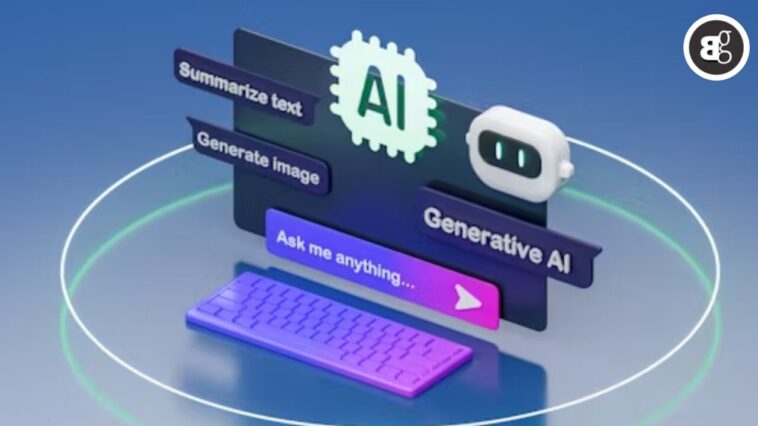
Artificial intelligence (AI) is everywhere in your phone, your searches, and even the tools you use at work. But one branch of AI is making the biggest buzz today: Generative AI. It’s the technology that can write stories, draw pictures, compose music, and even code.
To understand how this powerful technology works, it helps to know the key terms behind it. Let’s break them down in simple words.

What is generative AI?
Generative AI is a type of AI that can create new data or content — like text, images, audio, or video.
Unlike traditional AI that just analyzes or classifies information, generative AI actually produces something new. Tools like ChatGPT, DALL·E, and Midjourney are good examples.
Read More: The Future of Artificial Intelligence: Generative AI and Its Game-Changing Impact
Discriminative AI
While generative AI creates, discriminative AI focuses on decision-making and classification.
It looks at existing data and tries to decide which category something belongs to. For example, it can identify whether an email is spam or not.
AGI – Artificial General Intelligence
AGI is what scientists call the next big dream in AI. It refers to machines that can think and learn like humans, not just follow commands or repeat patterns.
An AGI system would be able to reason, solve problems, and understand the world across different areas, just like people do.
ASI – Artificial Super Intelligence
ASI is the concept of AI that’s smarter than humans in every way. It’s still just an idea, but many experts debate its impact.
Some believe ASI could help solve major world problems; others worry it could be risky if not controlled.
ANI – Artificial Narrow Intelligence
Today’s AI systems, including ChatGPT and Siri, are Artificial Narrow Intelligence (ANI). They are built to perform specific tasks, like answering questions or recognizing faces.
They are powerful but limited; they don’t understand or think beyond their programming.
Foundation LLM
A Foundation Large Language Model (LLM) is the core technology behind most AI tools. It’s trained on massive datasets and can understand and generate human-like text.
Once trained, it can be adapted for many uses, from chatbots to translators.
Self-Supervision
Self-supervision means an AI model learns from patterns in data without human labels. It figures out relationships on its own, like predicting the next word in a sentence. This method helps AI models learn faster and at a much larger scale.
Domain Adaptation
Sometimes, an AI trained in one area needs to work in another. Domain adaptation helps a model adjust to new topics or types of data — like moving from English news articles to medical research papers — while keeping its skills.
Context Length
This term means how much information or text an AI model can remember in one go. A longer context length means the AI can hold more conversation or understand a larger piece of text before forgetting earlier parts.
Zero-Shot and Few-Shot Learning
Zero-shot learning happens when AI answers questions or performs tasks it was never directly trained on. Few-shot learning means it only needs a few examples to learn something new.
These skills make modern AI more flexible and powerful.
Transformer
The transformer is a type of model design that changed everything in AI. It helps AI understand relationships between words in a sentence. Transformers are the backbone of LLMs like GPT and BERT.
Attention
The attention mechanism helps AI focus on the most important parts of the text or data when creating responses. It’s like how humans pay attention to key words when reading.
Weights
Weights are numbers that guide how AI makes decisions. They adjust during training to improve accuracy — like strengthening or weakening certain “connections” inside the model.
MM-LLM (Multimodal Large Language Model)
A multimodal LLM can handle more than one type of data — like text, images, and even audio. For example, it can describe a photo or answer questions about a chart.
Diffusion Models
Diffusion models are used to create images and videos. They start with random noise and slowly shape it into a clear picture. This is how AI art generators like DALL·E and Stable Diffusion work.
RAG – Retrieval-Augmented Generation
RAG helps AI give more accurate answers by pulling facts from a knowledge base or database while generating text. It’s used in AI assistants that need up-to-date information.
Tokenization
Tokenization breaks text into smaller parts, called tokens — like words or pieces of words. This helps AI understand and process language step by step.
Knowledge Base
A knowledge base is a collection of verified information that an AI can use to find facts and support its answers. It works like a built-in encyclopedia.
Structured vs. Unstructured Data
- Structured data is organized — like numbers in a spreadsheet.
- Unstructured data is messy — like videos, articles, or social media posts.
AI needs to learn how to handle both to work well.
Vector Databases and Vector Search
- Vector databases (Vector DB) store information in numerical form so AI can understand relationships between concepts.
- Vector search helps AI find similar meanings — not just exact words — which is why AI can answer questions naturally.
Embedding
Embeddings turn words or data into numeric representations. This helps AI recognize that “car” and “vehicle” have similar meanings.
Prompting and User Prompts
Prompting is how users tell AI what to do — by typing a question or command. A user prompt is the instruction you give. Good prompts can lead to better, more relevant answers.
System Prompts and Meta Prompting
A system prompt gives AI a specific role or rule before it starts answering, like “You are a helpful tutor.”
Meta prompting is when AI learns from your instructions to improve future responses.
Read More: AI Prompting: How to Write Better Prompts for Smarter AI Responses
In-Context Learning
In-context learning means the AI learns from the examples given in the same conversation — without retraining. It’s how ChatGPT can adapt to your writing style while you chat.
Fine-Tuning
Fine-tuning means retraining a model on new data so it performs better for a specific task or company. For example, a hospital could fine-tune AI to understand medical records.
PEFT – Parameter Efficient Fine-Tuning
PEFT is a smarter, cheaper way to fine-tune AI models. It only changes a few parameters instead of retraining the whole model.
Distillation and Quantization
- Distillation means making a smaller model learn from a bigger one — keeping its brainpower but using less space.
- Quantization reduces precision in the model’s numbers to save memory and speed up performance.
GGUF
GGUF is a file format that makes large AI models easier to store and run locally on smaller computers.
Reinforcement Learning
Reinforcement Learning (RL) trains AI through trial and error. The model gets “rewards” for good behavior and “penalties” for mistakes. This method helps improve decision-making over time.
RLHF – Reinforcement Learning with Human Feedback
RLHF adds a human touch. Humans score the AI’s answers, and the model learns what users prefer. This is how ChatGPT became more conversational and polite.
Adversarial Attacks
An adversarial attack tries to trick AI by feeding it misleading data. For example, slightly changing an image to make AI misidentify it. Researchers use this to test and improve model safety.
MoE – Mixture of Experts
A Mixture of Experts model uses several smaller AIs that specialize in different tasks. They work together, making the overall system smarter and faster.
Hallucination
When AI gives wrong or made-up answers, it’s called a hallucination. This happens when the model fills gaps in its knowledge with confident-sounding but false information.
The Big Picture
AI is changing the world — but it’s also complex. Understanding these terms helps people use it wisely. From chatbots and translators to self-driving cars and creative tools, these technologies rely on a mix of science, math, and language understanding.
Experts say the future will bring more multimodal models, smarter reasoning, and better control over bias and safety. Still, humans remain at the center — guiding AI with ethics, creativity, and purpose.
FAQs
1. What is the difference between AI and generative AI?
AI is the general concept of machines that can learn or make decisions. Generative AI is a type of AI that creates new content like text or images.
2. Why is everyone talking about LLMs?
Large Language Models (LLMs) are the brains behind chatbots like ChatGPT. They can understand and respond to human language naturally.
3. Can Generative AI replace humans?
No. AI can assist and automate tasks, but lacks emotions, judgment, and creativity in the human sense.
4. What is “AI hallucination”?
It’s when AI gives incorrect or imaginary answers. This happens because it predicts text patterns, not facts.
5. How can we make AI safer?
By improving training data, using human feedback, adding ethical rules, and testing models against bias and errors.